
Equity benchmarks fell sharply on Thursday in line with an extremely weak trend in the global markets, with the Sensex plunging 1,154.78 points in early trade. Persistent foreign fund outflows and a spurt in crude oil prices also dampened sentiment. The 30-share BSE benchmark was trading 1,154.78 points lower at 53,053.75. The broader NSE Nifty tumbled 335.65 points to 15,904.65.

Auto Expo 2023 may not trigger a fresh rally in automobile stocks, say analysts, as this year's edition lacks participation from major listed players. It is also owing to the focus on electric vehicles (EVs), a segment where four-wheelers have minuscule market share. "In the passenger vehicles (PV) segment, Maruti Suzuki India and Tata Motors are the only listed players.

The government on Friday proposed hiking the securities transaction tax on Futures & Options (F&O) contracts, a move that will increase the trading costs in the derivatives segment as well as help in curbing excessive trades. In the Finance Bill 2023, passed by the Lok Sabha on Friday, the Securities Transaction Tax (STT) on options is proposed to be increased to 0.0625 per cent from 0.05 per cent and on futures contracts to 0.0125 from 0.01 per cent. Analysts opined that higher STT will shore up the government's revenues to some extent and also discourage excessive trading since a large number of retail traders are losing money in the segment.

The rupee plunged 20 paise to close at an all-time low of 78.13 against the US dollar on Monday, as a lacklustre trend in domestic equities and stronger greenback overseas weighed on investor sentiments. Forex traders said weak Asian currencies and persistent foreign capital outflows were the other major factors that dragged the local unit down. At the interbank foreign exchange market, the local currency opened at 78.20 and witnessed an intra-day high of 78.02 and a low of 78.29 against the US dollar.

Lower crude oil prices and a rally in domestic equities restricted the losses to some extent, forex dealers said. At the interbank foreign exchange market, the domestic currency opened weak at 79.50 per dollar.

'We need people who can position a product digitally and craft the journey for customers, by improving user interface and user experience.'

'New record for the Nifty50 is only a question of when.'

Domestic equity gauges Sensex and Nifty extended their losing run for the third session in a row on Friday as participants remained cautious tracking other Asian markets amid geopolitical uncertainties in eastern Europe. After swinging about 700 points between gains and losses during the session, the BSE Sensex finally closed 59.04 points or 0.10 per cent lower at 57,832.97. On similar lines, the NSE Nifty edged lower by 28.30 points or 0.16 per cent to settle at 17,276.30.

The BSE gauge Sensex tanked over 1,500 points to crack below the 57,000-mark and the NSE Nifty slipped below the 17,000-level in the opening session on Monday, amid heightened tension over the Russia-Ukraine conflict. The 30-share Sensex nosedived 1,540.85 points to 56,612.07 in early deals and the broader Nifty plummeted 458.20 points to 16,916.55. On the Sensex chart, all 30 shares were trading with steep to moderate losses -- with SBI, Tata Steel and IndusInd Bank tumbling over 4 per cent.

Equity benchmarks Sensex and Nifty ended on a mixed note on Wednesday as the euphoria about the Budget fizzled out, with investors going for profit-taking ahead of the Fed interest rate decision. The 30-share BSE benchmark Sensex climbed 158.18 points or 0.27 per cent to settle at 59,708.08 after it trimmed most of the intra-day gains. During the day, it had zoomed 1,223.54 points or 2 per cent to 60,773.44.

The rupee depreciated 39 paise to an all-time low of 82.69 against the US dollar in early trade on Monday as elevated crude oil prices and risk-averse sentiment among investors weighed on the local unit. Moreover, a negative trend in domestic equities and firm American currency sapped investor appetite, forex traders said. At the interbank foreign exchange, the rupee opened at 82.68 against the greenback, then slipped further to 82.69, registering a fall of 39 paise over its previous close.

The rupee rose by 12 paise to close at 79.78 against the US dollar on Monday due to a weak dollar in overseas markets and an improved appetite for riskier assets. Stronger regional currencies also supported the rupee sentiment ahead of the US Fed policy decision on Wednesday. Weak domestic equities and FII outflows, however, capped sharp gains. At the inter-bank forex market, the local unit opened at 79.86 against the greenback and moved in a range of 79.70 to 79.87 in the day trade.

The benchmark Sensex is 2.4 per cent shy of a new lifetime high but the market capitalisation (m-cap) of all companies listed on the BSE is already in the record books. At Thursday's (August 18) closing price, the total m-cap of 4,776 firms on the BSE stood at Rs 280.5 trillion, surpassing the previous high of Rs 280 trillion on January 17. This, even if the Nifty Midcap 100 is currently 5.4 per cent below its lifetime high, while the Nifty Smallcap 100 index is down over 20 per cent.

Dalal Street investors became richer by more than Rs 16.36 lakh crore this year as the equity market scaled new highs despite persistent geopolitical uncertainties and inflation worries. Analysts attributed better macroeconomic fundamentals, the confidence of retail investors and foreign investors investing again in the domestic equities towards the latter half of 2022 as the key factors that led to the outperformance of the Indian market in comparison to many other stock markets worldwide. During the initial part of the year, markets were jolted by the Russia-Ukraine war.
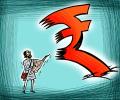
The rupee slipped by 4 paise to close at 77.59 (provisional) against the US dollar on Tuesday, weighed down by a negative trend in domestic equities and unabated foreign fund outflows. At the interbank foreign exchange market, the rupee opened lower at 77.56 against the greenback, and finally settled at 77.59, down 4 paise over its previous close. During the trading session, the rupee touched an intra-day low of 77.67 and a high of 77.51.

'An eerie similarity with 2019 inflation trajectory could now mean that the RBI and market inflation estimates could go awry.'
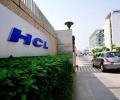
Shares of HCL Tech hit a fresh record high of Rs 1,118.55 on Friday, up 2 per cent on the BSE in intra-day trade, surpassing its previous high of Rs 1,101 touched on Thursday in intra-day deals.

Sliding for the fifth straight session, the rupee fell 3 paise to close at a fresh lifetime low of 79.06 against the US dollar on Thursday amid a strong greenback overseas and unrelenting foreign fund outflows. At the interbank forex market, the local unit opened at 78.92 against the greenback and witnessed an intra-day high of 78.90 and a low of 79.07. It finally settled at 79.06, down 3 paise over its previous close of 79.03.

The rupee on Friday rebounded from the near-80 levels to close higher by 17 paise at 79.82 against the US currency following a recovery in the domestic stocks and weakness in the greenback in overseas markets. The US dollar retreated from the two-decade high levels against a basket of six currencies which supported the rupee sentiment. At the interbank foreign exchange market, the local currency opened at 79.95 and witnessed an intra-day high of 79.82 and a low of 79.96 against the US dollar in the day trade. ,
The rupee plunged 90 paise to close at an all-time low of 80.86 (provisional) against the US dollar on Thursday after the US Federal Reserve's interest rate hike and its hawkish stance weighed on investor sentiments. Forex traders said the US Fed's rate hike and escalation of geopolitical risk in Ukraine sapped risk appetite. Moreover, the strength of the American currency in the overseas market, a muted trend in domestic equities, risk-off mood and firm crude oil prices weighed on the rupee.
Equity indices frittered away a good start to close with modest losses on Monday, pressured by heavy selling in metal stocks after the government imposed export duties on steel-making raw materials to curb soaring prices. The 30-share BSE Sensex opened strong and gained momentum as the session progressed, but came under severe selling pressure in afternoon trade to close 37.78 points or 0.07 per cent lower at 54,288.61. On similar lines, the broader NSE Nifty slipped 51.45 points or 0.32 per cent to end at 16,214.70.

It has been a slow 2022 thus far for the primary markets. In the last 8 months, only 16 companies have raised Rs 40,311 crore via the initial public offer (IPO) route, data from PRIME Database suggests. In comparison, 63 companies had raised a cumulative Rs 1.18 trillion via the IPO route in 2021. A large part of the funds raised in 2022 were on account of the two IPOs - Life Insurance Corporation of India (LIC) and logistics firm Delhivery - that raised a total of over Rs 26,000 crore between themselves.

Riding on an improved show across parameters, TVS Motor (TVS) outperformed larger two-wheeler peers Hero MotoCorp (Hero) and Bajaj Auto (Bajaj) during the September (Q2 of FY23) quarter. The Chennai-based firm, which has the most-diversified portfolio among two-wheeler majors, posted a 28 per cent jump in revenues. This compares to 18 per cent growth for Bajaj Auto and single-digit uptick for Hero MotoCorp.

Small stocks of Dalal Street grappled with turbulent times in 2022 as high volatility and higher interest rate regime sapped investors' appetite for these scrips but the horizon ahead seems less cloudy for the New Year. While the 30-share Sensex scaled multiple record peaks with bluechips glittering, small stocks underperformed and the BSE smallcap index declined more than 3 per cent this year. In comparison, the BSE Sensex climbed 2,673.61 points or 4.58 per cent till December 27.

The rupee tumbled 19 paise to close at a fresh lifetime low of 77.93 against the US dollar on Friday as rising crude oil prices and unabated foreign capital outflows soured sentiment. A sell-off in equity markets and stronger greenback overseas also weighed on the domestic unit, forex traders said. At the interbank foreign exchange market, the local currency opened at 77.81 and witnessed an intra-day high of 77.79 and a low of 77.93 against the US dollar.

Equity indices failed to hold on to their gains in see-saw trade on Tuesday, ending in the red for the third straight session despite a tentative recovery in global equities. The rupee too bounced back from historic lows, but the overall sentiment remained risk-averse amid concerns over economic recovery in a high interest rate scenario. The 30-share BSE Sensex had a choppy start but gained momentum in mid-session trade. However, it succumbed to selling pressure towards the fag end to close 105.82 points or 0.19 per cent lower at 54,364.85. On similar lines, the broader NSE Nifty declined 61.80 points or 0.38 per cent to finish at 16,240.05.

The Russia-Ukraine conflict, which has spooked financial markets globally, will set the tone for Dalal Street this week amid concerns over energy prices and foreign fund outflows, analysts said. Participants will also track key macroeconomic signals like GDP estimates and PMI data for manufacturing and services sectors to be announced this week, they added. "With earnings season behind us and given the overall sentiments, markets are expected to move in sync with global peers in the coming week. "A close eye will be kept on the developments concerning the Russia - Ukraine crisis and considering the inflation overhang, market participants will also observe movements in energy prices," said Shrikant Chouhan, Head of Equity Research (Retail), Kotak Securities Ltd.

While discount brokers have managed to grow at a rapid pace, they have not been successful in capturing substantial market share in the above-40 age category.

Tata Steel was the top gainer in the Sensex pack, zooming 7.57 per cent, followed by Sun Pharma, IndusInd Bank, L&T, ITC and HCL Tech.
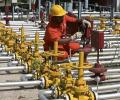
India's natural gas production is projected to jump by 52 per cent to 122 million standard cubic metres per day by 2024 as state-owned Oil and Natural Gas Corporation (ONGC) and Reliance Industries Ltd-BP combine raise output from the KG basin fields. Natural gas production in 2019-20 was 85 mmscmd, which is estimated to have fallen to 80 mmscmd in the following year, HDFC Securities said in a report. The output is projected to rise in the current fiscal that started on April 1 to 93 mmscmd, 107 mmscmd in the following year and 122 mmscmd in 2023-24, the brokerage estimated.

Titan was the top gainer in the Sensex pack, rising 3.5 per cent, followed by Kotak Bank, SBI, Maruti Suzuki, Bajaj Finance, HUL, Axis Bank and Sun Pharma. On the other hand, NTPC, Tech Mahindra, PowerGrid and Infosys were the laggards.

A strong performance by sectors including banking raised the profits of Indian companies by 28 per cent in the three months ended March 2022. The rate of growth is, however, lower than the 30 per cent seen in December. Growth in net sales was also lower than what was seen in the December quarter for the sample under consideration.

Lawyers say compensation may be an uphill task for investors because of a lack of judicial precedent and broader institutional difficulties.
The rupee appreciated 7 paise to 79.74 against the US dollar in early trade on Thursday as a positive trend in domestic equities supported the local unit. However, a strong American currency overseas and forex outflows restricted the rupee's gain, dealers said. At the interbank foreign exchange, the rupee opened at 79.72 against the American dollar, then went lower to trade at 79.74 against the greenback in early deals, registering a gain of 7 paise over the last close.

The electric scooter juggernaut which has been picking up momentum with heady growth month-on-month is now slowing down. The combined number of registrations in April of eight electric two wheeler companies has seen a dip of over 1 per cent to 43,061 vehicles, according to data from the Ministry of Road Transport & Highways' site VAHAN. The reasons are the continuing shortage of chips, especially after the Ukraine-Russia war, and the spate of fires which have led to scooters being recalled by manufacturers.

'Favourable product mix, sales recovery, and cost saving initiatives are expected to support margins going ahead while focus on debt reduction (target of debt free by FY24) will aid balance sheet strength'

India's rupee is likely to remain under pressure due to high prices of crude oil and other commodities, and may stabilise at around 79-80 against the US dollar in the near term, say experts amid limited headroom available with the Reserve Bank to check the weakening of the domestic currency. The currency has slumped over 5 per cent this year after Russia's invasion of Ukraine sent international crude oil prices soaring to a decade high. On Monday, rupee ended at a fresh all-time low of 78.34 (provisional) against the US dollar.

The economy segment of India's car market is unlikely to revive soon term as inflation and prices prompt buyers to defer purchases. The share of entry-level cars in the passenger vehicle market dropped to the lowest in seven years at the end of the Financial Year 2021-22 (FY22). A recovery in the segment will be largely driven by the overall economic growth, improvement in income levels, and easing of semiconductor shortage, say carmakers and analysts.
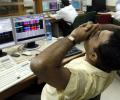
'The correction could take two to three months and traders need to be careful.' 'For investors, this could be a good time to nibble in.'

Premier bourse BSE has added 1 crore registered investor accounts to its platform between June 6 and September 21, taking the total to over 8 crore in a span of just 107 days. On June 6 this year, the exchange had said its registered user base has crossed the 7 crore (70 million) mark, which was an addition of 2 crore registered investor accounts in a little over 12 months (from May 23, 2020). Commenting on the achievement of crossing the 8 crore registered investor accounts on Tuesday, BSE MD and CEO Ashishkumar Chauhan said equity investments, whether directly or through mutual funds, are gaining ground over last one-and-a-half years due to variety of reasons globally, and the domestic market is also following this world trend.
 © 2026 Rediff.com - Advertise with us - Disclaimer - Privacy Policy - Sitemap - Feedback - About us - Terms of use - Grievances