
Japan is expected to increase its investment target in India from the earlier 5 trillion yen ($34 billion) to almost 10 trillion yen.

Japanese automaker Suzuki Motor Corporation will invest Rs 70,000 crore in the next five to six years in India to strengthen its operations in the country, its representative director and president Toshihiro Suzuki said on Tuesday. Prime Minister Narendra Modi on Tuesday kicked off exports of Maruti Suzuki India's first electric vehicle e VITARA to 100 countries and also inaugurated the production of lithium-ion battery cells for strong hybrid electric vehicles at its facility in Gujarat.
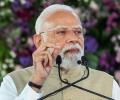
A day before US President Donald Trump's additional 25 per cent tariff kicks in, Prime Minister Narendra Modi on Tuesday made a vehement pitch for swadeshi and Make in India that should help create jobs in the country.

As expected, land prices in the region have shot through the roof in the last three to four months, rising about 12 times compared to prices a couple of years earlier.
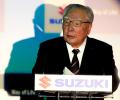
'Without his vision and foresight, his willingness to take a risk that no one else was willing to take, his deep and abiding love for India, the Indian automobile industry could not have become the powerhouse that it has become.'

After a successful tie up in traditional ICE and strong hybrid models, Suzuki and Toyota are now set to take their partnership to the next level: the electric vehicle segment. Both the Japanese auto giants recently announced a plan to produce Suzuki eVX-based SUV which will be sold under Toyota brand across the globe. This electric SUV, bearing Toyota's logo, will go for production at Suzuki Motor Group (SMG) facility in Hansalpur, Gujarat beginning the spring of 2025, marking the first EV launch for both companies in India.

Maruti Suzuki, Tata Motors, Mahindra & Mahindra, Hyundai and MG Motors are gearing up to introduce EVs in India.

Maruti Suzuki is keen that the Gujrat government revises payment condition in the agreement it signed with the former for setting up a plant in Hansalpur.

Maruti Suzuki India (MSIL) has ambitious plans to increase capacity. It is also seeking shareholders' approval for a complex swap transaction, which would acquire Suzuki Motor Gujarat (SMG), a subsidiary of Suzuki Motor Corporation (SMC) through a preferential offer. SMC already holds 56.37 per cent of MSIL's equity.

The company had set an annual production target of 250,000 for its Hansalpur plant in Gujarat.

A draft notice has been prepared and villagers are deliberating on the issue and taking legal counsel.
Maruti was allotted around 640 acres of land at Hansalpur which lies nestled between Mehsana district and the Sanand-Viramgam area.

According to villagers in the region, builders have been doing the rounds of the area, trying to spot suitable locations for residential projects.

Suzuki Motors' Gujarat plant will be ready by 2017.

For a contiguous plot, the company may need to pay almost three times more for 40 acres at Hansalpur.
The auto major likely to start work for phase one of its Gujarat project within next three months.

Hemant Shivsaran lists the number of projects the Modi government has announced since August to woo Gujarat voters.

The 125-km stretch covering Sanand, Hansalpur and Vithalapur, with connected nodes at Kadi and Halol, is set to emerge as the next major automobile hub in India.

Sanand has catapulted into the big league of automobile industry hubs.

Honda has invested Rs 3,526 crore in its Rajasthan unit.

Maruti Suzuki signed a State Support Agreement with the Gujarat government in June 2012 for buying land and setting up a factory

It expects the Indian market to grow to 10 million units annually by 2030 and it intends to control half the market then, like it does now.

Companies are drawn to the parks by the infrastructure and ready-to-occupy land.

Apart from around 40 Japanese companies and five global vendors of MG Motor India, many other biggies are eyeing Gujarat for either greenfield opportunities or brownfield expansion.

Domestic and foreign companies pour in a slew of investments in Gujarat.
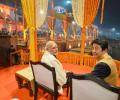
'Modi and Abe are working seriously for India-Japan bonhomie to grow stronger.' 'It is a win-win situation for both countries and the future look promising,' says Rajaram Panda, the Indian Council for Cultural Relations India Chair Visiting Professor at Reitaku University, Japan.
 © 2026 Rediff.com - Advertise with us - Disclaimer - Privacy Policy - Sitemap - Feedback - About us - Terms of use - Grievances