
'I want to show bearded men actually caring and loving for their sons or a woman from Pakistan in a position of power. How radical is that?'
'The United States loves working with dictators' 'Because then you don't have to worry about public opinion and you don't have to worry about the media anymore'
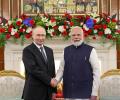
Luckily for us, a Russia that is desperate to stay relevant in an emerging multipolar world finds in India a reliable geostrategic partner. The Russian proximity to India also keeps China from exploiting its economic dominance vis a vis Russia, points out Colonel Anil A Athale (retd).

In a key revelation, former Central Intelligence Agency (CIA) officer John Kiriakou has said that Al Qaeda founder Osama bin Laden, who was the most wanted terrorist for the United States after the terrorist attacks of September 11, 2001, had escaped from the Tora Bora hills in Afghanistan in the guise of a woman.

In his address, Sharif praised US President Donald Trump, saying his "efforts for peace helped avert a ... war in South Asia".
According to Mr Babar, within four days of this interview the Mumbai terror attack was underway, bringing the two countries closest to war in years -- 'The warmongers shattered Zardari's dream of peace with India'.
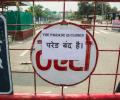
Pakistan's Foreign Minister Ishaq Dar has called for a 'composite dialogue' with India to address the contentious issues between the two sides.

'We are too important to want to be paired with Pakistan but too intensely connected to it to successfully detach ourselves,' asserts Aakar Patel.
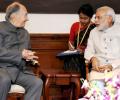
Prince Karim Al-Hussaini, Aga Khan IV, the 49th hereditary Imam of the Shia Ismaili Muslims, passed away in Lisbon at the age of 88 on Tuesday, February 4, 2025.
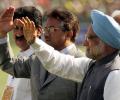
Jammu and Kashmir Chief Minister Omar Abdullah has said that India and Pakistan came closer to resolving the Kashmir issue during the Manmohan Singh-led UPA government. He added that he does not expect a return to that situation in his lifetime. Abdullah lauded Singh's efforts on Kashmir, including the setting up of working groups on the issue, and said he practically initiated measures for the return of displaced Kashmiri Pandits. The chief minister also praised Singh's contribution to India's economic development.
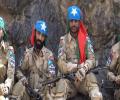
The Balochistan Liberation Army (BLA) has undergone a significant transformation, evolving from hit-and-run attacks to carrying out sophisticated operations with tactical precision. The group's tactics and targets have become increasingly audacious, targeting security forces, Chinese nationals, and innocent civilians. Experts attribute the BLA's evolution to various factors, including the leadership of Bashir Zeb, the group's growing intelligence network, and its exploitation of the grievances of the Baloch people. The BLA's actions are a cause for concern, as the group's sophisticated attacks pose a major challenge to security forces.
Baraut's sub-divisional magistrate Amar Verma confirmed Musharraf's grandfather lived in Kotana.

India's tactical and operational response demonstrated its ability to prosecute tri-service operations, even without a formal tri-service doctrine or the higher command structure needed to coordinate it, points out Ajai Shukla.

Had it not been for Pankaj Tripathi, who must have worked hard to get those Vajpayee intonations and mannerisms so perfectly well, Ravi Jadhav's flattering portrait of Vajpayee would have been more vacuous than what we get to see, observes Prasanna Zore.

Pakistan's former military dictator General Pervez Musharraf is hospitalised in the United Arab Emirates after his health deteriorated and is going through a 'difficult stage where recovery is not possible', his family said on Friday amidst speculation about his condition.
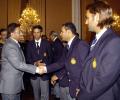
Lakshmipathy Balaji turned out to be the cynosure of all eyes during the Indian cricket team's tour of Pakistan in 2004.

Clearly, her father hopes that a successful tenure in Lahore will give Maryam the ballast to be prime minister after the next general election.

Chastened by the Kargil conflict, Pervez Musharraf will be remembered for gradually lowering the profile of terrorism and seeking a realistically negotiated settlement to the issue of Jammu and Kashmir, notes Ambassador G Parthasarathy, who served as India's high commissioner to Pakistan when Musharraf seized power in a coup in October 1999.

After his failed misadventure in Kargil, Musharraf deposed the then Prime Minister Sharif in a bloodless coup in 1999 and ruled Pakistan from 1999 to 2008 in various positions.

In the book, Anger Management: The Troubled Diplomatic Relationship Between India and Pakistan, Bisaria says this public telecast sounded to observers like a mid-summit report on the talks, where Pakistan's hard views were being inflicted on India, while New Delhi's positions were unclear.
To consider Pervez Musharraf a real force for peace is an absurdity, declares Ambassador T P Sreenivasan.

The first on the list is Hussain Shaheed Suhrawardy, a Bengali politician from then East Pakistan who served as the fifth prime minister. He was arrested in January 1962 and put in jail on bogus charges of "anti-state activities". His actual crime was his refusal to support military ruler General Ayub Khan.
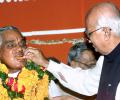
Chef par excellence Satish Arora recalls his days working as a chef to prime ministers to Chandrima Pal.

After news about the demise of Pakistan's former president General Pervez Musharraf was confirmed, the country's Foreign Minister Bilawal Bhutto Zardari on Sunday changed his Twitter profile picture to a photograph of his mother Benazir Bhutto and the late Nawab Akbar Bugti, in whose murder the former military ruler was named.

Pakistan Chief Justice Iftikhar Muhammad Chaudhry is fighting for the supremacy of law, and that is why a judge has become a hero of the masses for the first time

Several retired and serving military officers attend Pervez Musharraf's funeral prayers.

Tharoor's social media post condoling Musharraf's demise evoked a sharp response from the Bharatiya Janata Party which accused the Congress of "Pakistan parasti (worshipping)".
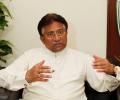
Learning perhaps from the Kargil debacle, Musharraf tried hard to evolve as a statesman in his dealings with India, recalls Rana Banerji, who headed the Pakistan desk at RA&W.
'He told senior journalists a few days after the Babri Masjid demolition, 'Jo hua theek hua. Maine isliye hone diya ki BJP ki rajniti hamesha ke liye khatam ho jaye.'
Rajiv Dogra, former ambassador and India's last Consul General to Karachi, talks to Avantika Bhuyan about the reigning mood in Pakistan and people's perception of Pervez Musharraf.
Under Pervez Musharraf, the Pakistan army not only suffered a humiliating military defeat in Kargil, but also sunk to an abysmal depth in the eyes of military professionals all over the world, says Gurmeet Kanwal.
Debunking Pakistan's claims about the Kargil conflict, Lieutenant General (Retired) Shahid Aziz, then head of the Inter Services Intelligence's Analysis Wing, has said regular soldiers, not rebels fighting for Kashmir's independence, took part in the "meaningless" 1999 war. The former officer also accused the then Pakistan Army chief General Pervez Musharraf of a "cover-up".
Former BJP president makes the claim at function to release Marathi translation of MJ Akbar's book
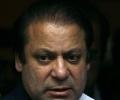
Behind Nawaz Sharif's 'peace with India' stance remain unanswered questions about his role in the Kargil conflict and his family's links with the Jamaat-ud-Dawa and Jaish-e-Muhammad, says Ajai Shukla

The Musharraf episode in the recent history of the subcontinent has convinced many realists in India that the hope of establishing peace with Pakistan is like accepting a dinner invitation from cannibals and expecting to live to tell the tale, points out Colonel Anil A Athale (retd).
Former Pakistan military ruler General Pervez Musharraf on Friday received praise from former Indian Army chief General V K Singh, who said the incident exhibited the "courage" of the military commander. Singh, who headed the Indian Army between 2010 and 2012, said there were mistakes on the Indian side that allowed Pakistani troops to cross over into Indian territory.
Aziz Haniffa finds out why few people are upset about the Pakistani ambassador's ouster and what the outlook on his successor is.
What Musharraf doesn't understand is that deposed dictators are like used toiler paper: No one has any use for them and hence, they are best discarded, says Sushant Sareen.
Taliban militants on Sunday attacked the Central Jail in Bannu and freed several of their comrades, including Adnan Rashid, a convict on death row who had plotted to kill General Pervez Musharraf. Tahir Ali reports
Pakistan Army chief General Ashfaq Parvez Kayani has "learned the lesson" of his predecessor General Pervez Musharraf and prefers staying behind the scene while manipulating the government's decision-making on key issues, according to secret American documents released by WikiLeaks.
 © 2026 Rediff.com - Investor Information - Advertise with us - Disclaimer - Privacy Policy - Sitemap - Feedback - About us - Terms of use - Grievances