
The government has decided to set up a joint venture company with industry body Ficci for encouraging investment in the country."The Invest India company, a joint venture between the department of industrial policy and promotion and Ficci, would be funded by the government and managed by the chamber," commerce and industry Minister Kamal Nath said
The Commerce Ministry is set to unveil the annual review of the Foreign Trade Policy on April 11. It would not be exports alone which would be the focus, but steps to ease imports are also likely to give a boost to supply of essential commodities.The government is facing political pressure from many quarters, including the Left parties, to check the rising prices within a couple of weeks.
At present, India's share in the global trade is about one per cent. Majority of the respondents said the FTP review is growth-oriented and would help in sustaining the 8.5 per cent growth rate of the country, besides, giving the much-needed boost to the rupee-hit exports. Over 73 per cent of the respondents said the target of India achieving 5 per cent share in world trade by 2020 is ambitious but achievable. Government has set an export target of $ 200 bn for the 2008-09.
There is no reason to worry. We have exceeded our expectations. When we announced the FTP in 2004, our exports were at $63 billion. Today (in 2007-08), they have crossed $155 billion.

The comprehensive foreign trade policy provides for setting up free trade warehousing zones and gives major thrust to service exports.

The country's exports are expected to contract by 5.8 per cent and imports by 11.3 per cent during the second half of the current financial year, though implementation of several measures by the government would help support exports going forward, according to the Economic Survey 2021. With gradual recovery of economic activities, the survey said that imports and exports have picked up. During the first half of 2020-21 (April-September), exports dipped by 21.31 per cent to $125.25 billion while imports declined by 40 per cent to $148.69 billion.
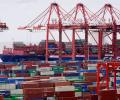
After staging a strong recovery from COVID-induced slowdown in 2021, India's exports are likely to extend the growth story to the New Year also on increased demand in the global markets, boost in domestic manufacturing due to production-linked incentive schemes and implementation of some interim trade pacts. Expectations of positive growth in the country's exports are also backed up by the outlook of the World Trade Organisation (WTO) which predicts a 4.7 per cent expansion in the global merchandise trade volume in 2022. Exporters believe that the outbound shipments would cross $400 billion mark in this fiscal going by the current momentum and may reach $475 billion in 2022-23.

References to the repealed laws for service tax, purchase tax, etc, continue in the SEZ laws.
India's exports need free trade and reform. The government, however, is extending failed schemes.

The meeting, which would have representation from the ministries of finance, external affairs and micro and small and medium enterprises, would suggest steps to prepare the way for the annual supplement to the Foreign Trade Policy (2009-2014), expected to be unveiled in April.

The new foreign trade policy is considered to be less effective.
Worried over continuous decline in exports, the Commerce Ministry has stepped up its pressure on Finance Ministry to expeditiously notify a scheme which was announced in June to boost the overseas shipments.

The initiatives announced by Commerce and Industry Minister Anand Sharma as part of the annual supplement to the Foreign Trade Policy are aimed at pushing exports which declined by 1.76 per cent to $300.6 billion during 2012-13 and pushed up the trade deficit to $190.91 billion.
India's exports during 2012-13 declined 1.76 per cent to $300.6 billion mainly on account of slowdown in the global economy, Commerce and Industry Minister Anand Sharma said.

Exporters, who were banking on the foreign trade policy (FTP) announced this year, have started becoming jittery as merchandise goods' exports have fallen around 15 per cent in July.

'Mere fundamentals will not do the trick,' cautions former commerce secretary Rahul Khullar.

The government has announced several incentives for exporters to explore new destinations under focus market and focus product scheme.

This decision is based on the precedent in the case of Iran where DGFT last week allowed export proceeds realised even in Indian rupees to be made eligible for export benefits and incentives under India's foreign trade policy.

The government might announce, yet another set of incentives for some export sectors in January even as it has completed a sector-wise review after the announcement of some measures under the Foreign Trade Policy (FTP) 2009-2014.

The Central Board of Excise and Customs has put in place a comprehensive mechanism for verification and monitoring of exports made under various duty exemption or reward schemes.

India is negotiating for a comprehensive economic partnership agreement with Malaysia and Japan and a broad based trade and investment agreement with the EU.

Commerce and Industry Minister Anand Sharma had earlier said the government would not hesitate in assisting sectors that employed huge amount of people if they failed to achieve growth. Some of those sectors were handicrafts, textiles, leather, engineering goods, rice and carpets.

While the tax-to-GDP ratio of 9.88 per cent has been assumed for FY21, the same as last year, when it touched a decadal low, for FY22 a ratio of 10.7 per cent has been assumed, an average of the last five years.

Ahead of unveiling the Foreign Trade Policy, Commerce Minister Anand Sharma on Wednesday said the government was looking at cooperating with states to bring down transaction costs to make exports more competitive. India's exports have been on a downslide since October 2008.

One of the most favoured duty reimbursement schemes among exporters - the Duty Entitlement Passbook (DEPB) scheme - is likely to be scrapped, as the government gears up to introduce the Goods and Services Tax (GST) from April 1.

E-commerce firms and sellers including Amazon and eBay have made recommendations to the government for a differentiated policy framework for e-commerce in the revised Foreign Trade Policy (FTP) which is expected to come into effect from April 1, 2021. This is because the existing policies on exports have catered largely to traditional, offline and business-to-business exports. Suggestions have been made to the government that through the FTP, it is important to create a conducive policy framework for e-commerce exports that lowers the entry barrier for small businesses to start exporting, according to the industry sources.
While the directorate general of foreign trade has completed consultations with the industry and exporters, it will start interacting with the different ministries like agriculture, finance, micro, small and medium Enterprises, steel and environment. Revenue department in the finance ministry holds the key for extending benefits to exporters who are facing the brunt of recession in several major economies.

The zero-duty EPCG scheme is in addition to the 3 per cent EPCG scheme that was introduced last year.

Exporters, facing slump in demand in the major markets of the US and EU, are expecting incentives in the foreign trade policy, to be unveiled in the second half of the month. The FTP broadly spells out the segments of priority in external trade and also gives incentives and disincentives, depending on the country's needs.
The government on Tuesday indicated that forthcoming Foreign Trade Policy may grant some sops for the ailing textile sector especially exporters, who were disappointed over the Budget proposals.
Commerce and Industry Minister Anand Sharma said he expected exports to reach $200 billion in the financial year ending March 2011.

India is the world's largest diamond cutting centre.

India on Thursday extended tax holiday and duty refund for exporters, while allowing duty free capital goods import under its Foreign Trade Policy to insulate them from protectionism induced by recession abroad. Unveiling the five-year policy, Commerce Minister Anand Sharma set a target of $200 billion worth exports for next fiscal, a feat that India failed to achieve in 2008-09 due to a slump in global demand in the face of financial crisis.

The government announced several incentives in the five-year Foreign Trade Policy.

It appears that the focus of commerce minister Anand Sharma, when he unveils the new foreign trade policy, will be to eliminate unnecessary paperwork and thereby help reduce transaction costs for exporters, while retaining the basic framework of the present FTP.
The exporters need to be told sometime or the other that the playing field can never be the same for all countries. Every country has its own advantages and disadvantages in terms of its natural endowments, capabilities of its manpower, stage of development, levels of technology absorption and so on. Each country has to make the best of what it has and carry on, says T N C Rajagopalan.
India on Friday said it would lay down clear guidelines on imports of genetically modified crop varieties, Commerce Minister Kamal Nath said.

The Customs clearance required for moving equipment like laptops, desktops, etc out of SEZ units was delaying things as the clearance had to be taken in person after a first level of approval online.
The boom in world trade has ensured that export has grown by over 20 per cent. Has the FTP contributed to the stellar growth in exports? T N Rajagopalan thinks it did.
"Exports of $150 billion are certain this year. If there is a surge, they could even go up to $155 billion," Commerce Secretary GK Pillai told reporters on the sidelines of a CII meeting on Foreign Trade Policy.
 © 2026 Rediff.com - Investor Information - Advertise with us - Disclaimer - Privacy Policy - Sitemap - Feedback - About us - Terms of use - Grievances