
Food inflation rose to 17.47 per cent in the third week of November against 15.58 per cent in the previous week.

Syed Firdaus Ashraf lists 10 ways in his life has improved under the first Modi Sarkar.

Inflation is gnawing at the nation's entrails and people's appeals to the government have had no impact whatsoever.

The Nifty, after dropping below the 6K mark on Tuesday, once again gained strength. The index, after flip-flopping between the zones ended finally at 5,999 - up 10 points. BSE market breadth was weak. Out of 3,085 stocks traded, 1,872 declined while 1,065 advanced.

According to Fitch rupee is expected to weaken to 72 to a dollar by the end of December 2019, and further to 73 by December 2020, from 69.82 to a dollar in end December 2018.

Food inflation is hovering near 20 per cent. Everyone is facing the brunt of rising prices. Food prices are soaring. . . all essential items like vegetables, oil, milk, sugar are getting costlier. Rentals and real estate rates have almost doubled in just a few months in most cities. The real estate prices are at record highs making life miserable, especially for people who have migrated to cities for jobs.

The central bank might raise repo and reverse repo rates by 25 basis points each, they said. Still, RBI action would be conditional on its ensuring sufficient liquidity in the banking system.

The global financial crisis has hit the realisation of Millennium Development Goals hard with loss of employment and food inflation slowing down the progress and an additional 64 million people expected to be thrown into extreme poverty by 2010-end relative to a no-crisis scenario.
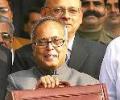
Even as India's annual inflation rate touched 10.16 per cent in May, Finance Minister Pranab Mukherjee on Monday ruled out the possibility of interest rates rising in the short term. He said he expected inflation to be on the higher side till the middle of July.

The Trinamool Congress and the Communist Party of India (M) on Thursday opposed the proposed increase in the prices of LPG and other petroleum products recommended by an expert panel headed by former Planning Commission member Kirti Parikh, saying a new burden of raised prices would hit the common people hard.

The meeting will be chaired by Prime Minister Manmohan Singh, official sources said in New Delhi.

Ahead of the third quarter monetary policy review by the Reserve Bank later this month, Commerce and Industry Minister Anand Sharma has opposed monetary tightening, saying fund flows to the industry have not caused food inflation.

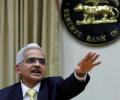
Chances of a rate cut in April improve if core inflation continues to ease, growth falling below the projected 7.2% for FY19 and if the global trade slowdown exacerbates.

The RBI governor, D Subbarao had met finance minister Pranab Mukherjee on December 18, fuelling speculation that the monetary policy would be tightened.

The NSE Nifty shut shop at 5,304, down 70 points.
With inflation at peak levels, a further rise in petrol prices would again lead to higher prices.

Annual food inflation fell marginally to 9.53 per cent for the week ended July 24 as prices of vegetables, especially potatoes and onions, declined.

The prices of oilseed, coarse cereals & vegetables could also be affected.

The Nifty ended comfortably above the crucial 5500 mark at 5546, up 64 points.

Reserve Bank of India on Friday raised short-term lending and borrowing rates.

Enthused by reforms and the strong fundamentals, the Economic Survey on Thursday predicted that India would bounce back to a high nine per cent growth in 2011-12 on the way to becoming world's fastest growing economy in four years.

Finance Minister Pranab Mukherjee on Thursday tabled the Economic Survey for 2009-10 that says that economic recovery is weak and the high double-digit food inflation in 2009-10 is a matter of great concern.

Food inflation, at almost 17 per cent, along with the rise in fuel prices will be a bitter pill for consumers.

A committee has been formed and the price situation was being reviewed, the finance minister added.

RBI's likely focus will shift back towards the resolution of non-performing loans in the banking system for reviving credit demand

The meeting assumes importance as prices of essential commodities continued to surge though the rate of price rise has come down in the recent weeks.

The rain gods, it appears, will play a role in the decision of fast moving consumer goods companies to either raise or maintain prices of their products in the second quarter of the financial year.
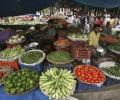
Inflation in fruits was 8.93 per cent.

Monsoon rains are vital for 55 per cent of the country's farmlands that lack irrigation facilities.

The minutes of the December MPC meet reveal members felt the current spike in the headline inflation rate was due to a temporary supply shock on the food front, expected to moderate by the second quarter of 2020-21.

The growth outlook is higher than the Reserve Bank's projection of 8 per cent but at the lower end of the finance ministry's forecast of 8.25-8.75 per cent.

The Central bank primarily factors Consumer Price Index while deciding on policy rate.

While moong and pork became dearer by 5 per cent each, urad price shot up by 4 per cent, vegetables by 2.63 per cent and coffee by 2 per cent during the week.
High domestic food prices are still a cause for concern despite India hugely benefiting from a slump in global oil and commodity prices that pushed inflation into negative zone, the Economic Survey said.

The Nifty closed at 5245, up 14 points. The market breadth was negative, with 1252 advancing stocks as against 1568 declines.
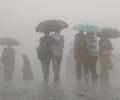
A number of significant linkages between rainfall and economic outcomes have policy implications.

However, the finance minister did not oblige members in the Rajya Sabha with clarifications on his intervention in the debate on the issue of price rise, even when Communist Party of India-Marxist member Sitaram Yechury sought some more information.

The rail ministry's proposal to reduce transportation tariff for foodgrain by Rs 100 per wagon would not have any cooling effect on food inflation, which was close to 18 per cent for the week ended February 6.
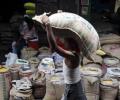
WPI inflation, which was in the negative zone from November 2014 to March 2016, has been on an upward trend for the seventh straight month
 © 2026 Rediff.com - Investor Information - Advertise with us - Disclaimer - Privacy Policy - Sitemap - Feedback - About us - Terms of use - Grievances