
There is no doubt that economic growth has picked up. It's also true that inflation has edged up. We had said at the beginning that sometime in the course of the year we would begin to slowly wind it down and what has happened is on course for that decision but exactly what, it's too early to say, says Montek Singh Ahluwalia.

This would indicate the beginning of a slowdown after five quarters of robust top line and bottom line growth, say the analysts. They blame rising food inflation as the key reason for the lower consumer offtake.

A likely easing in inflationary pressures in the forthcoming months will reopen the window for the RBI to once again prioritise growth and ease its interest rates.

Under the new Monetary Policy Framework, the central bank aims to contain inflation at 4 per cent with a band of (+/-) 2 per cent.

It could add to pressure on inflation, especially food inflation, which was already high, it said.

Food inflation is high. But it is possible to beat it by being a smart food shopper. Here are the tips that can help...

The union government may reduce the price of wheat and rice it plans to sell in the open market to check food inflation, after an earlier sale received poor response possibly due to high rates quoted by it.
The NSE Nifty ended at 5,132, up eight points. The market breadth was positive. Out of 2,840 stocks traded 1,653 advanced while 1,114 declined.

The inflation in vegetables remained stubborn, which jumped 16.91 per cent

Nifty settled at 5,005, down 102 points. Out of 2,814 shares traded on the BSE, 1,879 declined and 858 advanced.

Nifty ended at 5,378 -- down seven points. BSE market breadth was negative. Out of 3,020 stocks traded, 1,540 declined while 1,360 advanced.

The Reserve Bank may raise key policy rates by up to 50 basis points in its July 27 monetary policy review to check double-digit inflation, said a member of the Prime Minister's Economic Advisory Council.

Experts pointed out that the government's poor planning and lack of investment in farm infrastructure have led to food shortage in the country, which is been capitalised by traders.

The poll of over 30 economists, taken in the past week, showed Asia's third largest economy will expand 7.8 percent in the fiscal year ending March 2017.

Wholesale price-based inflation remained below the psychological two-digit scores inching up marginally to 9.9 per cent in March from 9.89 per cent in the previous month.
Higher prices of onion and other vegetables and fruits pushed up inflation to 6.46 per cent in September.
The ban on export of wheat and rice may be eased only after the government fulfills the election promise of providing 25 kg of staple food to poor families at Rs 3 a kg, Commerce Secretary Rahul Khullar said.
Dr Singh said that there was a need to re-look at the balance of power in the international financial systems. He said that this has been necessitated by the fact that bulks of the world's savings originate in Asia today and western institutions act only as intermediaries. This is a new power that the countries of Asia have acquired collectively, he said, and need to be given their due. The prime minister said: "The world system is not a morality play; it is a power game."
The most important safety valve as far as food supply is concerned is the short production cycle.
There are chances of taps running dry and prices of fruits and vegetables spiking.
High food prices have driven inflation to new highs, leading the Centre to clamp down on export of farm commodities.
To a specific question on the change in RBI's stance from "neutral" to "accommodative", Das said it means that there will not be any rate hike from here on.
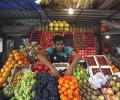
Consumer prices were forecast to have risen 10.00 per cent annually last month, barely changed from the 10.09 per cent clocked in October.

Here are the key decisions announced by the Reserve Bank of India on Thursday.
'Food grain availability for India's poorest is now approaching levels that haven't been seen since the British left. This has everything, sadly, to do with the rapacity of India's elites,' says Raj Patel, author, Stuffed and Starved.

If the PM wishes to be re-elected in 2019, there are a few things he needs to learn from his predecessor

The Reserve Bank of India has kept the key short term lending rate (repo rate) unchanged at 7.25%.
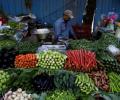
During the month, inflation in vegetables shot up to 35.99 per cent, as against 26.10 per cent in October. Likewise, the prices of cereals and eggs grew at a faster pace of 3.71 per cent.

Despite a slowing economy, the Budget does not envisage any major stimulus through the budgeted fiscal deficit figures, said Goldman Sachs.

Potato, a daily consumable vegetable, witnessed maximum inflationary pressure at 60.58 per cent

ICICI Bank and SBI were among the top Sensex gainers along with FMCG majors ITC and HUL.
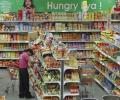
Zero inflation will pave way for rate cuts in the next RBI policy.

It would be beneficial for the economy to hold on to high interest rates till inflation numbers are under control.

Of the seven surveys presented under Modi govt, predictions of three were quite close to the actual GDP growth rate, one saw the base year change in between, but the last three were way off the mark.

Over to the government how they manage the uncertainty of monsoon and revive spending in order to entice RBI for another round of rate cuts

Total fuel subsidies accounted for less than 1 per cent of GDP and under 3 per cent of total government expenditures in FY14.

Economic affairs secretary S C Garg said that all macroeconomic parameters are performing well.

The price of export quality lady's finger, for example, shot up 150 per cent in two weeks to close on Thursday at Rs 40 a kg against Rs 16 a kg on September 16 in the Agricultural Produce Marketing Committee, Vashi, near Mumbai.
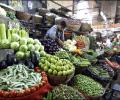
Wholesale fuel prices in May fell 10.51 per cent year-on-year.

In December, the index fell a provisional 0.73 per cent.
 © 2026 Rediff.com - Investor Information - Advertise with us - Disclaimer - Privacy Policy - Sitemap - Feedback - About us - Terms of use - Grievances