
The wholesale price-based inflation rose to an eight-month high of 1.48 per cent in October, as manufactured products turned costlier. The WPI inflation was 1.32 per cent in September and zero per cent in October last year. This is the highest level of wholesale price index-based (WPI) inflation since February when it was 2.26 per cent.
The Consumer Price Index hit the lowest in six months in March at 4.83 per cent.

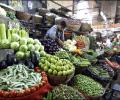
The retail inflation accelerated to a three-month high of 8.59 per cent in April mainly due to increasing prices of vegetables, fruits and milk.

With food inflation easing by over a percentage point during the week ended November 5, Finance Minister Pranab Mukherjee on Thursday said if the trend continues, "some relief" can be expected on the price front.

'Nobody is talking about the inequality that is going to come.'
The minister asked the state governments to assess the problem as action taken after price rise creates panic in the market.

Gujarat Cooperative Milk Marketing Federation (GCMMF), which markets milk and other dairy products under the Amul brand, will hike milk prices by Rs 2 per litre across India from July 1 due to an increase in input costs. The increase of Rs 2 per litre translates into a four per cent hike in MRP (Maximum Retail Price) which is much lower than average food inflation, GCMMF said in a statement on Wednesday. "We have increased Amul milk prices by Rs 2 per litre across all markets.
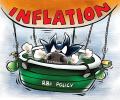
The Consumer Price Index (CPI)-based inflation is now projected to be at 5.3 per cent for 2021-22 with risks evenly balanced. In its August policy, the central bank had estimated inflation to be at 5.7 per cent due to supply side constraints, high crude oil and raw materials cost.
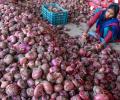
The Reserve Bank of India on Thursday raised its inflation projection to 5.1-4.7 per cent for the second half of the current fiscal on the back of spike in prices of vegetables such as onion and tomatoes.

High food inflation is here to stay as the economy is mismanaged, says Swaminathan.
Food inflation surged to a 10-week high of 14.44 per cent for the week ended December 18 as prices of vegetables, particularly onions, fruits, cereals and protein-based products, continued to escalate.
Given that food inflation remains high, the inflation outlook will be influenced by concerted efforts to break food inflation persistence.

Agriculture Minister Sharad Pawar on Friday said that the decline in prices of most agricultural commodities in coming weeks will bring down the food inflation, which is 12.63 per cent now.

Emerging markets such as India have always run higher inflation rates than developed economies such as the US and countries of Western Europe. But for the first time in the past 30 years, the US reported a higher consumer price inflation (CPI) rate than India in five consecutive months. The US reported a CPI rate of 7.5 per cent in January 2022 against 6.01 per cent in India and analysts expect the trend to continue for at least a few months more

"That 0.2 per cent rise in food inflation is temporary... This (rise in food prices) is not the trend," Pawar said on the sidelines of an Indian Council of Agricultural Research Award ceremony in New Delhi.

RBI governor Das flags growth slowdown, deputy raises alarm on inflation

Warning that the new year will be riskier than the previous two in terms of growth, inflation and the perils of monetary policy normalisation on consumption demand in particular, along with other external risks, a Wall Street brokerage has pencilled in an 8.2 per cent GDP growth next fiscal, with more downside risks to the projection. The biggest risk to the projection is a derailed consumption demand that has been the main growth driver in the past many years, said the Bank of America Securities India house economists who still believe that consumption demand will remain the key driver of growth next fiscal as well.

In its scheme of things, tackling inflation now comes ahead of ensuring growth in the world's sixth largest economy, points out Tamal Bandyopadhyay.

Crisil Research expects retail inflation to rise 60 basis points to 4 per cent this fiscal from 3.4 per cent in 2018-19.

The Index of Industrial Production (IIP) grew by 1.4 per cent in November as most components like manufacturing, electricity, mining, primary goods, and consumer durables witnessed a slowdown, according to data released by the National Statistical Office (NSO) on Wednesday. This is on the base of a decline of 1.7 per cent in November 2020 and before the new Covid variant started impacting economic activity. IIP growth was lower than the 4 per cent expansion recorded in the previous month but was better than a 1.6 per cent contraction seen in November 2020. Separately, rising prices of kitchen staples pushed retail inflation, or rate of price increase, to 5.59 per cent in December 2021, bringing it close to the upper band of Reserve Bank's comfort zone.

Bond yields have risen since the Reserve Bank of India raised interest rates for a second consecutive month on October 29.

We have not suffered such huge price shocks across so many basic commodities, at the same time, in decades. Has the inflationary impact of all this been factored into stock prices as yet, asks Debashis Basu.

A monsoon deficit is likely to affect the agriculture output, which could have an impact on the food inflation

'Our competitiveness with China is very important.' 'If the exchange rate depreciates, it is good for us because it helps in our competitiveness.'

However, so far only 16 states have amended their Acts based on the model provided by the centre.
Finance Minister Pranab Mukherjee on Thursday expressed concern over rising food inflation, saying it is perilously near double digits.

"Food inflation is still negative... There is a declining trend... If this trend continues, then the overall inflation will be manageable, says Mukherjee.

After unseasonal rains, supply disruptions and pandemic-induced woes pushed retail inflation well over the Reserve Bank's comfort zone in 2020, the scenario is likely to stay that way at least in the short term as economic recovery slowly gains foothold. For most part of this year, pricier food items pushed the retail inflation, based on Consumer Price Index (CPI), higher in the range of 6.58-7.61 per cent, except for March when the reading was 5.91 per cent. Experts believe retail inflation is likely to average around 6.3 per cent this fiscal and mostly will remain sticky going forward owing to pick-up in demand across sectors.

The country had imported 5.5 million tonnes of pulses last year.
After years of high food prices, India is now witnessing a deflation, according to the government's food inflation data.
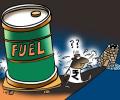
Inflation in food articles, fuel and power contracted in July.
In all, RBI has cut interest rates by 110 bps this year. But this has not yet led to a boost in economic activity. While the growth rate has slowed to a five-year low, consumer confidence is waning and foreign direct investment has plateaued.

His remark came in the backdrop of an Empowered Group of Ministers headed by Finance Minister Pranab Mukherjee postponing a meeting to hike fuel prices indefinitely on Oil Minister Murli Deora's insistence.
Attributing the latest jump in food inflation mainly to rising prices of protein-based items, Finance Minister Pranab Mukherjee on Thursday said the high inflationary regime was not acceptable and efforts would be made to bring it down.

The RBI has set up a panel to review ATM charges, and fees levied by banks.
Mukherjee said the high inflationary pressure, specially in food and some non-food articles, existed in other emerging economies also.
Participating in the resumed discussion on the General Budget in the Rajya Sabha, Communist Party of India-Marxist leader Brinda Karat said the government is linking food inflation to higher purchasing power among the poor resulting from employment programmes like Mahatma Gandhi National Rural Employment Guarantee Scheme.
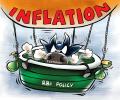
Inflation in food articles basket was 6.99 per cent In May, 2019, down from 7.37 per cent in April. However, onion prices spiked in May with inflation at 15.89 per cent, as against (-) 3.43 per cent in April.

"If this declining trend continues, I do hope it will have a moderating influence on the price front," Mukherjee told reporters in New Delhi.

The broader market breadth ended weak with 1,509 stocks advancing and 1189 shares declining.
 © 2026 Rediff.com - Advertise with us - Disclaimer - Privacy Policy - Sitemap - Feedback - About us - Terms of use - Grievances