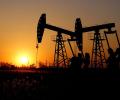
India's crude oil production fell 2.3 per cent in August but natural gas output rose by more than a fifth on the back of output from KG-D6 fields of Reliance-BP, government data released on Wednesday showed. Crude oil production dropped to 2.51 million tonnes in August as output from fields operated by state-owned Oil and Natural Gas Corp (ONGC) dipped. India is 85 per cent dependent on imports to meet its oil needs and the government has been for long looking at ways to raise the domestic output so as to reduce import dependence.

The Brihanmumbai Municipal Corporation said late Thursday that the odour was reported from Powai, Chembur, Mankhurd, Govandi, Chandivali, Andheri and Ghatkopar areas.

The stellar rise in corporate earnings in financial year 2021-22 (FY21) and FY22 did not result in a corresponding boom in capital expenditure (capex), with listed companies' investment in fixed assets rising just 2.3 per cent year-on-year (YoY) in FY22, growing at the slowest pace in the last six years. In comparison, the firms' combined net profit jumped 63.5 per cent YoY in FY22, while net sales increased 31.1 per cent - the fastest pace in over a decade. The 955 non-financial companies in Business Standard's sample reported combined net profit of Rs 7.18 trillion in FY22, compared with Rs 4.39 trillion in FY21 and Rs 2.59 trillion in FY20.

The people will view it from their viewpoint, their immediate interest, historical experiences, their insecurities, he said.
The wholesale price-based inflation in February rose to 13.11 per cent on hardening of prices of crude oil and non-food items, even though food articles softened. After two months of mild easing, WPI inflation accelerated in February and remained in double digits for the 11th consecutive month, beginning April 2021. WPI inflation last month was 12.96 per cent, while in February last year, it was 4.83 per cent. The rise in crude oil and natural gas prices after the Russian invasion of Ukraine, beginning February 24, has put pressure on the wholesale price index, even though food articles saw softening across categories of vegetables to pulses to protein-rich items.

Experts say while the increasing demand for a ban on Chinese goods might make for good optics, the reality is that India is still heavily dependent on that country in a wide range of industries like electronics, mobile devices, auto, pharma, telecom equipment, and fertilisers.

The eight sectors, which also include fertilisers, steel, natural gas, electricity and crude oil, had expanded by 1 per cent in June last year.
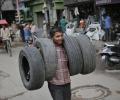
Steel, cement, aluminum, fertilisers, tractors, two-wheelers, beverages and carbonated drinks, tyres and FMCG could see demand back to near normal levels by the third or the fourth quarter of the financial year, or even earlier.

'For the common man, the economic conditions are not going to get better.'

Production of coal, crude oil, natural gas, refinery products, fertiliser, steel, cement and electricity contracted. The record contraction in the growth rate of eight core sectors will affect the Index of Industrial Production.

India and France expressed "serious concern" at the ongoing conflict and humanitarian crisis in Ukraine.

More than half of the total subsidy provisioning, amounting to 54 per cent, is going towards food subsidy, which is estimated at Rs 184,220 crore for 2019-20 - a 7.5 per cent increase over the revised estimates for 2018-19.

Will Empire strike back to prevent a game changing election result, asks T P Sreenivasan.

'What if Kim is alive as the latest reappearance suggests, but unable to rule?' 'Will his sister be installed as the leader to continue with the Kims's hereditary dynasty that began with the present ruler's grandfather?' asks Dr Rajaram Panda.

The battle for the takeover of MCFL has been going on for one year.

India's negotiating posture at the multilateral negotiations should be aligned with a significantly transformed development strategy domestically.' 'The positions the country takes at the negotiations will then carry credibility, says Shyam Saran, former foreign secretary and India's chief negotiator on Climate Change 2007-2010.

Coal, crude oil, natural gas, cement, and electricity recorded a negative growth of 8.6 per cent, 5.4 per cent , 3.9 per cent, 4.9 per cent and 2.9 per cent, respectively, in August.
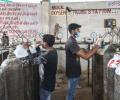
Goyal added the central government did mapping in a meeting with governments of 12 states and union territories most affected by COVID-19 and 6,177 metric tonnes of oxygen will be given to these states.

The government has also given permission to 20 plants to produce the antiviral drug.
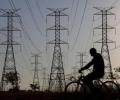
The production of coal, refinery products and electricity grew by 8 per cent, 1.9 per cent and 2.8 per cent, respectively.

According to the commerce and industry ministry data, during April-February 2018-19, the eight sectors recorded a flat growth rate of 4.3 per cent over the same period previous fiscal.

The finance ministry on Friday withdrew expenditure curbs on various departments and ministries imposed in June in the wake of the COVID-19 second wave, reflecting improvement in public finances and the urgency to step up growth.

Coal, natural gas, refinery products and cement grew by 16 per cent, 7 .4 per cent, 2.7 per cent, and 16 .6 per cent in April this year, respectively.

Swiss brokerage Credit Suisse expects the economy to continue to show positive surprises and record up to 9 per cent growth in the next fiscal. For the current financial year too, the brokerage anticipates growth to be higher than the consensus forecast of 8.4-9.5 per cent, and printing in at around 10.5 per cent. As a policy, Credit Suisse does not provide absolute growth numbers in its forecast.

He also said the Centre has not answered the questions raised by him in the Lok Sabha on the issues of farmers and said its reply was a 'joke'.

Natural gas output rose by 6.4 per cent in June.

Dhoni took up organic farming last July during the lockdown and his efforts have borne fruit.

As the economic crisis in Sri Lanka - the world's largest exporter of orthodox tea - continues to rage across the island nation, tea producers in India look to cash in on the opportunity to seize the market. The country's largest tea growing company, McLeod Russel India, expects orders to come in from July. "A huge opportunity is coming up for everyone in India. "McLeod Russel is well placed because we have the capacity for orthodox tea," said Azam Monem, director, McLeod Russel. About 10 per cent of McLeod's production is orthodox tea.

'A fragile Sri Lanka will have a serious impact on the security of India.'
The growth rate of eight infrastructure sectors of coal, crude oil, natural gas, refinery products, fertilisers, steel, cement and electricity was 5.7 per cent in January 2016.

India has a difficult relationship with China but it is 'perfectly capable' of managing it, External Affairs Minister S Jaishankar said on Friday, rejecting the European construct that New Delhi's position on Ukraine could impact global support to it if its problems with Beijing increases.

Making use of the time at hand, he carried out the sanitisation drive with his brother, uncle and a friend to help him out.

If the central banks act harshly now, the markets will crash and then rally. If they are hesitant, the pain will be prolonged, predicts Debashis Basu.

Armed with necessary macro and micro growth drivers, India is on its way to becoming the fastest growing major economy in the world, a finance ministry report said. Rapid vaccination and teeming festivities will push India's ongoing recovery resulting in narrowing of demand-supply mismatches and greater employment opportunities, as per the monthly Economic Review prepared by the ministry.

In the Upper House of Parliament, Chairman M Venkaiah Naidu did not allow adjournment notices moved by opposition members on the issue of price rise, prompting members of the Congress, the Trinamool Congress, the Left parties, the Dravida Munnetra Kazhagam, the Aam Aadmi Party, the Nationalist Congress Party, the Rashtriya Janata Dal and the Shiv Sena to create an uproar.

Every week, we bring you fascinating videos, chosen by you, through your likes.

As the Ukraine conflict impacts the global GDP, India is projected to grow by 6.4 per cent in 2022, slower than the last year's 8.8 per cent but still the fastest-growing major economy, with higher inflationary pressures and uneven recovery of the labour market curbing private consumption and investment, according to a UN report. The UN Department of Economic and Social Affairs said in its World Economic Situation and Prospects (WESP) report released on Wednesday that the war in Ukraine has upended the fragile economic recovery from the pandemic, triggering a devastating humanitarian crisis in Europe, increasing food and commodity prices and globally exacerbating inflationary pressures. The global economy is now projected to grow by only 3.1 per cent in 2022, down from the 4.0 per cent growth forecast released in January 2022.
IIP is expected to post a subdued volume growth in February 2017

The record contraction in the growth rate of eight core sectors will have its impact on IIP.
In May, Satpal Singh, who runs a dairy business with three buffaloes in Jewar, near Noida, was worried about the steep spike in input costs. Singh said dry fodder rates, which cost Rs 1,500-2000 per tractor trolley last year, were quoting at Rs 4,500-5,000. The price of other cattle feed ingredients (that include mustard meal and similar mixes) had also gone up from Rs 2,000 per quintal to Rs 3,100-3,200 per quintal.
