
Announcing the hotline, the Chinese defence ministry said as agreed upon by the defence departments of China and Japan, the two sides have recently completed the construction of a direct telephone line for the sea and air liaison mechanism and will maintain communication on the arrangement for the launch.

China on Monday said patrolling by its marine surveillance ships of the Diaoyu Islands disputed with Japan was successful in establishing its jurisdiction, warding off any challenge by the Japanese cost guard.
Amid growing confrontation between China and Japan over a group of uninhabited islets in the East China Sea, Chinese government will be briefing the Indian government regarding its case.
After months of high profile military posturing over the disputed islands with Japan, China said it attaches importance to the ties with Tokyo and called on the Japanese government to resolve the dispute through dialogue to keep the relations on track.
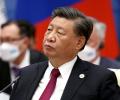
Xi Jinping's recent actions in South Asia have amply demonstrated the disastrous impact of China's embrace, observes Jayadeva Ranade, the retired senior RA&W officer and China expert.

Chinese military on Tuesday asked Japan to "stop activities" around the contested islands in the East China Sea, warning that Beijing has the "capability and determination" to safeguard its territorial sovereignty.
Declaration by China of a new overlapping Air Defence Identification Zone over contested islands of Diaoyu/Senkaku besides raising tensions between Tokyo and Beijing have caused reverberations in the strategic firmament of the entire Asia-Pacific region.

China on Thursday questioned the Japanese premier's assertions claiming sovereignty over disputed islands in East China Sea, saying Tokyo is 'self deceiving itself' by ignoring historical facts and international laws.
A day after its patrol plane was confronted by Japanese fighter jets over the disputed islands, China on Friday said it will 'resolutely fight' for the control of disputed islands with Japan and accused Tokyo of violating post second World War order by buying the islets.
The Sino-Japan row over disputed islands in the East China Sea took a new turn on Thursday as Beijing said its surveillance plane was 'disturbed' by Japanese fighter jets and warned Tokyo of consequences.
China on Tuesday warned that it reserves the right to take "further actions" over its maritime dispute with Japan even as fresh anti-Japan protests erupted across the country forcing top Japanese firms to remain padlocked.
Tensions between China and Japan over disputed islands in the East China Sea intensified on Tuesday after two armed Chinese maritime vessels reached close to the area protected heavily by the Japanese coast guard.
In a surprise move China's State Oceanic Administration (SOA) announced that a maritime surveillance fleet consisting of two patrol vessels, Haijian 50 and Haijian 66 started patrolling the waters of the Diaoyu Islands since Friday
Two Chinese surveillance ships on Friday entered the waters near disputed islands claimed by Tokyo and Beijing for the first time after they were bought by Japan from private parties.
China has dispatched two of its maritime security vessels to patrol the waters of disputed islands in the Pacific Ocean, amid attempts by Japanese politicians to buy land there.
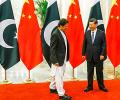
'If a 'two-front war' develops, Iron Brother may only turn out to be a drag on the PLA, since Pakistan is in no position to wage a war with India,' argues Ambassador M K Bhadrakumar.

China has issued a red alert as it braced for Typhoon Fitow, with tens of thousands evacuated as the storm is set to slam the country's eastern coast soon.

'We may think that in our border quarrel, the Chinese can give up a bit of territory here or there to satisfy us, but that's not how they see it.' 'Arunachal Pradesh is 90,000 square kilometres and twice the size of Taiwan.' 'The Chinese can't be seen to be asserting their rights to Taiwan and on the other hand, cheaply giving up Arunachal Pradesh.'

China also said that it was opposed to any third-party involvement in the resolution of the Sino-India boundary disputes.

Military clashes between China and Japan cannot be ruled out and the People's Liberation Army will fight back if provoked, a top Chinese official said on Monday.

China on Wednesday asserted that it has enough "will and ability" to enforce its unilaterally declared new air defence zone over disputed islands in the East China Sea after two US B-52 bombers challenged Chinese authority over the controversial airspace.
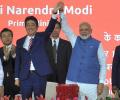
Chinese foreign ministry spokesperson Hua Chunying, while reacting to Japan's plans to step up investments in the northeastern states, told the media that China is opposed to any foreign investment in the areas where it has disputes with India.

China on Thursday ruled out establishing an air defence zone along the India-China border like it recently did over the disputed islands in the East China Sea, saying such zones are created only in coastal areas beyond territorial airspace.

China's newly-formed Rocket Force has held an exercise with advanced DF-16 medium-range ballistic missile with a range of over 1,000 kms that could threaten a number countries, including India, Japan and the United States.
India will not join Japan's efforts to build a strategic counterweight against China along with the United States as it follows an independent foreign policy, the Chinese state media said on Tuesday, ahead of Prime Minister Narendra Modi's maiden visit to the US.

In a stern message to its neighbours, China today said it is determined to defend "every inch" of its territory and there was "no room for compromise" with Japan over territorial or historical disputes.

As Japan beefs up its defences against China, both New Delhi and Tokyo seem to have decided to re-energise their relationship to ensure a strategic balance in Asia. It is a clear signal that they may be ready to work together in containing if not confronting China, says Nitin Gokhale.

Not just Vietnam, but other countries in the region like Philippines, Malaysia and Thailand, have also expressed an interest in acquiring the BrahMos cruise missile. Debalina Ghoshal explains the significance of the move.

There are many reasons for Japan to turn a deaf ear to its anti-nuclear lobby and concentrate on its geo-strategic imperatives to sign the nuclear deal with India, says Debalina Ghoshal.
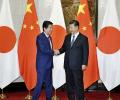
'Both Japan and China face a common challenge: How to deal with Trump.' 'The trade war with the US seems to have facilitated/hastened Abe's China visit, the first by a Japanese prime minister since 2011,' points out Dr Rajaram Panda.

'The military aim in a future conflict, if it can't be avoided, should be to cause maximum damage to the adversary's war waging capability and capture limited amount of territory as a bargaining counter,' says Brigadier Gurmeet Kanwal (retd).

Modi knew in his heart that India does not have the financial muscle to support the new bank with offers of co-financing international projects, something China can do from the bank's base in Shanghai. If established in Mumbai, it may have employed a few Indian bankers and satisfied the national ego but there was little financial value to be drawn from it.
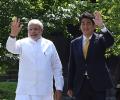
Although the India-Japan relationship has its own driving forces in terms of robust economic ties and shared values, China is the elephant in the room in the strategic parleys between the two countries, says Rup Narayan Das.

'The worst case scenario is for China to behave like a bull in China shop, and brazenly and wantonly indulge in further encroachments, create obstacles to free navigation and convert SCS into an Air Defence Identification Zone.'

What is so honourable in defending or dis-honourable in not defending the 'Johnson line' in Aksai Chin? That is a question that needs to be asked to the Indian shouting brigade. The Chinese also need to be asked as to why they wish to implement the 'MacDonald McCartney' line drawn by British Imperialists? asks Col (retd) Anil Athale.
 © 2026 Rediff.com - Investor Information - Advertise with us - Disclaimer - Privacy Policy - Sitemap - Feedback - About us - Terms of use - Grievances