
Rupee depreciation, if it continues, will likely pull the markets down further. Since September 2024, the rupee has declined by 3.1 per cent, the Nifty has dropped by 8.5 per cent during the same period, and the Sensex has fallen by 7.3 per cent. If the decline continues, markets will need to brace for more pain as it could push foreign portfolio investors (FPIs) to exit their positions faster than anticipated.

"The prime minister is thinking of having a meeting of all political leaders and it could take place in the second week of next month," sources in the government said. While the agriculture scenario was comfortable spiralling crude oil prices in the international market was causing a concern, they said. Crude oil reached $96 a barrel mark early this month. However, it has come a notch lower now.
The decision by the Union government and the Reserve Bank of India to infuse Rs 1,25,000 crore (Rs 1,250 billion) into the banking system in the last two weeks alone is unlikely to fuel inflation, say economists, since this infusion will only meet the basic demand and not lead to a spillover.

India's merchandise exports in October rose by 17.25 per cent to $39.2 billion against $33.43 billion a year ago, according to government data released on Thursday. Imports increased by 3.9 per cent to $66.34 billion in October compared to $63.86 billion in the year-ago period.

India's net oil import bill could widen to $101-104 billion in current fiscal from $96.1 billion in 2023-24 and any escalation in the Iran-Israel conflict could impart an upward pressure on the value of imports, ICRA said on Tuesday. The domestic rating agency said based on its analysis, lower value of Russian oil imports is estimated to have led to savings of $7.9 billion in 11 months (April-February) of 2023-24, up from $5.1 billion in 2022-23.
Crude oil import surged 15.4 per cent to 51.88 million tonnes as against 44.97 million tonnes in April-August and oil product exports jumped 35.7 per cent to 16.61 million tonnes.
Finance Minister P Chidambaram on Monday said the surge in international oil prices is a matter of grave concern and it was for the petroleum ministry to take a call on retail pricing of petroleum products.

'The biggest near-term risk to Indian equities is the outflow of investments to China as tactical trades by foreign investors.'

A fall in crude oil price and Aramco's $75 billion annual dividend commitment may have delayed Saudi company picking a stake in Reliance Industries Ltd's oil-to-chemical unit (O2C), research firm Jefferies said. Richest Indian Mukesh Ambani had in August 2019 announced talks for the sale of a 20 per cent stake in the O2C business, which comprises its twin oil refineries at Jamnagar in Gujarat and petrochemical assets, to the world's largest oil exporter. The deal was to conclude by March 2020 but has been delayed for reasons not disclosed by either company.

Apart from the emotional value attached to buying gold, the yellow metal offers protection against inflation, interest rate spikes, currency and geopolitical risks, says Anamika Pareek.

Or Iran may face the risk of losing its biggest client

Of Trump's reciprocal tariffs and trade deals
The country's fiscal deficit, as a percentage of GDP, would be wiped out if the crude oil price, as measured with the Indian basket, touch $80 per barrel.

'Even now, investors are not bothered about the war but are more concerned whether it will remain localised or not.' 'In case things are contained, markets can stage a bounce back in the next few days.'

The ongoing oil price decline is mainly a result of oversupply in the global market

The revised projection comes after a 17% rise in the April-June.
The government is considering building a strategic storage of crude oil to provide for a 45-day cover, Lok Sabha was informed on Thursday.

The growth of eight key infrastructure sectors rose to 5.2 per cent year-on-year in March due to improvement in the output of crude oil, cement and electricity, according to official data released on Tuesday. In 2023-24, the growth rate in the output of these eight sectors was 7.5 per cent, marginally down from 7.8 per cent recorded in the year-ago period.
State-run Indian Oil Corporation will import 31.41 million tonnes of crude oil this fiscal, 53 per cent of which would be on term contracts.\n\n\n\n

India's current account deficit (CAD) may dip further in the March quarter of FY24 as pressure from the negative net exports during the January-March period eased to an 11-quarter high. A part of the gross domestic product (GDP) data, net export- which is usually negative for India - captures the difference between exports and imports of both goods and services, while the CAD data, released by the Reserve Bank of India (RBI), also factors in private transfer receipts.

Oil and LNG prices are likely to shoot up if Iran is to block Strait of Hormuz, through which countries like India import crude oil from Saudi Arabia, Iraq and UAE, leading to a spike in inflation, analysts said on the Iran-Israel conflict. The Iran and Israel conflict has escalated over the last few days. Iran first launched drone and rocket attacks on Israel, which retaliated by firing a missile. Crude oil prices have hovered around USD 90 per barrel since the conflict.

Hit by inflation, higher input costs and pricing measures, fast-moving consumer goods companies are expected to see a contraction in their gross margin and a modest-to-flat operating profit in the October-December quarter. Several FMCG makers are likely to log a low single-digit rise in their revenue, returning to the cycle of value-driven growth.

The October-December quarter (Q3FY25) results of fast moving consumer goods (FMCG) major Hindustan Unilever (HUL) indicated weak demand, with urban growth muted and rural showing recovery. Consolidated revenue grew by 1.6 per cent (volume was flat) to Rs 15,818 crore, due to price hikes. Prices of key raw materials such as palm oil and tea remained elevated, leading to compression of gross margin.
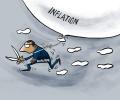
Wholesale price based inflation declined to a 3-month low of 1.89 per cent in November on cheaper food items, and experts predicted a 0.25 per cent interest rate cut by the RBI in the policy review in February. The Wholesale Price Index (WPI) based inflation was 2.36 per cent in October 2024. It was 0.39 per cent in November, last year. In August, 2024, it was 1.25 per cent.

India's crude oil imports from Russia fell for a second straight month in January to its lowest in 12 months but the nation's insatiable appetite for Russian crude remains for the long term, according to data from energy cargo tracker and industry officials. Russia supplied 1.2 million barrels per day of crude oil to India in January, down from 1.32 million barrels in December and 1.62 million barrels in November 2023, according to data from energy cargo tracker Vortexa. Russia however continues to remain India's top oil supplier, accounting for a little less than a quarter of 4.91 million barrels a day of oil that the world's third largest energy consumer imported in January.

The stubbornly high global crude oil prices are opening up a can of worms to heightened inflation risks and likely to disrupt government's fiscal maths along with deteriorating global financial conditions.

Latest GDP growth numbers a one-off development and not the beginning of a trend, says CEA V Anantha Nageswaran.
The oil industry experienced three upheavals between 1973 and 1991, which seem to be etched in the memory of the industry's decision makers. Naturally, at the sign of a new crisis, the decision makers like to dip into those tumultuous decades to find ways to deal with the new shock, in addition, of course, to expert reports and forecasts. So, the industry bigwigs turned the pages of history to get a peek into the future of oil price movements after Russia invaded Ukraine in 2022, Israel attacked Gaza in 2023, Iran-linked Houthi rebels pounded tankers crossing the Red Sea in support of Palestine the same year, and Iran rained missiles on Israel in 2024.
The imported crude was valued at $64.98 billion, up 85.8 per cent, as oil prices in the international market skyrocketed with import prices hitting a record high of $849.10 per ton in June, the General Administration of Customs said. China exported 2.37 million tons of crude and 7.88 million tons of refined products, a 30.6 per cent jump and 0.3 per cent decline, respectively, from a year earlier, it said. China had recently raised the prices of gasoline by 16 per cent.
India's crude oil production rose by 3.2 per cent in May on back of better performance by state- owned oil major Oil and Natural Gas Corp (ONGC), while refinery output remained unchanged.

Global factors and FII activity will dictate trends in domestic equity markets this week while assembly poll results of Maharashtra and Jharkhand may impact stocks on Monday, say analysts. Stock markets witnessed a spirited recovery on Friday with benchmark Sensex and Nifty notching the best single-day gains in more than five months and offering relief after weeks of correction.

BP Plc has won a bid to operate ONGC's giant Mumbai High oil and gas field by offering up to 60 per cent increase in output over baseline, the state-owned firm said on Wednesday. State-owned Oil and Natural Gas Corporation (ONGC) had in June last year floated a tender seeking foreign partners to reverse declining output at its flagship Mumbai High fields, offering a share of revenue from incremental production plus a fixed fee but not any equity stake.

The eight key infrastructure sectors' growth rose by 6.3 per cent in May on healthy expansion in the production of coal, natural gas, and electricity, though the growth rate is lower than in April, according to official data released on Friday. The production of the eight sectors grew 6.7 per cent in April. The growth of these core sectors -- coal, crude oil, natural gas, refinery products, fertiliser, steel, cement and electricity -- was 5.2 per cent in May 2023.

Chinese stock markets suffered their biggest single-day drop since the global financial crisis.

Indian Oil Corporation (IOC) on Tuesday reported halving of its March quarter net profit largely because of losses in the petrochemical business and shrinking margin after it announced a pre-election fuel price cut despite rising input costs. The net profit of Rs 4,837.69 crore in January-March compared to Rs 10,058.69 crore a year back and Rs 8,063.39 crore in the preceding October-December quarter, according to a stock exchange filing by the company.
The Opec output has fallen slightly in November at around 29 million barrels a day since last August.

Macroeconomic data announcements, global trends and trading activity of foreign investors would be the major driving factors for the equity markets this week, according to analysts.

Prime Minister Narendra Modi on Friday invited President Volodymyr Zelenskyy to visit India and the Ukrainian leader said he would be happy to travel to the 'great' country.
 © 2026 Rediff.com - Advertise with us - Disclaimer - Privacy Policy - Sitemap - Feedback - About us - Terms of use - Grievances