
In the early part of 1800, a 30-acre plot next to Fort Gloster on the banks of river Hooghly in Howrah district of Bengal was the nerve centre of industrial activity; it housed India's first steam-powered cotton mill, Bowreah Mills, which was set up by a British merchant and went on to become a hub of factories - a rum distillery, foundry, cotton yarn factory, an oil mill and a paper mill, et al. Spearheaded by Dwarkanath Tagore, the industrialist grandfather of Rabindranath Tagore, the commercial complex was possibly the first of its kind in the country. Close to 200 years later, after much ebb and flow of history, the hub is set for a resurgence of sorts.

However, a prolonged and intense second wave that curtails oxygen supply to industries for a longer-than-expected period will exacerbate downside risk in affected sectors

The regulator is more carefully scrutinising applications by infrastructure investment vehicles that have a limited number of investors. They have been asked to broaden their investor base before application approval, according to two people familiar with the matter. The Securities and Exchange Board of India is concerned about the structure being used for getting around tax requirements, according to one of the sources.

Crisil Real Estate Ratings provide city specific all-round assessment of real estate projects and help buyers benchmark and identify quality projects within their cities.

Fears of banks' earnings plummeting in a deregulated savings deposit rate regime appear to have gripped investors, with most analysts hinting that profitability may come under pressure due to higher cost of funds amid slowing growth in advances.

Banks are set to sell dud-loans worth Rs 90,000 crore of 22 firms in the first tranche to the National Asset Reconstruction Company (NARCL). It's reason for cheer given that such sales to asset reconstruction companies (ARCs) have been poor in recent times. In fiscal 2020, their assets under management (AUM) contracted by 4 per cent; and in fiscal 2021, it fell by another 100 basis points to Rs 1.07 trillion. So, why are we where we are?

While sales in the domestic market declined 4.2 per cent during the April-July period, exports grew steadily at 9.5 per cent during the same period.

"Profitability of companies will be negatively impacted due to rising input prices, as the ability of companies to pass on these hikes to customers is limited. Further, higher interest rate outlook would lead to lower investment, as profitability margins will be reduced," Crisil Ratings Director Pawan Agrawal said over the conference call.

Diamond industry expects revenues to drop by 20-25% in the current financial year.
26 out of 80 operational projects are in no position to service debt.

Revenue from divestment has fetched Rs 40,000-50,000 crore against target of Rs 2.10 trillion.

Ratings are based on the overall exposure to default risk, with regard to timely receipt of payments from the investments the scheme has made.

In spite of a severe second wave of the coronavirus pandemic, and a widespread disruption in public life therefore, India's fast-moving consumer goods (FMGC) sector seems to have emerged as one of the most resilient segments of the economy. The early numbers and estimates for the April-June quarter indicate a steady recovery in FMCG players' business, which is now set to exceed the pre-pandemic level. Amid nationwide lockdowns because of the first Covid wave, FMCG revenues had been severely affected in mid-2020.

Salary account holders could see their interest income rise by up to 25 per cent on the back of a new RBI rule from this month, under which banks will compute 3.5 per cent savings interest on daily basis instead of taking the lowest deposit during a month, Crisil Ratings said.

Overall, the credit profiles of players will be supported by healthy balance sheets and liquidity. Prudence in capital and development expenditure, efficient working-capital management, and recent equity raising will help sustain credit metrics in FY22.

Lenders can now initiate recovery proceedings since the SC has lifted the standstill on asset classification, which protected stressed accounts from slipping into NPAs.
About 50 per cent of the accounts that availed of the EMI moratorium amid the pandemic, which made things worse in an already slowing economy, are expected to be restructured, and of these accounts that would undergo restructuring, one-third, or Rs 6-9 trillion, could turn into NPAs.

The operating profit growth rate of mobile service providers is expected to double in next two years buoyed by increase in call rates and clarity in policy, credit rating agency CRISIL has said.

Experts say the focus is on preserving liquidity as there is uncertainty over the duration and impact of the 21-day nationwide lockdown imposed to check the spread of COVID-19.

Voicing concerns on overheating, Crisil Ratings on Monday said rising interest rates and liquidity constraints would push down India's GDP growth in the range of 7.9-8.4 per cent in 2007-08.
Public sector Dena Bank is awaiting Crisil rating before deciding on its real estate funding strategy, bank's M V Rao, chief managing director said on Saturday. Upon getting the rating, the bank would disburse at least Rs 50 crore (Rs 500 million) wo

Indian auto industry's dependence on China is high and it will continue to be so in the BS-VI era and as the country moves towards electric mobility. Domestic players lack both technological competence and the sheer pricing advantage that support Chinese imports.
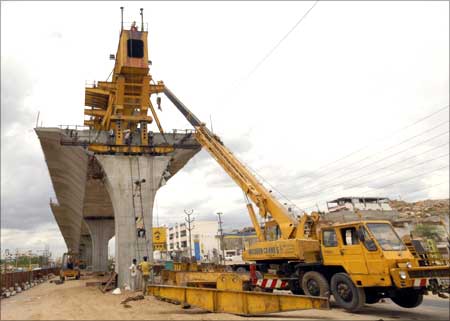
Banks have played a critical role in infrastructure financing.

The pensioners have been agitating for last 18 years

Ninety-nine companies, which also include some unlisted ones, have more than Rs 100 crore each of minimum alternate tax credit on their books, cumulatively adding up to Rs 75,000 crore. By utilising MAT credit, many companies will be able to bring down their effective tax cost.

The mergers will not involve any cash but only share swaps

Most borrowers of loans against property pin hopes on future cash flows from their business, but in case of failure to repay the loan, the lender can repossess the property and sell it.

A fourth of the property market is cash-based and this has affected home sales after high value notes were scrapped.

Indian companies struggle to escape debt burden as profit slows.

Also build a contingency fund equal to 9 to 12 months of expenses.

After a volatile session, Sensex closed the day 563 points lower

RBI's draft guidelines on computation of base rate, if implemented in its current form, will significantly impact the profitability of banks.

South leads; North-East at bottom but moves ahead, finds out the IndiaSpend Team

Some experts, however, see a silver lining in the fall and said the volatility has come down sharply and that bodes well for the Indian currency
 © 2026 Rediff.com - Investor Information - Advertise with us - Disclaimer - Privacy Policy - Sitemap - Feedback - About us - Terms of use - Grievances