
A profile of veteran Nepali politician K P Sharma Oli, detailing his rise to power, his various stints as prime minister, and his impact on Nepal's political landscape.

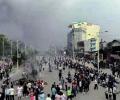
Nepal's deposed prime minister K P Sharma Oli has denied that his government gave the shootout order during the 'Gen Z' protests on the first day of the agitation on September 8 that killed at least 19 people.
'They mean business, but business as usual is unacceptable to them'
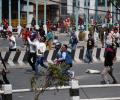
Nepal police used tear gas and water cannons to disperse pro-monarchy demonstrators who torched a house and tried to break security barricades in Kathmandu. The protesters chanted slogans demanding the restoration of the monarchy in Nepal. One person was injured in the clash.


The leader of Nepal's largest communist party was appointed as prime minister on Sunday by President Ram Chandra Paudel to lead the coalition government with the Nepali Congress (NC), the largest party in Parliament, apart from other smaller parties.

The exit of CPN-UML may not immediately affect the Prachanda-led government, which is supported by the Nepali Congress which has 89 lawmakers in the House.
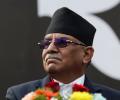
In a dramatic turn of events, Communist Party of Nepal-Maoist Centre chairman Pushpa Kamal Dahal 'Prachanda' was appointed as the new prime minister of Nepal by President Bidya Devi Bhandari on Sunday.

The main Opposition party Communist Party of Nepal-(Unified Marxist-Leninist) (CPN-UML) disrupted the National Assembly meeting on Wednesday, demanding the prime minister's resignation. The meeting has been postponed to 1 pm Thursday.

Prachanda took the oath of office and secrecy from President Bhandari at an official ceremony at Shital Niwas.

The JSP has made an electoral alliance with main opposition Communist Party of Nepal-Unified Marxist Leninist headed by K P Sharma Oli.

With the support from eight political parties, 78-year-old Poudel's victory was certain. His rival Subas Chandra Nebmang had support of former prime minister KP Sharma-led CPN-UML.

In a press statement, the foreign ministry here said 10 Nepali nationals lost their lives in the recent attack by Hamas in Israel.
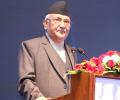
Nepal's political crisis deepened on Friday as both embattled Prime Minister K P Sharma Oli and the Opposition parties staked a claim for the formation of a new government by submitting letters comprising signatures of lawmakers to President Bidya Devi Bhandari.

Nepal witnessed political turbulence in 2022 that dramatically turned rivals into allies and throned former guerrilla leader Pushpa Kamal Dahal 'Prachanda' as the prime minister for a third time, as Kathmandu made efforts to balance ties with immediate neighbours India and China with high-profile talks and visits.

Nepali prime ministers traditionally choose New Delhi for their first foreign visit after being sworn-in.
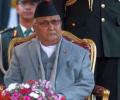
Deuba was elected as the 40th prime minister on June 6 with the support from Communist Party of Nepal-Maoist Centre, which is now a part of Left alliance and opting for merger with Communist Party of Nepal-Unified Marxist-Leninist.

Much to the surprise of Beijing, Nepal's Parliament on Sunday ratified the contentious US-funded $500 million Millennium Challenge Corporation compact along with an interpretive declaration a day ahead of the February 28 deadline set by Washington.
Former Nepalese foreign minister Ramesh Nath Pandey observed that the current situation is not encouraging for India-Nepal ties, saying the "present leaders" created irritants in the relationship in the past.

The 75-year-old veteran politician and Nepali Congress President took the oath of office and secrecy from President Bidya Devi Bhandari during a swearing-in ceremony which was delayed by over two hours.

Shergill said the primary reason was that "the ideology and the vision of the current decision makers of the Congress is no longer in sync with the aspirations of the youth and modern India".
Prime Minister Oli secured 93 votes in the lower house of parliament during a special session convened on the directives of President Bidya Devi Bhandari.

President Bidya Devi Bhandari administered the oath of office and secrecy to Oli, 69, at a ceremony at Shital Niwas, after he was reappointed to the post on Thursday night as the Opposition parties failed to secure majority seats in Parliament to form a new government.
The move comes as the intra-party feud reached climax in the ruling NCP which has been witnessing months long tussle between two factions, one led by 68-year-old Oli and Party's chairman and another led by 66-year-old 'Prachanda', also the executive chair of the party and former premier.

Communist leader Vidya Devi Bhandari was on Wednesday elected as Nepal's first woman President by the parliament, weeks after it adopted a new landmark Constitution that declared the country a secular state.
The Seven Party Alliance, which has been at the centrestage of the democratic movement in Nepal and was instrumental in the transition of the nation from a monarchy to a republic, is virtually defunct. The Himalayan nation is witnessing a new round of political alignments and re-alignments with the CPN-UML joining hands with the CPN-Maoists, leaving behind the Nepali Congress.The UML and Maoists have reached an agreement to seek consensus with other parties on amendments.
Nepal plunged into a political crisis after President Bidya Devi Bhandari dissolved the House of Representatives and announced dates for mid-term elections at the recommendation of Prime Minister Oli on Sunday, sparking protests from a section of the ruling party and various opposition parties.
The formation of the new government, which was expected on Friday, was delayed due to last-minute wrangling over the distribution of portfolios.
A five-member Constitutional Bench of the Supreme Court led by Chief Justice Cholendra Shumsher Rana issued the verdict stating that President Bhandari's decision to dissolve the lower house upon a recommendation of Prime Minister K P Sharma Oli was an unconstitutional act, delivering a major blow to the veteran Communist leader who was preparing for snap polls.
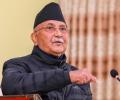
The decision to remove Oli from the party's general membership was taken at the Standing Committee meeting of the faction led by former prime ministers Prachanda and Madhav Kumar Nepal after Oli failed to produce explanation to his recent moves as sought by party leadership, sources said.

Three Madhesi leaders have supported Prachanda's candidacy.
Nepal's Unified Communist Party of Nepal-Maoist on Thursday demanded a suspension of the vote counting, alleging conspiracy after initial results showed the party trailing at third position in the constituent assembly elections.

Prime Minister Narendra Modi's advice to Nepal's warring political parties on the Constitution-making process was on Thursday criticised by the media in Kathmandu which termed it as "breaching of diplomatic norms".
The Communist Party of Nepal-Maoist, the breakaway faction of Nepal's ruling Maoists, has issued a warning against screening of Hindi films and operation of vehicles bearing Indian number plates in 10 districts, saying that anybody defying its ban will face consequences.
"The Prime Minister's unilateral move to conduct fresh election by allowing to dissolve the most representative Constituent Assembly was aimed at capturing power and this has created frustration in the minds of the general public," said a joint statement issued by five parties.
United States on Thursday lifted sanctions on Nepal's Maoists and removed it from the list of designated terrorist organisations, years after the rebels abandoned their armed struggle.

Nepal Prime Minister Sushil Koirala on Saturday resigned even as Parliament prepares to elect a new premier tomorrow after parties failed to forge a consensus amid continued protests and blockade of a key border trade point with India over the country's new Constitution.

K P Sharma Oli was elected as the next prime minister of Nepal on Sunday defeating incumbent Sushil Koirala in a contest which became necessary after parties failed to forge a consensus amid violent protests over the country's new Constitution.
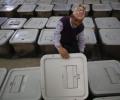
Nearly 70 per cent of Nepal's electorate voted on Tuesday to choose an assembly that will draft a new constitution to end years of turmoil and political uncertainty though balloting was hit by sporadic violence, including vandalism and explosions that injured a dozen.
The Unified CPN-Maoist that had been singing anti-India tune and blaming the Nepal Army for the stalled peace process has now changed its course and blasted on "spirits and ghosts" for hatching conspiracy against the Maoists.
 © 2026 Rediff.com - Investor Information - Advertise with us - Disclaimer - Privacy Policy - Sitemap - Feedback - About us - Terms of use - Grievances