
'There's a lot of sense in what Prime Minister Modi did, but the Indian government has to be really prepared for a really sharp escalation spiral.'

What drives Pakistani men to join its military, despite the toll it takes on them?

No tears are shed for the thousands of American soldiers killed in Afghanistan by Pakistan's proxies such as the Afghan Taliban, says South Asia expert Professor C Christine Fair. Aziz Haniffa reports.
If there is another Mumbai-like attack; the US should not constrain India. India and Pakistan should simply deal with it bilaterally, without US pressure, says South Asia expert Professor C Christine Fair. Aziz Haniffa reports.
If there is another Mumbai-like attack; the US should not be constraining India. India and Pakistan should simply deal with it bilaterally, without US pressure, says South Asia expert Professor C Christine Fair. Aziz Haniffa reports.
A staggering 94 per cent of fresh recruits of the Lashkar-e-Tayiba see Jammu and Kashmir as a "fighting front" and hail mostly from Pakistan's Punjab province from families having links with the powerful army and intelligence network, according to a United States military report.
Pakistan's former ambassador to the United States Husain Haqqani said that the judicial commission investigating the memogate was trying to coerce him to confess that President Asif Ali Zardari had urged him to draft the memo to former chairman of the US Joint Chiefs of Staff Committee Admiral Mike Mullen.
"Imran Khan is exciting because he is enervating the denervating, actually, the Pakistani polity, particularly the youth," said South Asia expert Professor C Christine Fair, at the Brookings Institution conference on The Future of Pakistan, on Monday.
Fair, who is a senior Fellow with the Counterterrorism Centre at West Point, said all of Pakistan's strategic and security threat perceptions have always centered around India and all of the military aid and weapons systems it has received from the US has been to beef up its arsenal vis-a-vis New Delhi.
The position of Deputy Assistant Secretary of State for South and Central Asian Affairs with responsibilities to work specifically on the India portfolio -- which has remained vacant for nearly a year since the controversial Christine Fair declined the offer of the job -- has finally been filled with longtime South Asian expert Alyssa Ayres

Christine Fair, who infuriated New Delhi when she alleged that India was meddling in Balochistan, has been offered the India portfolio in the Obama administration.
Christine Fair, an expert on Pakistan-based Jihadi groups, has predicted that even if there is an India-Pakistan rapprochement and a resolution of the Kashmir imbroglio, it will not result in Pakistan reining in these strategic assets that are invaluable to it to wage it proxy wars against India.
South Asia expert Christine Fair believes this week's Obama-Singh summit will accomplish little in terms of getting Pakistan to rein in terrorist groups using its soil to mount attacks on India.
India should review its Kashmir policy for itself, not for others, C Christine Fair, senior political scientist, RAND Corporation, tells KS Manjunath.

Madhav raised eyebrows when he told journalist Mehdi Hasan, 'your ISIS' when he was trying to make a point about his apprehensions about the dreaded militant group -- the Islamic State.

'At this point, neither the army or the IAF has that immediate, punitive deterrent power against Pakistan.' 'Forget a three-week war; on the LoC, where the action is, Pakistan has until now fielded better infantry weapons, body armour, sniper rifles, and matching artillery' points out Shekhar Gupta.
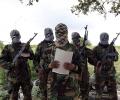
C Christine Fair, an acclaimed Pakistan expert who teaches at Georgetown University rebutted some of the common perceptions of Pakistan.

'The problem with India and Pakistan can be solved by Pakistan by ceasing its support for Islamist terrorists operating in India, letting go of its baseless demands upon Kashmir, ceasing its support for terrorists attacking India assets in Afghanistan.'

'There is a consensus within the Indian security establishment -- at least among those who draw their conclusions from data instead of speaking from nationalist sentiment -- that India lacks the offensive capability to defeat Pakistan in a short war.'
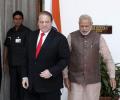
India'Prime Minister Narendra Modi has been congratulated for his speedy diplomacy and his talks with Pakistani counterpart Nawaz Sharif. However, academic Christine Fair and former Pakistan ambassador to US Husain Haqqani dismiss the meeting, calling it merely a photo-op and an exercise in futility. Aziz Haniffa reports.

A former top envoy of the country questioned Pakistan's decades-old Kashmir policy.

'A new doctrine now needs to be evolved for a new situation, and the army will do it.' 'You won't see more Kashmiris driven in front of army columns.' 'Nor will the army massacre hundreds, Dyer style,' says Shekhar Gupta.

"We should make it clear to Pakistan that any LeT attack upon our homeland, they will bear responsibility for that because of their close relationship between ISI and LeT," Congressman Peter King said during a Congressional hearing on Wednesday.

India is not making a choice of war over peace. Rather it is at war, a war thrust on it by a sick militaristic State, says Sankrant Sanu.
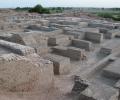
"South Asian studies" academics in the US would do well to introspect how they wittingly or unwittingly become part of Pakistan's proxy war in wielding influence over academics and policy, says Sankrant Sanu.

'While military acts such as the Uri surgical strikes are one option, cultural, economic and diplomatic isolation should also be part of the arsenal,' argues Sankrant Sanu.

The recent breach of ceasefire by Pakistan was aimed at infiltrating Lashkar-e-Tayiba cadres into Jammu and Kashmir ahead of the polls and to bring Kashmir issue back into limelight, as the neighbouring country was feeling isolated with the growing clout of India in the international forum, according to security experts.

The clichd path of conducting 'uninterrupted and uninterruptable' bilateral dialogue with Pakistan to improve ties remains unimplemented and un-implementable under prevailing circumstances that are unlikely to alter in the near future, says Rahul Bedi.

'The Modi government's pusillanimity vis-a-vis Pakistan makes almost certain that India will, in the coming weeks and months, be confronted with cross border terrorist actions of increasing intensity,' warns Satish Chandra, former deputy national security adviser.
 © 2026 Rediff.com - Investor Information - Advertise with us - Disclaimer - Privacy Policy - Sitemap - Feedback - About us - Terms of use - Grievances