
The Indian economy is rapidly normalising towards pre-pandemic activity levels, even as uncertainty exists about coronavirus mutations and repeated infection waves, industrialist Kumar Mangalam Birla said on Wednesday. Vaccination is picking up pace, which would improve India's resilience against a potential third wave, the chairman of Aditya Birla Group said while virtually addressing shareholders at the AGM of group firm UltraTech Cement Ltd. Moreover, various steps taken by the RBI and the government have helped in containing the economic disruptions of the pandemic, Birla added.

'The fiscal pressure will be there, but the intent of the government behind this move is to spur demand and growth.'
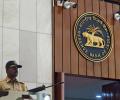
Striking a different note from its peers, US brokerage Bank of America Securities has maintained that the Reserve Bank will leave rates unchanged next week, recognising growth-focused and capex-driven fiscal expansion, which though poses huge price pressure and interest rate risks later. The RBI's rate setting panel Monetary Policy Committee (MPC) will begin its deliberations next Monday and announce the policy moves on Wednesday (February 9) in the backdrop of a massive spike in bond yields post the Budget. Almost all major central banks are in the process of hiking rates to tame inflation.

Fitch Ratings has upgraded Reliance Industries Ltd's (RIL) rating to 'BBB', one notch above India's sovereign rating, as the company benefits from cash flow generation across diversified business segments and continuation of deleveraging. In a statement, Fitch said it has upgraded RIL's long-term foreign-currency issuer default rating (IDR) to 'BBB', from 'BBB-', with a negative outlook. At the same time, the agency has affirmed RIL's long-term local-currency IDR at 'BBB+' with a stable outlook.

The Budget, to be presented on February 1, is likely to be less worried about fiscal deficit and will be focused more on nursing the fragile growth, according to a Wall Street brokerage report. Bank of America Securities India expects the budget to peg "fiscal deficit at a high 5 per cent of GDP for FY22 and 7.2 per cent for FY21, as it is likely to step up capex, recap public sector banks, push asset sales to break government monopolies, offer sops for real estate, tax cuts for lower income groups and creation of a bad bank". Its house economists expect these spends to be funded by debt and partly by imposing a cess on high income groups and also by some non-fiscal measures like tapping the central bank's revaluation reserves and bank recapitalisation and infra bonds.

A hallmark of some new businesses today is that they seek to use the brute force of capital, combined with smart technology and operations, to create new needs that you didn't even know existed, the chairman of Aditya Birla group said in a blog post on the trends for the new year.

With the spectrum auction now delayed till at least next May, the expected 5G orders for telecom equipment have not been sealed, the companies point out. Surajeet Das Gupta reports.

7 key areas that the Budget must address to re-energise the infrastructure sector, suggests Vinayak Chatterjee.

ONGC will invest Rs 35,049.23 crore (Rs 350.49 billion) in 2013-14 as compared to revised capital expenditure of Rs 33,577 crore (Rs 335.77 billion) in the current fiscal, according to the 2013-14 General Budget documents.

The finance minister has stayed true to her commitment to fiscal consolidation, even though the pace of the decline in the deficit could have been faster, notes A K Bhattacharya.

To make possible discretionary spending including capex and that on welfare, the government decided to borrow more than planned in FY21 -- Rs 12.7 trillion.

'The IPO market is cooling off and getting a reality check.'

'When the average growth in the last three years was just 2.5%, how does that make us the fastest growing country?' 'They only tell you what has happened in the last 2 years; they are not taking into account what happened in FY21 on account of their mistakes.'

RIL had been under pressure to utilise the cash on its books and these investment plans show how it has charted a way forward.

'Earning expectations remain strong.'

India, he said, has already taken a host of reforms in banking and other sectors and is now focussing on stepping up public investment. "Compared to other nations, even among advanced countries, I think India is relatively better placed for the simple reason that India paid a certain price last decade... we had a banking system stress which was then compounded by stress in the non-banking financial sector towards 2018," he said at Amazon Smbhav Summit.

Investors have scaled back their allocation to equities as pessimism has reached "dire" levels due to cloudy economic outlook, according to the latest Bank of America (BofA) monthly global fund manager survey that covered nearly 300 money managers with combined assets of $800 billion. The survey showed that the expectations for global growth and profits are at all-time lows and cash levels are at highest since the 9/11 attacks. Interest rate hikes by central banks, the unwinding of an easy monetary regime, disruptions in global supply chains, and fears of recession have heightened market volatility since the beginning of the year.

To be able to tide over the current crisis, automobile manufacturers have waged a war against all cost heads.

'It's important that every portfolio is well diversified.' 'My own portfolio is diversified across asset classes: 50% is in equity funds, 15% in international schemes, 25% in debt funds and 10% in sovereign gold bonds.'

The public sector behemoth is looking at forming joint ventures with states.

The RBI on Wednesday cautioned that while the Indian economy appears capable of weathering the deterioration in geopolitical conditions amid the ongoing Russia-Ukraine war, it faces headwinds from global spillovers from geopolitical tensions, elevated commodity prices and moderating external demand. The RBI, however, did not tinker with the GDP growth projection made in April. It had slashed the GDP growth projection for the fiscal 2022-23 to 7.2 per cent from its earlier forecast of 7.8 per cent.

Finance minister Nirmala Sitharaman on Wednesday exuded confidence that inflation would further decline and the government is on track to meet its budgetary target for deficit and said that there is no fear of stagflation in India. Replying to the debate on first batch of Supplementary Demands for Grants 2022-23 in Lok Sabha, the finance minister said inflation has come down and it is now in the tolerable band of the RBI. Inflation has been declining since April 2022 and it is declining further, she said.

The political-electoral calculus favours spending thousands of crores on vanity projects like Sardar Patel's statue and the Central Vista over building up our military to handle the confrontations and conflicts that loom large, points out Ajai Shukla.
The company is also looking at a turnover of Rs 4,500 crore this financial year, of which the appliances division is expected to contribute close to Rs 1,400 crore.

Chief Economic Advisor (CEA) V Anantha Nageswaran on Tuesday said India is not defending the rupee and the Reserve Bank of India is taking necessary steps to ensure that the movement of the rupee is gradual and in line with market trends. Nageswaran further said that the rupee is being managed in a manner that reflects the fundamentals of the economy. "India is not defending the rupee... I don't think Indian fundamentals are such that we need to defend the rupee. "The rupee can take care of itself," he said at an event in New Delhi.
The official explained that the contractor would take the worst-case scenario into account "to be on the safe side", when working out the field development plan and the probable cost of exploration and development of the block.

India's inflation trajectory in the coming months will be influenced more by the geo-political situation due to the war in Europe and its impact on supply chains and commodity prices. However, the country is better placed than most to "weather the storm" and achieve growth of close to 8 per cent in the current fiscal year, the finance ministry said in its latest monthly economic report on Thursday. "Through the channel of imports, elevated global crude and edible oil prices now have a significant impact on India's inflation outlook. "Government measures to keep the prices of these commodities in check, along with the recent hike in policy rates by the RBI, are expected to temper inflationary pressures in the economy," the monthly economic report for April, drafted by the finance ministry's economic division, said.

After three consecutive years of infusing huge funds, foreign portfolio investors retreated from the Indian equity markets in a big way in 2022 with the highest-ever yearly net outflow of nearly Rs 1.21 lakh crore. The huge outflow, which surpasses by a big margin the previous record of Rs 53,000 crore net withdrawal in 2008, came amid aggressive rate hikes by central banks globally but 2023 is expected to be better on positivity about overall macroeconomic trends in India, experts said. Apart from global monetary tightening, volatile crude, rising commodity prices along with Russia and Ukraine conflict led to an exodus of foreign money in 2022.

Of the 23 companies, eight have raised funds after Shark Tank India.

India was among the top-five economies with the largest general government capital stock level, said, in 2015, an International Monetary Fund report called "Making Public Investment More Efficient". The report fuelled a debate on countries sitting on piles of cash that could be used better. India was believed to have public assets worth $4.5 trillion. The report urged countries to start asset recycling. Six years after the report, Australia's success in asset recycling has turned India into a believer; despite doing averagely in its previous efforts on roads, railways or meeting its divestment targets.

Budget has already bombed at the box office and passing it without a revisit will be a mockery of the exercise though any modification may be short lived and perfunctory, observes V Ranganathan.

Nine of 10 bankers who attended the meeting admitted their sanctioned loan pipeline was shrinking fast due to tepid demand.
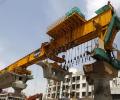
The combined net sales of 42 listed construction and capital goods companies that have declared their third-quarter results so far were down 2.3 per cent year-on-year in Q3FY21 while core operating profit was up just 4.9 per cent YoY during the quarter.

The number of times public sector undertakings (PSUs) have held conference calls with investors, their capital management, and debt financing are among the parameters that the Centre will use to judge their performance for the first time, a senior official in the know said. The government will evaluate PSUs for FY22 based on new parameters that were finalised by the Department of Public Enterprises (DPE) in consultation with the Department of Investment and Public Asset Management (DIPAM) last year, the official said. The government had included more conditions in the memorandum of understandings (MoUs) - used to set annual targets - that public sector enterprises sign with the DPE every year. These included a consistent dividend policy, which seeks to transfer dividends by PSUs every quarter; and market capitalisation or share price improvement over the sectoral index on an annual average basis for listed companies.

Companies are approaching them again with capacity expansion proposals, suggesting a more durable basis for an economic turnaround.

While no specific state-oriented sops were rolled out, a strong thread of political wellness ran through the Budget.

India Inc's cash pile was up 13.8 per cent last fiscal year, thanks to a combination of higher profits in sectors such as IT and fund raising by top companies such a Reliance Industries, Bharti Airtel and Tata Motors, among others.
'We will likely be buffeted by tailwinds from the global economy, geopolitical shifts and robust domestic demand.'

Citing faster-than-expected recovery, rising consumer confidence and the resultant spending spike, Swiss brokerage UBS Securities has revised upwards its growth forecast for the current fiscal to 9.5 per cent from 8.9 per cent in September. The brokerage also sees the economy clipping at 7.7 per cent in FY23 but moderating to 6 per cent in FY24, as it expects the benefit of the low-interest rate regime to end by the end of FY23, and it sees the central bank hiking policy rates by 50 bps in the second half of the next fiscal. The Reserve Bank also forecasts 9.5 per cent GDP growth this fiscal while the average projection ranges from 8.5 to 10 per cent.
Bharti Tele-Ventures Ltd, which runs GSM mobile services under the Airtel brand name, would invest around $1 billion this financial year for its capital expenditure plans.
 © 2026 Rediff.com - Advertise with us - Disclaimer - Privacy Policy - Sitemap - Feedback - About us - Terms of use - Grievances