
Shares of Mukesh Ambani-owned Reliance Industries Limited (RIL) rose nearly 1 per cent on Tuesday, hitting an intraday high of Rs 2,986.05 per share, after most brokerages reacted positively to the company's March quarter (Q4FY24) results. The bullish outlook stems from Reliance Jio's potential tariff hikes, given the competitive landscape, along with slow but steady improvement in the oil-to-chemical (O2C) vertical.

In August, the Reserve Bank of India Governor Shaktikanta Das held a meeting with chief executive officers/ managing directors (CEOs/ MDs) of large non-banking financial corporations (NBFCs). The discussions included diversifying borrowing sources for NBFCs and housing finance companies (HFCs) to contain increasing reliance on bank borrowing, risks associated with high credit growth in retail segment in unsecured loans, prioritising IT upgrades and cyber-security, improving provisioning, monitoring of stressed exposures and slippages, ensuring robust liquidity and asset-liability management, ensuring transparency in pricing, creating robust grievance redress mechanisms.

The share of foreign companies in private sector investments, directed towards building new factories and other facilities, has declined over the past six months. A mix of large domestic announcements and relatively lower growth in foreign capital expenditure (capex) plans have played a role, although foreign investments remain near record levels. The share of foreign companies in the overall private sector investments over the four quarters ended June 2023 has dipped to 14.9 per cent, as shown by a Business Standard analysis of data from the project tracker Centre for Monitoring Indian Economy.

Consumption-related stocks, such as hotels, and quick service restaurants (QSRs), have been hitting the ball out of the park ahead. On the other hand, the Miss World Pageant scheduled for later this year in New Delhi, too, could provide some tailwind to these stocks, especially hotels and aviation. However, analysts suggest investors put their best foot forward and buy these counters only on a decline given the recent rally and economic headwinds.

The finance ministry on Thursday sought to clarify that there was no distress in household savings and the data indicated that changing consumer preference for different financial products was the real reason for the change in the pattern of household savings. The clarification comes in the backdrop of Reserve Bank of India data showing that household net financial savings rate is at its lowest in decades, at 5.1 per cent of GDP in FY23 compared to 7.2 per cent of GDP in FY22. The divergence in the data for household gross financial assets and liabilities is not a cause for concern for the government, as the loans have largely been taken to buy real assets or automobiles, the finance ministry said.

Reliance Industries (RIL) was the top-performing index stock on Friday (May 26) and closed the day with gains of 2.8 per cent, against a 1 per cent rise in the benchmark S&P BSE Sensex during the day. RIL's performance on the bourses on Friday was, however, an exception, and the stock has struggled to beat the broader market for nearly two years now. The company's share price is currently at the same level as in September 2021, while the benchmark index is up 6 per cent in the period.

The question is: Will the company have a strong balance sheet to support this massive investment plan?

Logistic players have seen a sharp correction at the bourses over the past six months as intense competition from new-age-tech startups, higher freight rates, and weak macros dented listed players' growth outlook. Analysts warn that the emergence of tech-based startups could weigh on organised players' profit-pool, and can potentially erode their market share. Thus, a stock-specific strategy would be prudent at this juncture with focus on companies that are rapidly innovating and investing in technology.
The move to demerge the hotel business into a separate entity by ITC has brought back focus on hotel stocks, which have already seen a good run thus far in fiscal 2023-24 (FY24). Analysts believe there could be more gains in store over the next one year for the stocks in this sector, but suggest investors put in money on a correction only from a long-term perspective. Hotel stocks, according to A K Prabhakar, head of research at IDBI Capital, have seen a good run as travel picked up post Covid in India. Not only have the room rents increased, the occupancy, too, has surged.
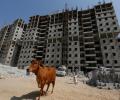
Tata Realty and Infrastructure, a subsidiary of Tata Sons, is looking to expand its business with over 50 projects across major cities in India, Sri Lanka, and the Maldives. The combined projects boast a development potential exceeding 51 million sq ft, according to a top executive. The Mumbai-based real estate major has completed the first phase of project developments in Male (the Maldives), and is gearing up for the second phase. It has also expanded its footprint in Sri Lanka and plans to add about 2 million sq ft. in Colombo.

HDFC Bank's market capitalisation (market cap) touched Rs 13 trillion in Thursday's (December 28, 2023) intra-day trades as the largest private sector lender is set to report its sharpest monthly rally in the past two years. At 10:33 AM; HDFC Bank's market cap stood at Rs 13.03 trillion, the BSE data shows. The stock was up 1 per cent at Rs 1,717.90 in intra-day trades on December 29, inching towards its record high of Rs 1,757.80 touched on July 3, 2023.

New investment projects announced in the manufacturing sector declined in the three months ended June 2023. The value of new projects was lower than in the March quarter, as well as the year-ago period, shows data from project tracker the Centre for Monitoring Indian Economy (CMIE). The new project announcements worth around Rs 85,000 crore in the manufacturing segment in June were a 48 per cent decline from the Rs 1.6 trillion in March and a 66 per cent decline from the Rs 2.5 trillion seen in June 2022.

At Rs 919 crore, InterGlobe Aviation, the parent firm of low-cost airline IndiGo, posted its best-ever fourth quarterly net profit in the January-to-March quarter (Q4) of financial year 2022-23 (FY23). The bottom-line, however, was lower than the Street's expectations where estimates ranged from Rs 1,160 crore to Rs 2,180 crore. On the bourses, shares of IndiGo have added just 30 paise (0.01 per cent) since the announcement of the Q4-FY23 results on May 18.

Hindustan Unilever Ltd on Friday reported a 1.08 per cent increase in consolidated net profit at Rs 2,508 crore in the third quarter ended December 2023. The company had posted a consolidated net profit of Rs 2,481 crore in the same quarter last fiscal, Hindustan Unilever Ltd (HUL) said in a regulatory filing. Its revenue from sales of products was marginally down to Rs 15,259 crore during the quarter.

UltraTech Cement's third quarter of financial year 2023-24 (Q3FY24) performance saw a combination of 6 per cent year-on-year (Y-o-Y) volume growth and 8 per cent revenue growth coupled with better realisations per tonne. The earnings before interest, taxes, depreciation, and amortisation (Ebitda) stood at Rs 3,250 crore and Ebitda per tonne was Rs 1,191. Profit after tax (PAT) was reported at Rs 1,780 crore. Other income dipped and interest costs rose.

Automotive (auto) and auto ancillary stocks have been in the fast lane thus far in 2023-24 (FY24), with the National Stock Exchange Nifty Auto Index surging nearly 27 per cent, outperforming the Nifty50, which has gained roughly 11 per cent during this period. The top-gear performance of auto stocks at the bourses, according to A K Prabhakar, head of research at IDBI Capital, has been triggered by the premiumisation of products across vehicle manufacturers, which has seen vehicle sales remaining relatively stable. "It is not about higher sales figures now, but about premiumisation.

'What will matter in 2024 from the market standpoint is the direction of interest rates globally, as well as in India.' 'The results of the general elections will also be keenly watched.'

The "asset-right" strategy, reiterated by ITC chairman Sanjiv Puri during the company's 112th annual general meeting (AGM) on August 11, received a thumbs up from the analysts. They, however, believe that sustained earnings growth and synergies with the demerged hotel's vertical will help the stock break out from the ongoing consolidation. "The stock is expected to consolidate between Rs 420 and Rs 450 in the near future.

Eicher Motors is a leader in the premium motorcycle segment, where it holds market share of over 85 per cent under the Royal Enfield (RE) brand. The company's joint venture VE Commercial Vehicles (VECV) with Volvo, where it holds 54.5 per cent stake, gives it a strong footing in commercial vehicles (CVs). The company had good results in FY23 and it has a strong balance sheet and good operating margins.

Tata Communications has seen analyst upgrades after reporting Q3FY24 results. The biggest factor is the visible signs of a turnaround in its new acquisition, Kaleyra. The consolidated revenue grew 16 per cent Q-o-Q to Rs 5,630 crore led by 15 per cent Q-o-Q improvement in the data segment.

Titan Company on November 21, became the second Tata group firm to join Rs 3 trillion market capitalisation (market cap) club after its shares hit a new high of Rs 3,400, up nearly 2 per cent on the BSE in Tuesday's intra-day trade. At 12:28 PM; with a market cap of Rs 301,847 crore (Rs 3.02 trillion) Titan stood at number 16th position in overall market cap ranking on the BSE listed companies, the exchange data shows. Titan overtook paint company Asian Paints, which has a market cap of Rs 300,579 crore, data shows.

Among index funds, the most popular products are funds tracking the Nifty 50 and Sensex, says Dwaipayan Bose, and explains the finer points of selecting the right index mutual fund.

In the June quarter of FY24, 51 per cent of consumers who took small-ticket personal loans already had more than four credit products at the time of accessing yet another new loan, compared with just 17 per cent in the June quarter of FY20, points out Tamal Bandyopadhyay.

Rising penetration of trade generic medicines is eating into the value growth of the domestic pharmaceutical market, showed a recent analysis. According to a Kotak Institutional Equities analysis, 70-110 basis points (bps) annual dent is expected from trade generics and Jan Aushadhi on Indian Pharma Market (IPM) growth at least until FY27-28 (see chart). Trade generic medicines are those that are not pushed into the market through doctor promotions.

State Bank of India's earnings growth may turn lacklustre in the near-term, warn analysts. This, they said, could be due to margin compression and likely lower fee income over the next one year. "While the cost of deposits is repricing sharply across the system, there will be relatively lower yield expansion going ahead as most of the back-book has been repriced and there is a high competitive pressure on yields.

Chinese fashion e-commerce platform Shein is expected to make a second entry into India and has tied up with Reliance Retail for this, according to a source in the know. The source said as part of the tie-up, Shein would source goods from India for its global operations. Also, the manufacturing of its products could happen in the country and they could be exported.

SIP top-ups are especially beneficial for young investors, who may start with a small SIP installment and grow it over their working careers, says Dwaipayan Bose.

Shares of Reliance Industries (RIL) traded 2 per cent higher at Rs 2,310.10 on the BSE in intra-day trade in an otherwise volatile market after the company reported a 27.4 per cent year-on-year (YoY) growth in its consolidated net profit at Rs 17,394 crore for the September quarter (Q2FY24). While revenue growth of the company was flattish YoY at Rs 2.32 trillion, the profit rose on the back of operational improvement across most segments, especially higher profits in the O2C (oil-to-chemicals) and oil & gas businesses, as well as the retail business. "Strong operational and financial contribution from all business segments has helped Reliance deliver another quarter of robust growth," said Mukesh Ambani, chairman and managing director of the company.
With the merger between HDFC Bank and HDFC Ltd complete, analysts said the next key monitorable for the Street would be successful resolution of merger-related hiccups, including employee-related churn and roll out of complete banking services across branches. At the bourses, they expect the stock to perform in-line with the benchmark indices in the near-term. "There's usually an initial period of consolidation after a merger as the entities work towards integration.

'However, we have seen weakness in our active pharmaceutical ingredients business.'

An interesting imaginary conversation between Kirtan A Shah and an investor about how investing in mutual funds is better than investing directly in stocks.

While Emami is still struggling to push growth, given weak rural demand, the sale of the group's stake in AMRI Hospitals should ease investor concerns about stake pledges by promoters. It has also carried a series of stake acquisitions which should enable the expansion of its brand portfolio. The Q2 results are likely to see flat volumes and low revenue growth alongside some gross margin expansion.

Crude and gas supply concerns have eased amid reports that Israel and Hamas have struck a peace deal. The International Energy Agency estimates oil demand may drop slightly in calendar 24 but Opec probably has enough pricing power to maintain $80/ barrel Brent prices. Russia's share of India's crude imports remained strong at about 35 per cent in September 2023.

Over the past two decades, India has evolved economically as well as from the market's perspective.

The duty hike on cigarettes by 16 per cent announced in the Union Budget 2023-24 would have a nominal impact of around 7-12 paise per stick across cigarette categories, according to experts. This upward revision in National Calamity Contingent Duty (NCCD) would have negligible impact on smokers and the companies could easily absorb the shock as it may not also have any resultant impact on margins, they said. Finance Minister Nirmala Sitharama in the Union Budget for 2023-24 on Wednesday proposed to revise and increase the duty on cigarettes to about 16 per cent.

India is among the top three emerging markets in the wellness economy.
Target prices around Rs 400 suggest a significant upside.

Avenue Supermarts, the operator of DMart retail chain, reported good results for the July-September quarter (Q2FY24) with strong earnings before interest before interest, taxes and depreciation (Ebitda) and profit before tax (PBT) growth, but lower PAT due to higher tax incidence. The operating margin improved, and like-to-like store sales growth was strong. Average bill value also increased though this may be a seasonal effect to some extent. Analysts are assuming this means the slowdown in retail may have bottomed out.

Dwaipayan Bose on how index funds play a key role in the diversification of portfolios and help manage risks

rediffGURU Ramalingam Kalirajan answers your personal finance queries.
 © 2026 Rediff.com - Advertise with us - Disclaimer - Privacy Policy - Sitemap - Feedback - About us - Terms of use - Grievances