
Banks feel happy shifting their toxic assets from loan books to investment books while the ARCs enjoy the management fees with a smile, observes Tamal Bandyopadhyay.

PSU divestment, LIC IPO, fiscal deficit: Budget 2021 marks a clear change in the Modi government's stance from fiscal conservatism to growth orientation.

But it is disappointing to note that Sitharaman's third Union Budget continues to promote a few problematic ideas, observes A K Bhattacharya.

We will find it difficult to exceed an average of 5 per cent growth in the medium term, warns Shankar Acharya, the former chief economic adviser.

Of the three major Budget announcements related to the banking sector, privatisation of PSBs is the most audacious, says Tamal Bandyopadhyay.

Central bank likely to keep tabs on large wilful defaulters; policy likely by month-end.

Kenneth Rogoff, professor of public policy and economics at the Harvard University, tells Dilasha Seth on the sidelines of the Delhi Economics Conclave that public sector banks will need to take a one-time haircut to address non-performing assets.

The party's research department team, which Rajya Sabha member M V Rajeev Gowda heads, has sifted through the suggestions received in the last five months, and the manifesto is slated to be released later this month, reports Archis Mohan.

While 'staycation' means a holiday spent at home due to straitened financial circumstances, 'brickor mortis' is a period of difficult times in the housing industry, and 'bad bank' refers to a state-owned financial institution created to alleviate a financial crisis. As well as the economic downturn, the trend in social networking has also been recognised.
New Development Bank plans to issue $300-500 mn worth masala bonds in rupee: K V Kamath.
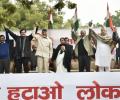
Some of the key proposals of the agenda relate to transforming the banking sector, addressing agrarian distress, countering hate crimes and discrimination, and spurring employment generation.

The Budget would have been the perfect vehicle to introduce some bold initiatives.
That opportunity has been lost through this Budget, observes Shreekant Sambrani.

The McKinsey report said faster employment growth at 12 million non-farm jobs annually is needed in the post-Covid period till 2029-30, up from just four million created each year between 2012 and 2018.

As India emerges from the COVID-19 crisis, the ninth budget under the Modi government, including an interim one, is widely expected to focus on boosting spending on job creation and rural development, generous allocations for development schemes, putting more money in the hands of the average taxpayer and easing rules to attract foreign investments.
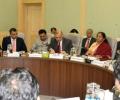
At a pre-Budget meeting, the FM was asked to ensure that NBFCs come out of the liquidity crisis they are facing with the help of RBI. They also spoke about the futility of trying to achieve a 3 per cent fiscal deficit target over the medium term.
'No commercial bank will be allowed to fail. There is nothing to worry about.'

Of the seven surveys presented under Modi govt, predictions of three were quite close to the actual GDP growth rate, one saw the base year change in between, but the last three were way off the mark.

After helping the government in policymaking since October 2014, Chief Economic Adviser Arvind Subramanian is returning to academics and will be teaching at Harvard Kennedy School on a visiting position. In an interview to Dilasha Seth and Somesh Jha, he says the ease of doing business agenda needs to move forward and India must try to integrate with the global value chains. Edited excerpts.
If customers did not see value in what we provide them at the price point at which we provide these, they would not have been there with us in such a competitive market, says HDFC deputy managing director Paresh Sukthankar.

Resolution to the bad loans problem has to be incremental, and the RBI has to ensure NPAs are not swept under the carpet, HDFC chairman Deepak Parekh tells Joydeep Ghosh.

'We have set out a timetable to reduce income tax rates for all incomes below Rs 50 lakh, and to progressively eliminate the surcharges on income above Rs 50 lakh, by 2024.' The Budget speech past CII president Naushad Forbes wants to hear.
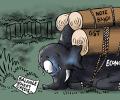
'The current budgetary practice of shifting expenditures off-balance sheet in order to be seen to be meeting fiscal targets should be discontinued; additional fiscal stimulus would be imprudent; individual income tax rates should not be cut; GST rates should not be raised now,' advise Arvind Subramanian and Josh Felman.

Rumours in the bureaucracy on his successor include the names of Sajjid Chinoy of JP Morgan, Rathin Roy of the National Institute of Public Finance and Policy, Neelkanth Mishra of Credit Suisse and the principal economic advisor, Sanjeev Sanyal.

In a soon to be published book, 'Of Counsel: The Challenges of the Modi-Jaitley Economy,' former chief economic advisor Arvind Subramanian says though RBI has a good reputation, it does not mean it's always right, as for years, the RBI was unable to grasp the seriousness of the loan repayment problems or identify the prolonged frauds of Nirav Modi and the likes.

There can't be a parallel inquiry and parallel monitoring by the courts, Attorney General K K Venugopal told the court.

Arvind Subramanian was appointed CEA in October 2014 and got a year's extension in September 2017

'For years, the RBI has been warning banks on probable frauds in bank guarantees and advised them to exercise due care.' 'PSB staffers feel their jobs are secured, hence there is no need to be vigilant and exercise financial prudence.'
'The financial sector will be hit even harder than the overall market.' 'The banking sector will eventually be rescued.' 'But it may go into a long downwards spiral before things turn around.' 'Threat or buying opportunity?' asks Devangshu Datta.

The PAC, headed by Congress lawmaker K V Thomas, is keen to find out the details of huge loans given by the banks to corporates including the basis on which such favours were extended.

The Indian economy was on an impressive growth path through the first decade of this century till it was brought to an abrupt halt by the policy inertia during UPA2 and the Modi government's inability to restore economic and financial momentum. Fascinating glimpses of what went wrong from Puja Mehra's must-read book The Lost Decade: How India's Growth Story Devolved Into Growth Without A Story.
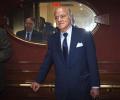
Henry Kravis, co-Chairman and co-CEO of private equity giant Kohlberg Kravis & Roberts (KKR), which has over $195 billion assets under management and a balance sheet of $16 billion visited Mumbai recently for a closed conference where he shared his views on the new governor at RBI, what India needs to fix, and PE's prospects for the long term.

'We need to further catalyse economic growth and the government needs to increase revenue,' says G K Agarwal, BJP's national spokesperson on economic affairs.

Recpaitalising banks through taxpayers' money will not solve the NPA problem.
Mergers to create at most six state banks

Republican presidential frontrunner Donald Trump on Friday came under scathing attack from rivals Ted Cruz and Marco Rubio who blasted the real estate mogul on his immigration stand and for hiring foreigners in his business projects, as the debate turned shriller ahead of the crucial "Super Tuesday".
'The Insolvency and Bankruptcy Code is neither beneficial to banks nor helpful for the borrower.' 'Genuine people who are caught in economic stagnation will lose everything and thousands will lose jobs.'
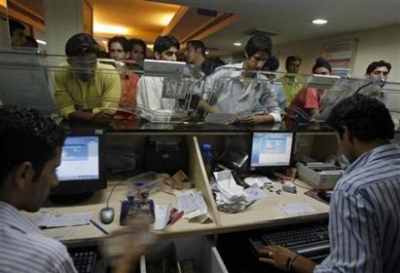
Quarterly results of many of these banks show significant losses.

'Tilting at the Government in English in front of India may make him feel like Joan of Arc, but without a feel for Bharat he will merely be Don Quixote,' says S Muraleedharan, former managing director, BNP Paribas.

India's aggregate NPA as a percentage of GDP is far lower than that in Italy, Greece.
If the Modi government's approach to economic policy making is any indication, expectations of a sudden spurt in economic reforms after the assembly election results appear to be grossly misplaced.
 © 2026 Rediff.com - Investor Information - Advertise with us - Disclaimer - Privacy Policy - Sitemap - Feedback - About us - Terms of use - Grievances