
The target was for banks to sell Rs 2 trillion worth of non-performing assets to NARCL, the so-called 'bad bank, by 2021-2022. Only 10 per cent of this has been executed.

'The concern that the bad bank may create a moral hazard for the system is extremely valid.'

Rogue lending under political influence was rife in the Congress-led regime and is not happening in the Modi regime, certainly not on that scale. But if PSBs cannot lend as indiscriminately as they did last time in the name of 'credit expansion', how well will these banks do, asks Debashis Basu.
Why do we need a bad bank, owned by the banks themselves when there are at least 28 ARCs around, asks Tamal Bandyopadhyay.

The 'bad bank' -- which will help banks clear their balance sheets by transferring the NPAs to special purpose vehicles -- has been one of the most debated ideas for stressed asset resolution.
The Union Cabinet has cleared a proposal to provide Rs 30,600 crore government guarantee for security receipts issued by the National Asset Reconstruction Company (NARCL) as part of resolution of bad loans, Finance Minister Nirmala Sitharaman said on Thursday. The proposed bad bank or NARCL will pay up to 15 per cent of the agreed value for the loans in cash and the remaining 85 per cent would be government-guaranteed security receipts. The government guarantee would be invoked if there is loss against the threshold value.

State-run lenders will take a lead in creation of the bad bank, but the sick asset resolution platform needs the support of private banks and other lenders to be successful, State Bank of India managing director Swaminathan J said on Thursday. If all lenders come on board, the National Asset Reconstruction Company (NARC) announced in the budget will be able to aggregate 100 per cent of a sick company's outstanding loans, which shall ultimately lead to better resolution of the asset quality stress for all. The government is yet to announce the specific contours of the NARC or the bad bank and has also only said that it is willing to provide some sovereign guarantee to help the platform.

'It has remained around 38 per cent over the past four to five quarters.'

FinMin officials say an announcement could be made in the Budget.

All banks are eligible for privatisation. A committee of secretaries will decide which banks will be privatised, says Financial Services Secretary Debasish Panda.

'Let's walk on two legs: Facilitate better resolution under the present system and set up PARA as well by transferring loans amounting to, say, Rs 1 lakh crore.'

Henry Kravis, co-founder of global private equity firm Kohlberg Kravis Roberts & Co, thinks India should go for a bad bank to deal with bad assets in banks. In an interaction with journalists in Delhi, he says there are plenty of opportunities in India. He was joined by India CEO Sanjay Nayar.

Raghuram Rajan said on Friday it is not clear India needs a so-called "bad bank.

Finance Minister Nirmala Sitharaman presented her third Budget on February 1.

Finance Minister Nirmala Sitharaman's Rs 30,600 crore government guarantee for the bad bank has changed the body language of bankers for the better, observes Tamal Bandyopadhyay.

A gradual approach to privatise public sector banks (PSBs) is more ideal than taking a big-bang approach, a study by Reserve Bank of India (RBI) staff has concluded. It has backed the government's idea to privatise two PSBs initially. Such a gradual approach would ensure that large-scale privatisation does not create a void in fulfilling important social objectives of financial inclusion and monetary transmission, the study has argued.

While a DFI will help banks derisk their loan portfolios, creation of a bad bank will clean up their balance sheets.

A paper authored by Rajan said, state-linked banks can be a first step in altering the ownership structure of some PSBs, where the government brings down its stakes to below 50 per cent, creating distance from operations of banks, and improving governance along the way.


Chief Economic Adviser K V Subramanian on Wednesday said India is expected to hit a growth rate of 6.5-7 per cent in 2022-23 and accelerate further to 8 per cent in the subsequent years on the back of reforms undertaken by the government. He also said the government is expected to meet the fiscal deficit target of 6.8 per cent in the current fiscal despite pressure on revenue collections.

The United Forum of Bank Unions (UFBU), an umbrella body of nine unions, on Tuesday gave a call for a two-day strike from March 15 to protest against the proposed privatisation of two state-owned lenders. In the Union Budget presented last week, Finance Minister Nirmala Sitharaman announced the privatisation of two Public Sector Banks (PSBs) as part of its disinvestment plan. The government has already privatised IDBI Bank by selling its majority stake in the lender to LIC in 2019 and merged 14 public sector banks in the last four years.

Move to increase 90-day window to 120 days to give more time to borrowers to service loans.

The Budget, to be presented on February 1, is likely to be less worried about fiscal deficit and will be focused more on nursing the fragile growth, according to a Wall Street brokerage report. Bank of America Securities India expects the budget to peg "fiscal deficit at a high 5 per cent of GDP for FY22 and 7.2 per cent for FY21, as it is likely to step up capex, recap public sector banks, push asset sales to break government monopolies, offer sops for real estate, tax cuts for lower income groups and creation of a bad bank". Its house economists expect these spends to be funded by debt and partly by imposing a cess on high income groups and also by some non-fiscal measures like tapping the central bank's revaluation reserves and bank recapitalisation and infra bonds.

'While we note the very strong cyclical recovery in the economy, we believe there is still uncertainty over medium-term prospects.'

The country's economy will start witnessing a growth of 6.5 to 7 per cent from fiscal 2023 onwards, helped by various reforms undertaken by the government so far and also as COVID-19 vaccination drive progresses, Chief Economic Advisor Krishnamurthy Subramanian said. He said the second wave of COVID-19 is unlikely to have a very significant on the economy. The country's economy contracted by 7.3 per cent in fiscal 2020-21. "Together with the reforms and focus on vaccination, I expect growth to start hitting close 6.5 to 7 per cent from FY23 onwards and accelerate from there on," Subramanian said at a virtual event organised by Dun & Bradstreet.

'What do the moves towards protectionism suggest?' 'That we do not have Aatmavishwas.' 'If you have self-confidence, confidence in your ability to compete with the best in the world, why do you need protectionism?'
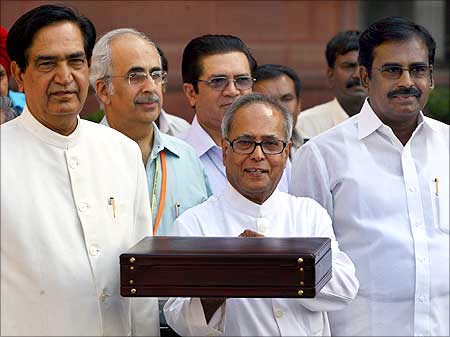
The sad truth is that the debt-to-GDP ratio will shoot up close to 90 per cent in the coming year, and the fiscal deficit glide path does not promise to reduce it substantially any time soon, predicts Mihir S Sharma.

Dhrupadi Ghosh, who works for a magazine in Kolkata, tells Rediff.com's A Ganesh Nadar what she would like to see in Finance Minister Nirmala Sitharaman's Budget.

The country's largest lender SBI on Thursday reported a 4.20 per cent decline in consolidated December quarter net at Rs 6,257.55 crore, largely because of a higher base in the year-ago period where it had benefitted from a Rs 4,500 crore one-off income. On a standalone basis, the city-headquartered lender's net profit came in at Rs 5,196.22 crore as against Rs 5,583.36 crore in the year-ago period and Rs 4,574.16 crore in the preceding September quarter. SBI chairman Dinesh Kumar Khara told reporters that the year-ago period had seen the resolution of the Essar Steel loans, resulting in an over Rs 4,000 crore interest income and Rs 500 crore other income benefit.

The beleaguered Deutsche Bank announced major overhaul of its business, which included discontinuing loss-making equities trading business, creating a new 'bad bank', and cutting 18,000 jobs. Deutsche Equities India employs 35 people, all of whom could face the job axe.

The improved outlook on the Government of India announced by rating agency Moody's might need to be viewed with some scepticism. There is no doubt the performance of the Indian economy has sharply improved from the deep trough it hit last year. But the ability of the second largest global ratings agency to assess an upside and downside before events make everyone wise about India has been dismal for a long time, as the chart shows.

Reserve Bank of India Governor Raghuram Rajan had said recently that there was "no need" to set up a separate bad bank to deal with stressed assets of public sector lenders.
Retaining the GST rate assumes importance since states are under pressure to increase their revenues, hit hard by lockdown. Also, the Centre has not fully compensated states for their revenue losses on account of GST for 2019-20.

Expect a more modest out-turn of around 5 per cent (if not less) because of the longer-term scarring effects of the Covid shock, the sharply slowing growth in the pre-Covid years and some scepticism about the growth-efficacy of some of recent official policy initiatives, explains Shankar Acharya, former chief economic advisor to the government.

New-generation private sector banks such as ICICI, HDFC, Axis, Kotak etcetera owe their existence to the recommendations of the first Narasimham Committee.

sharper-than-expected economic recovery back home, analysts say, can fuel a further rally in domestic cyclicals, industrials, and financials as global central banks continue with their easy money policy.

Bank of America (BofA) Securities expects India to be the third-largest economy in the world by 2031. The economic rise could become a reality by 2028, but the Covid pandemic delayed the pace, BofA Securities economists Indranil Sen Gupta and Aastha Gudwani wrote in a report.

Fitch Ratings on Wednesday said India's high fiscal deficit would pose a challenge in lowering the debt to GDP ratio, which is expected to rise above 90 per cent in the next five years. It said India entered the pandemic with little fiscal headroom from a rating perspective. Its general government debt/GDP ratio stood at 72 per cent in 2019, against a median of 42 per cent for 'BBB' rated peers.

The only feasible way to have a healthy banking sector could be making it mostly private, along with two or three large, better-run government banks, suggests T N Ninan.
'By not letting bankrupt banks fail, we have discouraged ordinary folk from taking precautions while choosing their bank or at least when they hear bad news about their bank,'says S Muralidharan, former MD, BNP Paribas.
 © 2026 Rediff.com - Investor Information - Advertise with us - Disclaimer - Privacy Policy - Sitemap - Feedback - About us - Terms of use - Grievances