
The court said it was conscious of the fact that framing of the scheme and its implementation were in the government's domain who are the best experts in such matters.

On October 23, the top court said people in the country can only burst firecrackers from 8 pm to 10 pm on Diwali and other festivals. It also allowed the manufacture and sale of just "green crackers" which have low emission of light, sound and harmful chemicals. The apex court carved out an exception for Christmas and the New Year's Eve, saying crackers on these days could be burst between 11.55 pm and 12.30 am since the celebrations start at midnight.
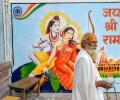
The apex court, which delivered a historic verdict and put the curtains down on the vexatious legal battle that had torn the social fabric of the nation, said that dividing the land would not subserve the interest of either of the parties or secure a lasting sense of peace and tranquillity.

The Supreme Court on Tuesday asked the worst Covid-19 affected state of Maharashtra to be more vigilant and make concerted efforts in identifying and sending the migrant workers still stranded there to their native places. The top court, which directed all states and Union territories to transport all stranded workers by train, bus or other modes within 15 days, said there were "huge lapses" by the Maharashtra authorities in dealing with the issue and asked the government there to announce a suitable place for their registration.

A curative petition is the last and final judicial remedy available to a person convicted by courts of law.
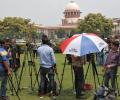
A nine-judge Constitution bench headed by Chief Justice S A Bobde at the outset said that it will only deal with the issues referred to it by a five-judge bench on November 14 in the Sabarimala case, and asked the lawyers to convene a meeting on January 17 to decide on 're-framing' or adding additional issues to be deliberated upon by it.
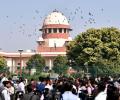
18 review pleas were filed against the November 9 verdict of the apex court. The SC found 'no ground to entertain' any of them.

The top court said the old practices of "human sacrifices" and 'sati' amounted to murder under law and could not be saved on ground of "essential religious practice".

Sharma, one of the four convicts on death row in the 2012 case, has also sought commutation of his death sentence to life imprisonment claiming that he has "developed mental illness" inside the prison due to the alleged "torture and ill-treatment".

The top court said the private hospitals including laboratories have an important role to play in containing the scale of the pandemic by extending philanthropic services in the hour of national crisis.

The judge passed the order on the plea by the convicts seeking adjournment of the executions 'sine die'. The four were scheduled to be hanged on February 1 at 6 am. This is for the second time that the execution of the death warrants has been deferred.

The bench said all relevant material including judgments pronounced by trial court, high court and Supreme Court were placed before the President when he was considering the mercy plea of convict Mukesh Kumar Singh.
There is no word on extending the February 6, 2018 deadline for linking mobile SIM cards with Aadhaar.
As the last-ditch attempt, Mukesh through his counsel on Tuesday sought an urgent hearing on his plea against dismissal of the mercy plea before the top court.
highlights of the Supreme Court judgment in which it unanimously granted the entire 2.77 acre of the disputed Ram Janambhoomi-Babri masjid land in Ayodhya to deity Ram Lalla.

The court then asked Prasaran if question of this nature about birth of a religious figure has ever arisen in any court.

Justice Ranjan Gogoi, who will demit office as the Chief Justice of India in a week's time, has etched his name in the annals of history by giving finality to one of the most politically and religiously sensitive cases, the Ayodhya land dispute, which dates back to even before the Supreme Court came into existence in 1950.

The apex court said the parties in the matter should be ready to start the hearing on the appeals which are before it.
However, the SC allowed him to retain his official bungalow.

The execution of death warrants of these convicts have been deferred thrice so far due to delays by them in exhausting their legal remedies.

Calcutta high court judge C S Karnan, evading arrest since May 9, on Wednesday failed to get relief from the Supreme Court, which refused to hear his plea seeking a stay on its order awarding him a six-month jail term for contempt of court.

The bench said that there are reports coming that many areas doctors are not being paid. "We saw report that doctors went on strike. In Delhi, some doctors have not been paid for past three months. These are concerns that should have been taken care off. It should not require court intervention."

A bench of Justices Ashok Bhushan, R S Reddy and M R Shah said if any State/Union Territory in exercise of their jurisdiction under the Disaster Management Act (DMA) has taken a decision that it is not possible to conduct the final year/terminal semester examination by September 30, then they can make an application to the UGC for extending the deadline.

The SC also said that if parties to the case want to amicably resolve the matter through mediation, they can still go ahead with it.

A five-judge Constitution Bench headed by Chief Justice Ranjan Gogoi said that even if one per cent chance of mediation exists in the politically sensitive land dispute matter, it should be done.

The apex court, which passed interim directions, said all migrant workers who are stranded at various places shall be provided food by concerned states and Union Territories (UTs) at places which shall be publicised and notified to them for the period they are waiting for their turn to board a train or a bus.

He claimed the people of Delhi were facing "injustice and humiliation" since independence because the government elected by them lacked power to work for them.

The apex court had on August 1 upheld the clean chit given by the high court and the trial court to the BJP president in the encounter case and rejected the plea for its revival.

The Supreme Court directed that the voting in the assembly will not be on the basis of secret ballot and the entire proceeding will have to be telecast live.

The fourth convict, Pawan Gupta, has not filed a curative petition, which he still can if he chooses.
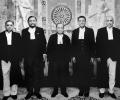
The Ayodhya verdict heralds not the beginning of theocracy or Hindu rashtra (that never existed in 5,000 years), but marks the end of a divisive phase of our history.

The Waqf Board has sought time from the top court for setting up of a committee for exploring an amicable resolution of the vexatious issue.
A 5-judge Constitution Bench headed by Chief Justice Ranjan Gogoi, in its historic verdict delivered on a court holiday, held that the lawsuit of the deity was "within the period of limitation" and granted the title decree in its favour.
The counsel appearing for both the Hindu and Muslim parties expressed confidence over the ongoing mediation proceedings and said they are fully cooperating with the process.

The plea, filed by advocate Manohar Lal Sharma, termed the notification "illegal, unconstitutional and ultra vires to the law".

One of the most important cases which have political implications is the Ayodhya land dispute case.

The petitioner contended that the provisions in the notification were unconstitutional.

None of the four judges -- Justices J Chelameswar, Ranjan Gogoi, M B Lokur and Kurian Joseph -- feature in the list of members of the 5-judge constitution bench.
The bench said after perusing the report, if it came to a conclusion that an amicable solution through mediation was not possible, then the apex court would commence day-to-day hearing in the matter from July 25.

The Gandhis and senior Congress leader Oscar Fernandes have challenged the Delhi high court's September 10 verdict by which their plea against the re-opening of their tax assessments for 2011-12 was dismissed.
 © 2026 Rediff.com - Investor Information - Advertise with us - Disclaimer - Privacy Policy - Sitemap - Feedback - About us - Terms of use - Grievances