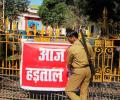
Banking operations at public sector banks across the country were impacted on Tuesday as the United Forum of Bank Unions (UFBU) went on nationwide strike demanding the immediate implementation of a five-day work week.
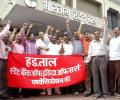
The United Forum of Bank Unions (UFBU) on Thursday said its two-day nationwide strike on March 24 and 25 will be observed as scheduled since discussions with the Indian Banks' Association (IBA) over key demands failed to yield any positive outcome. In a meeting with the IBA, all UFBU constituents raised issues, including recruitment in all cadres and a five-day workweek.

At a time when the finance ministry is focusing on addressing employee grievances, the number of employees in most public-sector banks (PSBs) has declined over the last three financial years.
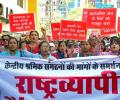
Bank unions on Friday deferred their two-day nationwide strike beginning Monday after they received positive assurance from both the finance ministry and the IBA on their demands, including a five-day work week and adequate recruitment in all cadres. The strike call for March 24 and 25 was given by United Forum of Bank Unions (UFBU), an umbrella organisation of nine bank employees' association.
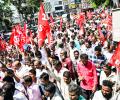
A nationwide strike called by trade unions to protest against the central government's labor policies had a mixed impact across India. While normal life remained largely unaffected in most parts of the country, some sectors like banking, transport, and insurance experienced disruptions. Sporadic incidents of violence were reported in West Bengal.
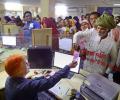
Union Finance Minister Nirmala Sitharaman will review the performance of regional rural banks (RRBs) after the Budget session of Parliament, according to two people familiar with the matter. The finance minister will review the performance of RRBs after August 13. The review will include discussions on enhancing the digital capabilities of RRBs, said a senior government official.

The United Forum of Bank Unions (UFBU), an umbrella body of nine unions, has given a call for a two-day strike from December 16 to protest against the proposed privatisation of two state-owned lenders. In the Union Budget presented in February, Finance Minister Nirmala Sitharaman had announced the privatisation of two public sector banks (PSBs) as part of its disinvestment plan. The government has already privatised IDBI Bank by selling its majority stake in the lender to LIC in 2019 and merged 14 public sector banks in the past four years.
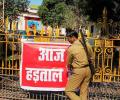
Services such as deposits and withdrawal at branches, cheque clearance and loan approvals would be affected due to the strike.
United Forum of Bank Unions (UFBU), an umbrella body of nine unions, has given a call for a two-day strike from March 15 to protest against the proposed privatisation of two state-owned lenders. In the Union Budget presented last month, Finance Minister Nirmala Sitharaman had announced the privatisation of two public sector banks (PSBs) as part of its disinvestment plan. The government has already privatised IDBI Bank by selling its majority stake in the lender to LIC in 2019 and merged 14 public sector banks in the last four years.
The United Forum of Bank Unions (UFBU), an umbrella body of nine unions, on Tuesday gave a call for a two-day strike from March 15 to protest against the proposed privatisation of two state-owned lenders. In the Union Budget presented last week, Finance Minister Nirmala Sitharaman announced the privatisation of two Public Sector Banks (PSBs) as part of its disinvestment plan. The government has already privatised IDBI Bank by selling its majority stake in the lender to LIC in 2019 and merged 14 public sector banks in the last four years.
Operations of public sector banks (PSBs) may be impacted as bank union AIBEA has given a strike call for Saturday to oppose incessant outsourcing of jobs. Although the officers are not part of the strike, there may be some impact on cash deposit and withdrawal, clearing of cheques etc. Several banks, including Bank of Baroda and Punjab & Sind Bank, have already informed their customers about the potential impact on services if November 19 strike materalises.

Lakhs of employees of public sector banks continued their strike on the second day on Friday as well to protest against proposed privatisation of banks by the government impacting normal operation across the country. Shutters of branches across many parts of the country on Friday were down following the strike call given by the United Forum of Bank Union (UFBU), an umbrella body of nine bank unions including All India Bank Officers' Confederation (AIBOC), All India Bank Employees Association (AIBEA) and National Organisation of Bank Workers (NOBW). As a result, services such as deposits and withdrawal at branches, cheque clearance and loan approvals remains paralaysed due to the two-day strike ending later in the day.

Bank unions said they will not participate in the 'Bharat Bandh' on Tuesday, even as they expressed solidarity with farmers protesting against the new farm laws. Farmer groups, camping at various Delhi border points for over a week, have called for a nationwide shutdown on Tuesday to protest against three recently enacted agriculture-related legislations.
Banking operations across the country may be impacted on Thursday as some bank unions would be joining the one-day nationwide strike called by central trade unions. Ten central trade unions, except Bharatiya Mazdoor Sangh, will observe the nationwide general strike to protest against various policies of the central government. Many lenders, including IDBI Bank and Bank of Maharashtra, in regulatory filings on Wednesday said their normal working could be affected at the branches and offices.

Employees of public sector banks (PSBs) on Thursday went on two-day strike against the move to privatise public sector banks impacting normal banking operation across the country. Many branches across different parts of the country were shut as the United Forum of Bank Union (UFBU), an umbrella body of nine bank unions including All India Bank Officers' Confederation (AIBOC), All India Bank Employees Association (AIBEA) and National Organisation of Bank Workers (NOBW) had given two day strike call. As a result, services such as deposits and withdrawal at branches, cheque clearance and loan approvals might be affected due to the strike. But ATMs are expected to function as usual.
Some of the services like cash deposit and withdrawal at the counter and cheque clearances have been impacted due to the strike by banking staff.
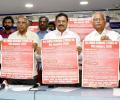
Most of the lenders had informed their customers in advance about the strike call given by All India Bank Employees Association (AIBEA), All India Bank Officers' Association (AIBOA), BEFI, INBEF, INBOC and Bank Karmachari Sena Mahasangh (BKSM), and its impact on banking services.

RBL Bank's interim chief executive officer (CEO) and managing director (MD) Rajeev Ahuja on Sunday tried to allay concerns around the health of the bank. He said events during the weekend are not linked to RBL's asset quality. The bank said Vishwavir Ahuja, its managing director (MD) and chief executive officer (CEO), had on Saturday proceeded on leave with immediate effect on medical grounds.

Employees of public sector general insurance (PSGI) companies are observing nationwide one-day strike on Wednesday to protest against intended privatisation of state-owned insurers. The Joint Front of Trade Unions in PSGI companies met on Monday and decided to protest against the decision of the government to privatise PSGI companies. The unions have given a call for one-day strike against the passage of the General Insurance Business (Nationalisation) Amendment Bill 2021 in the Lok Sabha, General Insurance Employees All India Association general secretary K Govindan said. Employees of all four PSGI companies are participating in the day-long strike, he said.

All India Bank Employees' Association (AIBEA) has announced a list of top 50 loan defaulters, mainly the corporate firms, whose total default amount to the banks is allegedly to be around Rs 40,528 crore.

Employees of four bank unions participating in strike are from All India Bank Employees Association, Bank Employees Federation of India, All India Bank Officers' Association and National Union of Bank Employees.

The All India Bank Employees' Association (AIBEA), which represents the employees of the public-sector banks, has threatened to go on a two-day strike from August 22, against the government's proposed Banking Bill, closure of rural branches and other set of banking sector reforms.

A bank employee from Rajasthan was shot dead on Thursday by terrorists in Kulgam district of Jammu and Kashmir, officials said.

The All India Bank Employees Association, Bank Employees Federation of India, All India Bank Officers' Association and National Union of Bank Employees have given a call for one day country-wide strike.

The All-India Bank Employees Association on Friday said the proposed two-day national strike on July 25-26 has been deferred after a meeting with Indian Banks Association (IBA) and the labour commissioner in Mumbai.

A joint forum of central trade unions has given a call for a nationwide strike on March 28 and 29 to protest against the government policies affecting workers, farmers, and people.
Unions claimed that about 10 lakh staff and officers of public sector banks and some private sector banks are participating in the strike.

The finance ministry on Friday asked state governments to accord priority to employees of banks and insurance companies for Covid-19 vaccination, saying they are exposed to high risks during these difficult times.

The strike notices were given by workers' unions of various sectors such as coal, steel, oil, telecom, postal, income tax, copper, banks and insurance.

Bank employees are planning to go on strike on December 16 during the Parliament Session against banking sector reforms such as privatisation of public sector banks (PSBs) and closure and merger of associate banks/other PSBs with State Bank of India.

The unions have also threatened to explore an indefinite strike option, if their demands were not addressed.
The All India Bank Employees Association (AIBEA) has threatened to go on a nationwide strike on August 20.
The association had earlier called for a strike on July 3 to oppose the merger plans of the subsidiary banks with the parent SBI. AIBEA General Secretary C H Venkatachalam said though the government authorities and the bank managements deny any policy decisions or guidelines in this regard, there had been overt and covert attempts to merge the banks.
AIBEA General Secretary C H Venkatachalam said the SBI management has made it clear it would expedite the merger process. The association had chalked out the strike plan in view of this immediate threat, Venkatachalam added. The merger of the banks would lead to the closure of a large number of bank branches, thereby curtailing banking services for the masses. The closure of branches would also jeopardise the jobs of bank employees, he said.
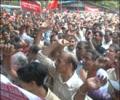
Normal banking operations were affected on Wednesday as the Left-leaning bank employees went on a one-day nation-wide strike to protest the proposed merger of the State Bank of Indore with its parent SBI.

Banking services across the country were hit on Wednesday by the day-long strike by 10 central trade unions and 14 bank unions, but workers of largest lender SBI and a few other banks stayed off the agitation.
The United Forum of Bank Unions, a body of nine bank unions, has announced a nationwide strike on September 12, after recent talks with the chief labour commissioner over the implementation of a memorandum of understanding failed.
However, the likely impact of strike may not be much excluding few areas, said SBI.
Banking operations across the country were affected on Friday as over six lakh employees went on a day-long token strike to protest Reserve Bank's decision to outsource banking activities to external agencies.
'What the RBI is doing is trying to catch the mouse when they have to catch the tiger.'
 © 2026 Rediff.com - Advertise with us - Disclaimer - Privacy Policy - Sitemap - Feedback - About us - Terms of use - Grievances