
Dr Sneha Tirpude, a pulmonologist at Pune's Ruby Hall Clinic, suggests simple measures to protect your lungs when the air quality is poor.

The air quality in the national capital remained poor for the sixth consecutive day on Monday with stubble burning accounting for seven per cent of the capital's PM2.5 pollution.

Green think tank Centre for Science and Environment (CSE) said the ongoing smog episode is a public health emergency.

The overall Air Quality Index was recorded at 231 on Sunday which falls in 'poor' category.

Delhi's air quality improved for the second consecutive day on Thursday, with the Air Quality Index (AQI) recorded in the "moderate" category at 165. This marks a significant improvement from the "poor" category recorded on Tuesday. Several restrictions imposed under Stage 4 of the Graded Response Action Plan (GRAP) were lifted, but some restrictions under Stage 2 remain in place. The Decision Support System (DSS) has not been updated since Friday, with technical difficulties hindering the update of data for the last six days.

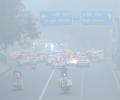
The smog reduced the visibility to merely 300 meters in the morning affecting traffic, an official of the India Meteorological Department said.
Curbs under Stage III include a ban on non-essential construction and demolition, closure of stone crushers and mining activities in Delhi-National Capital Region (NCR).

The Central Pollution Control Board on Monday reviewed the air quality in Delhi-NCR observing that the contribution of stubble burning may rise in the next five days with the AQI fluctuating between 'very poor' and 'severe' categories.

Data from the ministry of environment, forest and climate change reveals that 30 cities recorded an increase in PM10 levels compared to 2017-18 (FY18), indicating deteriorating air quality.

Glimpses from Agra, New Delhi, Gurugram, Kolkata and Mumbai.
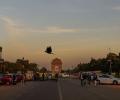
At 9 am on Monday, the air quality index (AQI) in the national capital stood at 207 against an AQI of 254 at the same time on Sunday.

The Indian government has announced staggered working hours for its employees in Delhi due to the severe air pollution in the city. The move comes after a week of 'severe' pollution levels, which have slightly improved but are still in the 'very poor' zone. The order also encourages employees to pool vehicles and use public transport to minimize vehicular pollution.

Experts said while meteorological conditions were "moderately" favourable for dispersion of pollutants, a "very high" number of farm fires in Punjab was the primary reason for "severe" air quality.

Delhi's overall air quality index (AQI) stood at 463 at 11.30 am, according to the System of Air Quality and Weather Forecasting and Research (SAFAR).

Delhi's air quality was again in the severe category with the 24-hour average AQI recorded at 403 after remaining in the 'very poor' category till Tuesday morning, when the AQI was recorded at 396.

A thin layer of toxic haze hung over Delhi in the morning and the overall air quality index stood at 313 at 9 am. It continued its upward trend and was recorded at 337 at 1 pm.

Delhi's air quality deteriorated significantly on Monday, with areas like Dwarka, Mundka and Najafgarh recording an AQI of 500, the worst this season. The city's overall AQI reached 491, triggering the implementation of the Graded Response Action Plan (GRAP) Stage-IV restrictions in Delhi-NCR. Doctors warned of health risks, urging people to wear N95 masks and avoid outdoor activities. The Supreme Court questioned the Delhi government on its anti-pollution measures and warned against scaling down preventive measures without its permission. Delhi Chief Minister Atishi accused the BJP-led central government of political maneuvering while neglecting stubble burning in states it governs. Meanwhile, the city enforced stricter pollution control measures, including a ban on truck entry and suspension of construction activities. Air purifier sales surged, reflecting the public's concern over the severe air pollution.

Tourists at the Taj Mahal found themselves taking selfies with the iconic monument barely visible in the fog.
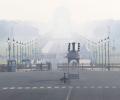
Toxic grey smog has sickened tens of thousands of people, mainly children and elderly people, since last month when the air quality started worsening in Lahore, the city bordering India.

Some residents have already taken this step to relocate, either temporarily or permanently, some to their native places and others to clean-air destinations like Goa and Himachal Pradesh.
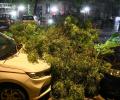
A strong dust storm and gusty winds followed by rain hit Delhi-NCR on Friday evening, causing trees to be uprooted in several parts and leading to traffic congestion. Thunderstorms caused power disruptions in several parts of the city, primarily due to trees and branches falling on electricity cables. The India Meteorological Department (IMD) has issued an orange alert, recommending people stay indoors and avoid unnecessary travel.

According to the Central Pollution Control Board (CPCB), the 24-hour average concentration of lung-damaging fine particles known as PM2.5 in Delhi-NCR shot up from 243 micrograms per cubic metre at 6 pm on Thursday (Diwali day) to 410 micrograms per cubic metre at 9 am on Friday, around seven times the safe limit of 60 micrograms per cubic metre.

Areas in the National Capital Region -- Noida and Gurugram -- recorded an AQI of 529 and 478 respectively both in the highly toxic 'severe'.
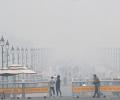
The SC questioned the Delhi government over delay in implementation of stricter anti-pollution measures under GRAP-4, and said it will not allow scaling down of the preventive measures without its prior permission.
The city's overall air quality index stood at 306 on Friday.

Dense fog enveloped Delhi for a second consecutive morning, leading to disruptions in air and rail traffic. Visibility dropped to zero in several areas, causing delays for 81 trains and diversions for 15 flights. The Met office attributed the fog to calm surface winds, and predicted continued dense to very dense fog throughout the day. Meanwhile, the national capital's air quality remained in the 'very poor' category, with an AQI reading of 380 at 9 am.

Air quality index (AQI) soared past 350 level in parts of Delhi on Thursday and experts cautioned that as weather turns colder it may breach the 400-mark ceiling and enter the 'severe' zone soon, notwithstanding the incidents of stubble burnings which have nosedived from 17,529 in 2020 to 4,262 this year.
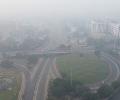
An AQI of 400 or higher is deemed 'severe' and it can have an adverse effect on both healthy individuals and people who already have medical conditions.

The overall air quality index was recorded at 426 which falls in the 'severe' category, according to data by the Central Pollution Control Board.

The air quality had turned 'severe' on Saturday evening with stubble burning accounting for 32 per cent of Delhi's PM2.5 pollution, but firecracker emissions and calm winds made the situation even worse.
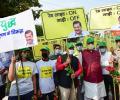
According to the Central Pollution Control Board's mobile application SAMEER, the city recorded an air quality index of 168, which falls in the 'moderate' category, much better than Monday's AQI of 221, which falls in the 'poor' category.
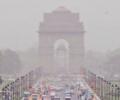
Rediff Labs has analysed Delhi region's air quality through its product real-time air quality analyser

Delhi recorded an air quality index of 315 at 11:10 am. The last time the air quality hit such a poor level was in February.

According to SAFAR, both stubble burning in surrounding states of Delhi and firecrackers are causing deterioration of air quality in the national capital.

On Thursday, the overall AQI in Delhi was 312 around 8:30 in the morning.
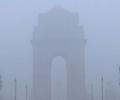
The India Meteorological Department (IMD) reported that very dense fog began forming around 5.30 am, resulting in a thick haze over different parts of the national capital.

The central government's Air Quality Early Warning System for Delhi said a significant increase in the number of "fire points" was observed over Punjab (around 3,000), Haryana and Uttar Pradesh on Wednesday, which is likely to impact the air quality of Delhi-NCR and other parts of northwest India.

Pollution levels were inching towards 'severe plus emergency' category due to a change in wind direction and rampant stubble burning in neighbouring states

Harry Brook, the English middle-order batter, faced criticism after being dismissed by Varun Chakravarthy for the second consecutive time in the ongoing T20I series against India.

In view of an 'improvement' in the air quality, the Delhi government has decided to resume physical classes in schools, colleges and other educational institutions and reopen government offices from November 29, environment minister Gopal Rai said on Wednesday.
 © 2026 Rediff.com - Investor Information - Advertise with us - Disclaimer - Privacy Policy - Sitemap - Feedback - About us - Terms of use - Grievances