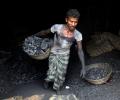
The production of eight infrastructure sectors rose by 7.5 per cent in October on healthy performance by the segments of coal, natural gas, refinery products and cement, official data released on Tuesday showed. The output of eight core sectors of coal, crude oil, natural gas, refinery products, fertilisers, steel, cement and electricity had contracted by 0.5 per cent in October 2020, according to the data released by the commerce and industry ministry. Core sectors' growth stood at 4.5 per cent in September this year.

The Delhi high court has permitted Bollywood actress Jacqueline Fernandez, against whom a lookout notice was issued by the Enforcement Directorate in connection with an alleged money laundering case, to travel abroad for IIFA awards subject to certain conditions.

Bollywood's adorable star kids celebrate Ganesh Chaturthi with their famous parents and make lovely pictures.

A summary of Friday's action in the Ranji Trophy matches across the country.

Malaika Arora invited her friends to celebrate her 46th birthday, and what a turnout it was!
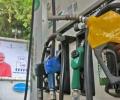
This may come as a surprise to many. Retail price inflation in petrol was the lowest at 10.21 per cent in March since November 2020. In diesel, it scraped the bottom of the barrel at 5.19 per cent in the last month of 2021-22 since February 2020. Even liquefied petroleum gas (LPG) was at a nine-month low of 9.97 per cent in the month.
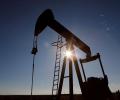
The wholesale price-based inflation spiked to 12.54 per cent in October, mainly due to rise in prices of manufactured products and crude petroleum. WPI inflation has remained in double digit for the seventh consecutive month beginning April. Inflation in September this year was at 10.66 per cent, while in October 2020 it was at 1.31 per cent.

West Bengal chief minister Mamata Banerjee and Trinamool Congress general secretary Abhishek Banerjee are among the star campaigners of the party for the October 30 bypolls to four Assembly seats in the state, but interestingly, the names of actor-turned-MP Nusrat Jahan and former BJP leader Babul Supriyo, who recently joined the TMC camp do not feature in the list.


In Maharashtra, Bhagat Singh Koshyari has done pretty much as he liked, observes Aditi Phadnis.


Arjun Rampal has a surprise visitor... What's Randeep Hooda doing in the Chambal?

With red carpets a no-go and limited traveling, it's the fresh-faced selfies that are gathering most notice.

Today, a friendship forged by common ideals behind prison walls has become a transactional understanding, notes Aditi Phadnis.

Kangana Ranaut graced the ramp with Aditi Rao Hydari for designer Gaurav Gupta at Blender's Pride Fashion Tour in Hyderabad.

The charge sheet also claimed Fernandez consciously chose to overlook Chandrashekhar's criminal past and continued to indulge in financial transactions with him and both were working in collusion.

Maharashtra Deputy Chief Minister Ajit Pawar and various other state ministers sat on a dharna in Mumbai on Thursday to protest against the arrest of their cabinet colleague Nawab Malik by the Enforcement Directorate in a money laundering case.

A recipe to celebrate the wonderful sourdough.

Bollywood's trendy beauties are happy to sport extra long danglers.

Only 80.6 per cent of the Rs 6-trillion allocation has been spent by February, data from the Controller General of Accounts shows.

Diwali fashion is taking a new meaning this year.
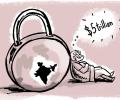
The wait for India to become a $5-trillion economic powerhouse by 2024-25 (FY25) is going to take longer than what the finance ministry had originally intended, according to the International Monetary Fund (IMF). The vision will instead be achieved in 2028-29 (FY29), reveals the IMF data, illustrating a four-year delay. Chief Economic Advisor (CEA) V Anantha Nageswaran had in February said India would become a $5-trillion economy by 2025-26 or the following year, on the back of 8-9 per cent sustained growth rate in real gross domestic product (GDP). However, the IMF data conveys that the economy will be $4.92 trillion in FY28, clearly alluding to the fact that the target will be realised in FY29.
 © 2026 Rediff.com - Advertise with us - Disclaimer - Privacy Policy - Sitemap - Feedback - About us - Terms of use - Grievances