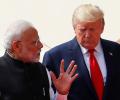
Delhi's appeasement strategy may now translate as more mega arms deals with the US, generating substantial business and job creation in the American economy. Make no mistake, Americans will use it to pressure India, predicts Ambassador M K Bhadrakumar.
'Trump is likely being purposefully vague, hoping that this lack of clarity will pressure India, fearing the worst, to agree to scale back its imports of Russian oil.'

India's new Test captain Shubman Gill will drop down one spot in the order to take Virat Kohli's old position at number four

Unveiling his launch day playlist, the Indian pilot revealed that he loves to listen to Shah Rukh Khan's Swades song Yuh Hi Chala Chal.

Equity investors would track global market trends, inflation data and trading activity of foreign investors for further cues this week, analysts said. Moreover, progress of monsoon and developments related to trade talks would also be monitored by investors, experts noted.
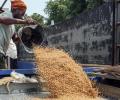
Very sensitive items -- such as apples, which carry political weight and are closely tied to farmer interests in states like Himachal Pradesh and Uttarakhand -- may face restricted concessions.
"For instance, you generally buy your military gear from Russia. That's a way to kind of get under the skin of America, if you go to buy your armaments from Russia."

The mission was originally scheduled for lift-off on May 29 but was put off multiple times when engineers detected a liquid oxygen leak in the boosters of the Falcon-9 rocket and NASA also detected leaks in the ageing Russian module of the ISS.

The United States offers an "abundance" of stability and transparency, which makes the world's largest economy an attractive investment destination for the Aditya Birla Group, a top official from the Indian conglomerate has said. Kumar Mangalam Birla said the group chaired by him has invested $15 billion in the US over the last 17 years, making it the biggest Indian investor in the country.

'Trump's sons, and the son of Trump's Mideast envoy Steven Witkoff, are in the crypto business and recently signed deals with Pakistan's crypto council.' 'It may not be coincidental that not long before the Trump-Munir meeting, the head of Pakistan's crypto council met with Trump's White House crypto policy czar.'

With the regulatory approval from the US Department of Energy in its kitty, Indian multinational conglomerate L&T is planning to focus on manufacturing small modular reactors (SMRs) to play a leading role in the commercialisation of nuclear energy in India.

'This incident offers ammunition to those inside the US government and elsewhere who question the wisdom of trusting India, so it will have a lasting consequence no matter how it is managed.'
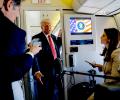
Two 'very smart' leaders of India and Pakistan decided to end last month's conflict that could have turned into a nuclear war, United States President Donald Trump said after holding a rare luncheon meeting with Pakistan army chief Field Marshal Asim Munir at the White House.
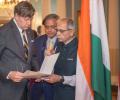
A statement issued by State Department Spokesperson Tammy Bruce said Landau "reaffirmed the United States' strong support of India in the fight against terrorism and the strategic partnership between the two countries".
Secretary of Commerce Howard Lutnick has said one should expect a trade deal between India and the US in the "not-too-distant future" as the two countries have found a place that works for them. "So the idea is when they put the right person and India put the right person on the other side of the table, and we've managed, I think, to be in a very, very good place," Lutnick said in his keynote address at the eighth edition of the US-India Strategic Partnership Forum (USISPF) Leadership Summit in Washington on Monday.

External Affairs Minister S Jaishankar has said the recent confrontation between India and Pakistan was not just a mere conflict between two neighbours, but it was about combating terrorism, which will eventually come back to haunt the West.

Movement in the equity market this week will be guided by a host of macroeconomic data announcements, global trends and trading activity of foreign investors, analysts said. Stocks markets concluded the last week on a subdued note, as investors grappled with global uncertainties.

Foreign investors continue to show confidence in the country's equity market, infusing Rs 14,167 crore so far this month, largely driven by favourable global cues and robust domestic fundamentals. Notably, this inflow has come despite the ongoing military tensions between India and Pakistan.
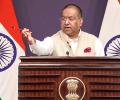
External affairs ministry spokesperson Randhir Jaiswal said India will keep the IWT in abeyance until Pakistan "credibly and irrevocably" abjures its support for cross-border terrorism.

US Vice President JD Vance described the evolving US-India relationship as a family-like bond that transcends diplomacy, highlighting how his children have become fond of Prime Minister Narendra Modi during their trip to India. Vance shared a heartfelt account of his family's experience, revealing the significance of personal connections in strengthening bilateral ties. He said his three kids have developed rapport with both President Donald Trump and Modi, with Modi's warm reception and gestures impressing the family. Vance also spoke about the hospitality he received from Modi, including a dinner at his residence, and his wife Usha Vance's surprising celebrity status in India.
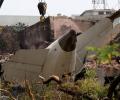
'A few answers for the reason of the crash will be known -- whether it was a technical fault, design issue, human error etc.'
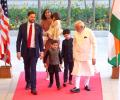
'When we were able to visit his home, they just sort of ran up. They were hugging him.' 'He was just incredibly kind and generous to them.'

Tata Motors, State Bank of India, UltraTech Cement, Tata Consultancy Services, Tata Steel and Asian Paints were among the other laggards from the 30-share pack. Maruti, Bharti Airtel, Power Grid, Hindustan Unilever and HDFC Bank were among the gainers.
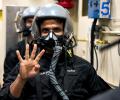
'You can imagine for India what Shuks means not just to the billions of people in India but the entire Indian diaspora around the world.'

US Vice President J D Vance visited Jaipur, India, as part of his trip to the country. He met with Prime Minister Narendra Modi in Delhi and discussed strengthening US-India cooperation in areas such as defense, energy, and technology. In Jaipur, Vance is scheduled to deliver a lecture on US-India relations and visit the Amber Fort, a UNESCO World Heritage site. The visit is a testament to the strong bilateral relationship between the two nations.
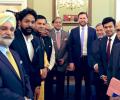
The reality is that far from being friendless, India is better positioned in the world than at any point post-Cold War, asserts Shekhar Gupta.

From the Sensex firms, Eternal, ICICI Bank, Bharti Airtel, Sun Pharma, State Bank of India, Bajaj Finserv, Kotak Mahindra Bank and Reliance Industries were among the biggest gainers. Tech Mahindra and Maruti were the laggards.
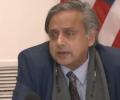
Congress MP Shashi Tharoor on Saturday (local time) highlighted how India responded in a measured and calibrated manner towards terror bases and headquarters in Pakistan, following the dastardly Pahalgam terror attack in which 26 people were killed.

However, Tata Consultancy Services, Infosys, Tech Mahindra, UltraTech Cement, IndusInd Bank, Hindustan Unilever and ICICI Bank were the gainers.

The Trump administration has revoked Harvard University's eligibility to enrol foreign students, raising concerns over the legal status of thousands of students, including nearly 800 from India, currently enrolled at the varsity.
Indian and US officials will begin deliberations on the proposed bilateral trade agreement in Washington from Wednesday with an aim to iron out issues and give an impetus to the negotiations.
India and the US have finalised the terms of reference outlining the roadmap for negotiations of the proposed Bilateral Trade Agreement (BTA), according to a statement issued by the US. US Trade Representative (USTR) Jamieson Greer said that these ongoing talks will help achieve balance and reciprocity by opening new markets for American goods and addressing unfair practices that harm US workers.

'It brings precarious peace because the red lines have shifted. 'The next Pahalgam attack would mean a full scale war.'

Artificial Intelligence, innovation and next-generation technologies figured prominently during the high-stakes discussion between Prime Minister Narendra Modi and US President Donald Trump at the White House, as the two sides announced transformative measures, including the US-India TRUST initiative, roadmap on accelerating AI infrastructure and INDUS Innovation, to boost tech ties.
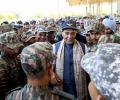
'Pakistan is no longer a front-burner issue for America.'

'Surgical strikes or air strikes, or both, are likely on the table.'
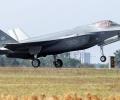
We need to equip the Indian Armed Forces, not 'commercial' as Trump wants, but 'operationally' looking at growing Chinese military capabilities, asserts Lieutenant General Prakash Katoch (retd).

From the Sensex pack, UltraTech Cement, Infosys, Bajaj Finserv, Axis Bank, HDFC Bank, Bharti Airtel, HCL Tech and Tata Consultancy Services were the biggest gainers. Zomato tanked nearly 6 per cent followed by IndusInd Bank which declined about 5 per cent. Adani Ports, Mahindra & Mahindra, Reliance Industries and Sun Pharma were also among the laggards.

'There is no independently verified imagery or battlefield evidence to support Pakistan's claim.'
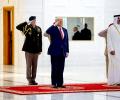
'He is intrigued by the intractability of Kashmir issue. With his interest in dealmaking and peacebrokering, he sees it as an exciting challenge to tackle.'
