
The IMD said India did not experience any "break monsoon" conditions this year because of the large number of low-pressure systems.

The India Meteorological Department (IMD) has predicted below normal monsoon rains for India this year, citing the potential emergence of El Nino conditions. This could significantly impact the country's agriculture-dependent economy.

Very heavy rainfall is likely to occur at one or two places in Kerala on Wednesday.

After its late withdrawal from northwest India, the southwest monsoon remains active over some parts of the country.


India is likely to witness normal rainfall during the southwest monsoon season this year, the India Meteorological Department said on Thursday. Rainfall will be 96 per cent to 104 per cent of the Long Period Average (LPA) of 87 cm of the 1971-2020 period, it noted. Earlier, the IMD used to consider the LPA of 88cm of the 1961-2010 period.

"This year, the Southwest Monsoon is likely to set over Kerala on May 31 with a model error of four days," the India meteorological department said on Wednesday.

A likely western disturbance over north India during the weekend might cause heavy to very heavy showers in a few places, including New Delhi.

'Monsoon is the pran (life) of our water system.' 'A weak monsoon will have a very negative impact on crops and people's lives.'
Twelve of the 36 meteorological subdivisions recorded deficient rainfall, while the rest witnessed normal to excess rain. In total, 38 per cent of the 662 districts received below-normal rain.

Agriculturally important UP, MP, Haryana, Maharashtra, and Punjab received 20-30% shortfall in rain

Sowing had started on a sluggish note in several parts of the country because of delay in the onset of the monsoon but has picked up pace subsequently as the rains progressed and performed appreciably well in August.

Kerala has been receiving rainfall since Saturday and 10 out of the 14 weather monitoring stations in the state have received more than 2.5 mm rains.
R D Singh, director of MET, said conditions are favourable for further advance of the monsoon into remaining parts of coastal and south interior Karnataka during the next 48 hours.

India is likely to witness a mixed temperature pattern along with wetter-than-usual conditions in May, with the India Meteorological Department (IMD) indicating that rainfall across the country is "most likely to be above normal" at over 110 per cent of the long period average (LPA).
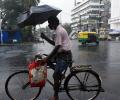
The Southwest Monsoon is set to arrive early with the Andaman and Nicobar Islands expected to receive first seasonal showers on May 15, the weather office said on Thursday.

The southwest monsoon arrived in Maharashtra on Sunday, making it the earliest onset of the annual rainfall season over the state in 35 years, according to the India Meteorological Department. The monsoon is expected to advance to Mumbai and some other parts over the next three days. The monsoon advanced into some more parts of the Arabian Sea, Karnataka, entire Goa, parts of Maharashtra, north Bay of Bengal, and parts of Mizoram, parts of Manipur and Nagaland on Sunday. The northern limit of monsoon passes through Devgad, Belagavi, Haveri, Mandya, Dharmapuri, Chennai, Aizawl and Kohima. Conditions are favorable for further advance into some more parts of central Arabian Sea, more parts of Maharashtra including Mumbai, Karnataka including Bengaluru, some parts of Andhra Pradesh, remaining parts of Tamil Nadu, more parts of west-central and North Bay of Bengal and some more parts of North Eastern states during next three days. The southwest monsoon hit Kerala on Saturday, marking its earliest arrival over the Indian mainland since 2009.

'During the hot season (April to June), above-normal minimum temperatures are likely over most parts of the country, except in some regions of Maharashtra and Telangana, where minimum temperatures are expected to be normal to below normal,' IMD said.

The last time the southwest monsoon arrived earlier than in 2025 -- that is, back in 2009 -- the rains lost steam after the early onset and ended the season with almost 23 per cent deficient rainfall, which was the lowest recorded average rainfall in several decades over India.

According to Skymet Weather, the initial surge in the Monsoon rains can be attributed to the transition of El Nino into the neutral phase.
The India Meteorological Department (IMD) forecasts the withdrawal of the southwest monsoon from northwest India around September 15. This year's monsoon covered the country earlier than usual, resulting in surplus rainfall and extreme weather events.

IMD director general K J Ramesh said the Met wasn't being conservative and weather patterns indicated that there was a possibility of rainfall being very near to the 50-year LPA of 89 cm.

The southwest monsoon has arrived in Mumbai 16 days before its usual date, making it the earliest arrival since 1950. This early onset follows the monsoon's arrival in Kerala, the southernmost state, on Saturday, marking the earliest arrival since 2009. The India Meteorological Department (IMD) predicts an above-normal rainfall for the 2025 monsoon season, with rainfall between 96 per cent and 104 per cent of the 50-year average of 87 cm considered 'normal'. The monsoon is crucial for India's economy, providing vital water for agriculture and replenishing reservoirs.

The India Meteorological Department (IMD) has predicted above-normal rainfall for most parts of India during the post-monsoon season (October to December), except for some areas in the northwest. The southwest monsoon season ended with the country recording eight per cent above normal rainfall.

The record monsoon rains across India during the June to September months was 937.2 millimetres, the 5th-highest since 2001 and 38th-highest since 1901.

IMD data shows in the 24 hours between September 1 and 2, Haryana received 806 per cent more rainfall than normal, Punjab 759 per cent, Himachal Pradesh 510 per cent, Delhi 740 per cent, Chandigarh a staggering 1,638 per cent, and Rajasthan 193 per cent.

Maharashtra Deputy Chief Minister Eknath Shinde on Monday attributed early arrival of the southwest monsoon and heavy rainfall in a short span for the inundation of low-lying areas in Mumbai, which disrupted road and railway traffic.

Skymet expects a good monsoon over western and southern India.

Spurred by cyclone Remal, the southwest monsoon set in over the Kerala coast and parts of the northeast on Thursday, a day earlier than forecast by the weather office.
The bulk of these districts are in Bihar, where 87 per cent districts are monsoon-deficient till July 9.

Delhi Police have arrested another suspect in connection with the killing of a 26-year-old man during a clash between two families in Uttam Nagar on Holi. A total of seven people have been arrested and a minor apprehended. Stringent provisions of the SC/ST Act have been invoked.


Heatwave may abate over most parts of North India in next two days; temperatures likely to drop by 2-3C.

On May 15, the weather office had announced the onset of monsoon over Kerala by May 31.

The onset of the southwest monsoon is being keenly watched this year as it may provide an early sign regarding its progress over the Indian subcontinent, particularly when El Nio is expected to rear its head during the latter half of the season.

Delayed by 10 days due to cyclone Biparjoy, southwest monsoon is likely to progress further and hit Mumbai between June 23 and 25, the India meteorological department said on Wednesday.

Conditions were becoming favourable for further advance of the southwest monsoon over some more parts of the south peninsula and east India and adjoining areas between June 18 and 21.

From the Sensex firms, Mahindra & Mahindra, HCL Tech, Tata Motors, Nestle, ITC, Hindustan Unilever, Larsen & Toubro, and Tech Mahindra were the biggest gainers. In contrast, Eternal, UltraTech Cement, Power Grid, Tata Steel and Kotak Mahindra Bank were among the laggards. Eternal dropped 4.51 per cent.

India is likely to see above-normal rainfall in the four-month monsoon season (June to September) with cumulative rainfall rainfall estimated at 106 percent of the long-period average (87 cm), he said.

The India Meteorological Department (IMD) has predicted above-normal rainfall across India in June, with most parts of the country likely to experience normal to below-normal maximum temperatures. The IMD also anticipates above-normal minimum temperatures across most of the country, except for some parts of central India and the adjoining south peninsula. The southwest monsoon reached Kerala on May 24, marking its earliest arrival over the Indian mainland since 2009. The monsoon is crucial for India's agriculture-dependent economy, providing vital water for crops and supporting drinking water and hydropower generation.
 © 2026 Rediff.com - Advertise with us - Disclaimer - Privacy Policy - Sitemap - Feedback - About us - Terms of use - Grievances