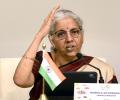
Union Finance Minister Nirmala Sitharaman has urged an increased focus on '3Fs'-fuel, fertiliser, and forex-to maintain India's economic resilience amidst the West Asia crisis, while also criticising those who spread pessimism.
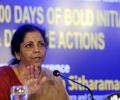
A high-level committee, including representatives from banks and payment associations, is set to decide on Merchant Discount Rate (MDR) for UPI transactions exceeding Rs 2,000 to merchants. While person-to-person and person-to-merchant transactions up to Rs 2,000 remain free, the move follows a recent amendment to the Payment and Settlement Systems Act, sparking debate and clarification from the Finance Minister that only certain high-value merchant transactions might incur charges.

The Congress party has criticised the government's recent notification regarding UPI transactions, alleging it paves the way for users to be charged fees, particularly for transactions above Rs 2,000. The party claims the government lacks transparency and questions if the move is to benefit American firms. The government, however, states that charges are necessary for the system's sustainability and infrastructure upgrades, with the Finance Minister clarifying that Merchant Discount Rate (MDR) applies to merchants, not customers.

Mobile phone retailers across India, represented by AIMRA, are protesting the 0.4% Merchant Discount Rate (MDR) on UPI transactions exceeding Rs 2,000 for merchants. They plan to observe 'No UPI Day' on October 2, 2026, arguing that this fee will significantly impact their income and burden small businesses, advocating for a continued Zero MDR structure for UPI merchant payments.

Congress leader Rahul Gandhi has accused the Modi government of quietly paving the way for imposing fees on UPI transactions, alleging it's a surrender to American pressure. The government's recent notification exempts charges only up to Rs 2,000, sparking concerns that higher value transactions and eventually all UPI payments could incur fees. Finance Minister Nirmala Sitharaman, however, clarified that Merchant Discount Rate (MDR) applies to merchants, not customers, and supports digital infrastructure.

Even as lawyers on both sides study the pros and cons of a court battle, there are unanswered questions: When did Tata Trusts review its resolution of 2025 on backing Chandrasekaran for a third term?How will the shareholders of Tata Sons respond on listing and the leadership issue?

The finance ministry has clarified that its letter to state chief secretaries, urging them to align their bonus policy to promote pulses, oilseeds, and millets, was an advisory and not a directive. This clarification comes in response to Tamil Nadu Chief Minister M K Stalin's criticism, who called the advisory a 'treacherous act against farmers'.

Finance Minister Nirmala Sitharaman urged PSBs to become 'cool' and shed their 'government bank' image to attract young customers.

From a milk abhishek and aarti in Patna and Vadnagar to blood donation camps in Delhi, sand art tributes in Puri and Agartala, and havan pujas in Jammu, BJP leaders and others nationwide honoured the occasion of Prime Minister Narendra Modi's 76th birthday with prayers, service drives and tributes.

India has significantly increased its diplomatic engagements with Bhutan, Nepal, Bangladesh and the Maldives.

A trade body in Jharkhand, FJCCI, has urged the Union Finance Minister to withdraw the proposed 0.4% Merchant Discount Rate (MDR) on UPI transactions above Rs 2,000 for merchants. The body argues that this charge will significantly increase operating costs for businesses, especially MSMEs and retailers, who rely on the current zero-MDR regime for digital payments.

75% of India's 60 million digital-payment merchants have never recorded a transaction above 2,000.

Finance Minister Nirmala Sitharaman clarified that the Merchant Discount Rate (MDR) on digital transactions applies to merchants, not customers, and aims to support banks and fintech in infrastructure investment. She countered Congress leader Jairam Ramesh's claims, stating that a committee will decide on MDR only after Parliament passes the Taxation and Other Laws (Amendment) Bill, 2026, a process currently stalled by parliamentary disruptions.
BJD president Naveen Patnaik has requested Union Finance Minister Nirmala Sitharaman's intervention in a case where an Odisha tribal man was forced to exhume his sister's skeleton to prove her death to a rural bank. Patnaik seeks accountability for the incident, which has sparked public outrage.

Congress leader Rahul Gandhi has launched a scathing attack, calling Prime Minister Narendra Modi, Home Minister Amit Shah, and Chief Election Commissioner Gyanesh Kumar 'deshdrohis' (traitors) for allegedly 'destroying' India's voting system and 'stealing elections'.
Odisha Chief Minister Naveen Patnaik has requested Union Finance Minister Nirmala Sitharaman's intervention in a case where a tribal man was forced to exhume his sister's skeleton to prove her death to a rural bank in Keonjhar district. Patnaik urged for accountability and empathy in rural banking services.

Chinese President Xi Jinping notably skipped a gala dinner hosted by Prime Minister Narendra Modi for BRICS leaders and other dignitaries, with sources suggesting he returned to his hotel to rest. Meanwhile, a grand cultural performance, 'BRICS Symphony - One Rhythm, Many Cultures', featuring artistes from member countries, was a highlight of the evening.

Union Finance Minister Nirmala Sitharaman has accused the TMC government in West Bengal of preventing the implementation of central welfare schemes, depriving the state's residents of benefits such as Ayushman Bharat and PM Kisan.

Essel Group founder Subhash Chandra has called for an independent audit to examine the group's borrowings, defaults, and repayments, stating that approximately 43,000 crore of its 45,000 crore total debt has been repaid.

A high-level meeting of Union ministers, including Amit Shah, Rajnath Singh, S Jaishankar, and Nirmala Sitharaman, along with National Security Advisor Ajit Doval, was held at the Prime Minister's Office in Parliament to discuss crucial matters.

The Congress party has accused the Indian government of imposing new charges on UPI transactions due to pressure from the United States, specifically to benefit American card companies. The opposition party demanded the withdrawal of the decision, calling it "anti-national" and alleging it fills the coffers of US firms while burdening Indian citizens. The government, however, clarified that the Merchant Discount Rate (MDR) charges apply only to commercial transactions above Rs 2,000 and are not levied on consumers, a stance supported by the BJP which accused Congress of spreading "fake news".

The Congress party has criticised the government's new 0.4% charge on UPI transactions above Rs 2,000 for merchants, terming it a "Modi tax". Opposition leaders, including Rahul Gandhi and Mallikarjun Kharge, allege that this move will ultimately burden consumers through price hikes and accuse the government of succumbing to American pressure to dilute India's zero-MDR policy. The government states the charge will support banks and fintechs.
The Congress party has criticised the Modi government over a notification regarding UPI transactions, alleging it paves the way for imposing fees, especially on transactions above Rs 2,000. Rahul Gandhi claimed the government is surrendering to American pressure, while Mallikarjun Kharge highlighted the potential burden on common citizens amidst inflation. The government's notification prohibits charges on UPI transactions up to Rs 2,000 but remains silent on higher amounts, sparking fears of a "Digital Payments Tax."
The Rajya Sabha has passed The Bankers' Books Evidence Bill, 2026, which aims to replace a British-era law and allow digital and virtual records to be admissible as evidence in courts. This legislation aligns with contemporary digital banking practices and extends a uniform evidential framework to various financial entities, including NBFCs and fintech companies. Finance Minister Nirmala Sitharaman highlighted the bill's role in strengthening public confidence and safeguarding customer privacy. The bill's passage, however, saw an Opposition walkout over unrelated issues.
The Payments Council of India has confirmed that Unified Payments Interface (UPI) services will continue to be free for consumers and small merchants, despite a recent Lok Sabha Bill. This clarification addresses concerns about potential charges, emphasising that while a sustainable financial model for UPI infrastructure is being developed, transaction charges will not be passed on to users or small businesses.

Finance Minister Nirmala Sitharaman announces increased domestic LPG production to offset import disruptions caused by Middle East tensions, alongside assurances of fertiliser availability and the clearing of UPA-era oil bonds.

Finance Minister Nirmala Sitharaman stated that it is premature to comment on the tariff changes announced by the United States, adding that the commerce ministry is currently reviewing the situation.

We know what Mrs Sitharaman and Mr Chaudhary (who may soon be moving out of the finance ministry to head to Lucknow to take charge as president of the Bharatiya Janata Party's Uttar Pradesh unit) look like, but who are the others in these photographs?

Economists highlight that resolving domestic policy bottlenecks, particularly through land reforms and improving the ease of doing business, will be critical for Prime Minister Narendra Modi's 'next-generation reforms' and India's economic transformation towards its 'Viksit Bharat' vision for 2047.

Sitharaman continues with the tradition she set in 2019, carrying the budget speech in a 'bahi-khata', which she used after dropping the briefcase tradition.

For the second time in two years, Karnataka minister B Nagendra resigned from the state Cabinet on Friday amid the Opposition heat over his alleged involvement in the Rs 89 crore Valmiki Corporation scam.

Finance Minister Nirmala Sitharaman presented her ninth consecutive Union Budget, focusing on investments and growth. The speech was marked by its business-like approach and lack of cultural references, while opposition members raised concerns about regional representation.

Finance Minister Nirmala Sitharaman's biggest challenge will be to find a new growth driver, particularly against the backdrop of a global economy ravaged by heightened uncertainty and fragmentation, financial markets on a precipice, and global commodity prices on a continued uptrend.

Finance Minister Nirmala Sitharaman on Sunday makes history as she presents a record ninth consecutive Budget that is expected to unveil measures to sustain growth momentum, maintain fiscal discipline, and contain reforms that could buffer the economy from global trade frictions, including US tariffs.
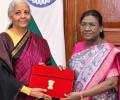
Union Finance Minister Nirmala Sitharaman is well-known for donning saris that speak as powerfully as her budget speech. Each Budget Day, she selects a drape that pays tribute to India's amazing textile heritage and the mastery of its artisans.

Finance Minister Nirmala Sitharaman will present the general budget in Parliament on February 1. The Budget session of Parliament begins on January 28 with President Droupadi Murmu addressing both houses.

Prime Minister Narendra Modi has called upon citizens to celebrate Independence Day with honour and pride, urging them to take a pledge for a developed India. This appeal comes amidst parliamentary sessions marked by protests from both ruling and opposition alliances.

The Indian government has approved the introduction of one billion polymer banknotes in Rs 10 and Rs 20 denominations for field trials, aiming to enhance durability. This move comes as the Finance Minister also addressed Parliament on declining retail inflation, GST reforms, and other fiscal measures taken to support the economy and household consumption.

Inflows into foreign currency non-resident (bank), or FCNR (B), deposits have significantly underperformed market expectations, leading to a more than 1 per cent depreciation of the rupee against the dollar this week. Analysts point to fading RBI support measures, tepid interest due to rising global bond yields, and narrowing interest rate spreads compared to 2013 as key challenges.

Chandrasekaran's exit is more than a change of chairman. It represents the breakdown of the informal consensus that governed the Tata system under Ratan Tata.
