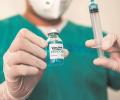
The Wold Health Organisation has granted approval on June 1 to China's second COVID-19 vaccine, Sinovac, which was expected to strengthen China's vaccine diplomacy.
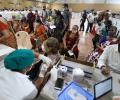
Sputnik V is already approved in India and Sinovac is unlikely to come in as it does not meet the criteria.
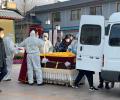
The global health intelligence company had said China's zero-COVID strategy also means the population has almost no naturally acquired immunity through the previous infection.
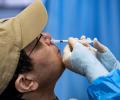
'Viral infections rise in winter and better care needs to be taken in the next few months.'
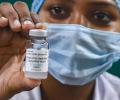
The move follows the World Health Organisation's Emergency Use Listing for Covaxin, which is the second most used formulation in India.

Addressing a press briefing, Union Health Secretary Rajesh Bhushan said Zydus Cadila, Sputnik V, Biological E and Gennova are other vaccines also in the pipeline which are in advanced clinical trials in India.

The decision to open Kartarpur shrine was taken by the National Command and Operation Centre (NCOC) on Saturday due to the approaching death anniversary of Sikhism founder Baba Guru Nanak Dev on September 22.
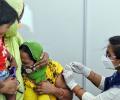
Experts, however, feel that given the intensity of the second wave and the high single dose coverage, India is in a good position to avoid any drastic wave in the near future.

More than 2 million people have been diagnosed with coronavirus across the world, and the pharmaceutical industry is pulling out all stops to find potential treatments and vaccines for the global pandemic. According to the World Health Organization, there are now more than 70 potential vaccines under evelopment, with some already in clinical trials.

Core to the planning is the rigidly-enforced closed loop that physically separates Games-related personnel from the local population

Australia's medicines and medical devices regulator on Monday formally recognised India's Covaxin, a vaccine against the coronavirus as the country's border was reopened for the first time in nearly 20 months.
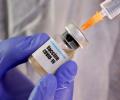
Early data from its vaccine candidate 'mRNA-1273' showed it produced protective antibodies in a group of eight healthy volunteers, Moderna said. The other closely watched COVID-19 vaccine is the one being developed by scientists at Oxford University.
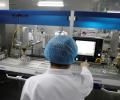
China has given conditional approval for a single dose COVID-19 vaccine, touted to be a rival to Johnson & Johnson's one-jab shot cleared by the United States drug regulator on Sunday.
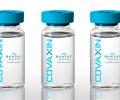
A technical advisory group of the UN health agency which met on Tuesday has sought "additional clarifications" from Bharat Biotech for Covaxin to conduct a final "risk-benefit assessment" for Emergency Use Listing of the vaccine.

Apart from the 1.1 crore doses of Covishield being procured from the Serum Institute of India, 55 lakh doses of indigenously developed Covaxin were being obtained from Bharat Biotech, Union Health Secretary Rajesh Bhushan said at a press conference.
According to the findings of the phase 1/2 randomised clinical trial, published in The Lancet Infectious Diseases journal, the vaccine candidate could induce an antibody response in participants within 28 days of the first immunisation, by giving two doses 14 days apart.

Scientists around the world, including in India, suggest it hasn't been tested properly given the time constraint and there may not be enough evidence to prove its efficacy.

Bharat Biotech, Serum Institute, Zydus Cadila, Panacea Biotec, Indian Immunologicals, Mynvax and Biological E are among the domestic pharma firms working on the coronavirus vaccines in India.

A massive pan-India inoculation drive against COVID-19 was set in process on Tuesday with more than 56 lakh doses of the Covishield vaccine flown to 13 cities across India from Pune and taken to designated national and state-level stores amid tight security.

'All the vaccines that are available in most countries, right now, are all highly effective and safe.'
 © 2026 Rediff.com - Advertise with us - Disclaimer - Privacy Policy - Sitemap - Feedback - About us - Terms of use - Grievances