
India not only lost its top place as the most represented higher-education system to China, several of its marquee institutions saw a significant drop.

A parliamentary committee has voiced concerns over ongoing examination irregularities despite government measures, recommending the Ministry of Education publish a time-bound roadmap for reforms. The panel also urged a nationwide blacklist of firms involved in exam processes and suggested utilising the National Testing Agency's financial surplus to enhance its capabilities.

The overhaul comes after a series of controversies surrounding the conduct of examinations administered by NTA, which has faced questions over examination security and its handling of irregularities.

There is clearly something deeply rotten in the systems of institutional governance in the bastions of higher education in India, says TCA Anant.

Job aspirants and guest faculties in Bihar are protesting in Patna, demanding the timely conduct of the BPSC TRE-4 exam, transparency in recruitments, and the resignation of education officials. They also seek implementation of UGC regulations, increased age limits, and regularisation of assistant professor appointments, threatening further agitation if demands are not met.

Education sector experts agree that using the "best technology" was essential to ensure students did not have to sit for an examination all over again because of a question paper leak.

The Assam government has decided to withdraw all police cases registered against individuals involved in protests concerning the NEET question paper leak and to release those arrested or detained during these demonstrations, citing the need for systemic reforms in the education ecosystem.

The National Testing Agency (NTA) is undergoing significant reforms, including the removal of over 50 staff members and the onboarding of new leadership and domain specialists. This comes after recent issues like errors in UGC-NET papers, leading to re-tests, and the cancellation of NEET-UG 2026. The Education Ministry has directed a complete overhaul of exam protocols and a thorough audit of all processes to ensure integrity.

'We can integrate AI and tech into education, but that is just a means and not an end.' 'Ultimately, we need to control what happens in a classroom and we need to let teachers innovate their teaching style to suit the needs of Gen Z and beyond.'

A parliamentary panel has decided to review the implementation of reforms in the National Testing Agency (NTA) as well as the NEET-UG 2026 paper leak case and has summoned NTA Chairperson Pradeep Kumar Joshi and other bureaucrats for deliberations.

90 per cent of institutions recorded no improvement in international student metrics, despite government initiatives such as the Study in India programme, UGC regulations on internationalisation, and efforts to attract foreign students.

Veteran banker K V Kamath stresses the importance of reskilling and education reforms to leverage artificial intelligence (AI) in India, advocating for practical applications over expensive foundational models.

The Maharashtra government has abolished the mandatory one-year service bond for MBBS students, citing an "inverse ratio" of available positions to graduating candidates. This decision benefits graduates from various medical colleges, exempting most from the bond, though those who have already joined their postings must complete it. The move aims to ease postgraduate admission difficulties and address issues of competency and motivation in bond service, a decision welcomed by the Maharashtra Association for Resident Doctors (MARD).

The National Testing Agency (NTA) has terminated 47 officials and plans legal action following the NEET paper leak controversy. This comes amidst widespread protests and demands for the Education Minister's resignation, as the NTA initiates a major overhaul and recruitment drive to strengthen its operations.

'We have to pull 80 million workers out of agriculture and go back to where we were in 2014. That itself is going to be a huge task.' 'We have already lost time, and that is a catastrophe impending.''

Seeking regulatory reforms in higher education, the Economic Survey has suggested that quality foreign players should be allowed in the sector.

Delhi Police detained several anti-reservation protesters at Jantar Mantar who were demanding that economic criteria be prioritised over caste for government support and reservation. The protest, mobilised via social media by 'Reservation Hatao Andolan', proceeded despite police denying permission for Jantar Mantar and offering Ramlila Ground as an alternative venue. Demonstrators called for a review of the existing reservation system and the introduction of a creamy-layer criterion.

'Providing funds and autonomy to a few institutions that may not have the intent to excel must not become a case of trying to feed those who are not hungry and starving those who are famished,' says Jitendra Kumar Das, Director, FORE School of Management, New Delhi.

Congress Parliamentary Party chairperson Sonia Gandhi has launched a scathing attack on the Modi government, accusing it of responding to student demands for accountability and educational reforms with 'cowardice and wanton cruelty,' treating them as 'enemies of the nation.' She further alleged that the government has degraded India's education landscape and routinely chooses violence over dialogue.
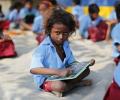
Prof Pradip Narayan Ghosh, former Vice Chancellor of Jadavpur University, Kolkata tells us how the quota system has been unable to make higher education accessible to a large section of society.

'After more than 12 years in power, he has been forced to retreat under public pressure. The education minister's resignation is the biggest political climbdown of his government so far.'

The Jharkhand government is holding fresh talks with students protesting alleged recruitment exam irregularities, including a hunger striker whose health has deteriorated. Despite multiple rounds of discussions, protesters vow to continue their agitation and plan a march to the Assembly if demands are not met.

As the agitation over alleged irregularities in Jharkhand recruitment examinations entered its 14th day, talks between the state government and student protesters on Friday failed to break the deadlock, with students deciding to continue their protest and hunger strike until their demands, including cancellation of the 14th JPSC examination, are met.

The challenge thrown by the youth movement creates the opportunity for a more consequential debate on India's economic trajectory because it must remain centered on India's youth as its driving impulse, asserts former foreign secretary Shyam Saran.

'The prohibition regime has been accompanied by concerns regarding the expansion of the illicit liquor trade, increased enforcement challenges and corruption, and the growing use of alternative intoxicants, including illicit drugs.'

Following Jharkhand Chief Minister Hemant Soren's decision to cancel the JSSC-CGL exam and other recruitment tests due to alleged irregularities, approximately 2,000 successful candidates now fear losing their jobs, demanding a CBI probe and a fair opportunity to defend themselves.

Holding Home Minister Amit Shah responsible for alleged police brutalities on protesting students, Leader of the Opposition in the Rajya Sabha Mallikarjun Kharge on Thursday said that "Jan Shakti" (people's power) will "drag him out" one day to make him accountable.
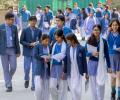
The Ministry of Education has dismissed concerns about On-Screen Marking (OSM) affecting students' scores in CBSE class 12 exams and announced a reduction in revaluation and answer sheet verification charges to ease student anxiety.

'Improved law and order and transparent governance have helped change UP's investment image.'
Recent changes to tax exemptions and allowances, including increased education, hostel, and HRA limits, have made the old tax regime more competitive against the new regime, prompting salaried employees to re-evaluate their choice for the current financial year.

A research paper by the National Council of Applied Economic Research (NCAER) recommends that Bihar revoke its alcohol ban, citing its failure to reduce violence against women and a rise in illicit drug and alcohol consumption. The report suggests that reinstating the liquor excise tax would significantly increase state revenues and decrease enforcement costs.
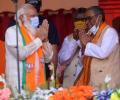
Ten days after the expansion of the BJP government's cabinet in West Bengal, key portfolios have been allocated, with senior leader Tapas Roy taking charge of industries and journalist-turned-politician Swapan Dasgupta appointed finance minister.

How did hundreds of errors slip through multiple stages of drafting, editing, proofreading, expert review and final approval before making their way into classrooms?
'The provincial universities have already been lost at the hands of unscrupulous politicians, the central universities are fast moving towards deep degeneration.'

The Jharkhand government is holding fresh discussions with student aspirants protesting alleged recruitment exam irregularities, even as the health of key protest leader Devendra Nath Mahto has significantly deteriorated after being on an indefinite hunger strike for about a week.

Student protests in Jharkhand over alleged irregularities in recruitment exams have intensified, leading to a state-wide bandh called by the BJP and a march by the ABVP to the state assembly. The agitation, now in its 18th day, has seen police action against demonstrators, an ED money laundering probe, and the arrest of a former JPSC chairperson, while talks between the government and students remain deadlocked.

Protesting aspirants in Jharkhand have vowed to continue their agitation over alleged paper leaks in recruitment exams, despite talks with a five-member government panel. The protesters, including JLKM leader Devendra Nath Mahto who is on a fast, demand the cancellation of the 14th Jharkhand PSC Civil Services Examination and an independent probe into irregularities.
Private and foreign corporate investment may soon get to flow into Indian higher education with the government considering a move to reform policy that hinders such financing.

'The main problem the country faces is not low GDP growth, but low employment growth.'

The winter session of Parliament is set to begin with the government prioritizing its reforms agenda, including a bill to open the civil nuclear sector to private players. The opposition is expected to raise concerns about electoral roll revisions and air pollution.
