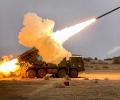
The rocket systems that were tested at Pokharan field firing ranges were manufactured by a private industry following transfer of technology by the Defence Research and Development Organisation.
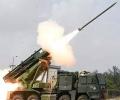
The Army is also looking at strengthening the existing Pinaka regiments and had recently placed orders for buying the area denial ammunition for these rocket regiments.

The Defence Acquisition Council (DAC) has approved procurement of long range rockets, missiles, radar systems and military platforms worth Rs 79,000 crore to bolster the military's combat prowess.

The Enhanced Pinaka has demonstrated a range of 75 km and an ability to strike within 10 metres of where it is aimed. This allows a Pinaka battery to destroy a terrorist camp, or an enemy post, logistics dump or headquarters, without sending soldiers across the border.
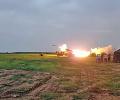
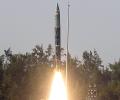
The Defence Research and Development Organisation successfully completed trials for DRDO's enhanced range Pinaka rockets at Balasore in Odisha and Pokhran in Rajasthan over the past few weeks.

The Defence Acquisition Council (DAC) has recently approved procurement proposals worth Rs 79,000 crore across three services and it has cleared AoN (Acceptance of Necessity) of Rs 3.3 trillion in financial year 2026 (FY26).
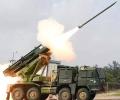
'A crucial role in bolstering the Indian Army's firepower by enabling precise and long-range strikes.'

The largest tranche came in July, in the wake of Operation Sindoor, with the DAC according acceptance of necessity -- or initial approval -- for 10 capital acquisition proposals amounting to approximately 1.05 trillion through indigenous sourcing.
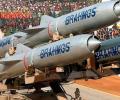
Army Chief Gen Upendra Dwivedi announced that India is considering raising a 'rocket-cum-missile' force in response to the evolving regional security situation and similar units in China and Pakistan. The move aims to enhance India's combat capabilities and long-range strike potential.

The ministry said the rocket system has been upgraded with advanced technologies enhancing the range to meet the emerging requirements.

A salvo from a Pinaka battery brings down on the enemy more than seven tonnes of high explosive in just 44 seconds.

The Pinaka rockets have a range of around 37 km.

Indian Army has deployed Pinaka and Smerch Multiple Rocket Launcher Systems (MRLS) at forward position near the China border to counter any threat arising across on the Line of Actual Control (LAC).
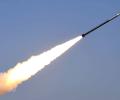
Engineering and construction major Larsen & Toubro (L&T) on Friday said its defence arm has received orders for the Indian ministry of defence for the supply of four regiments of Pinaka weapon systems.

The conversion facilitated range enhancement and improvement in Pinaka's accuracy.

India's indigenously developed Pinaka rockets were on Thursday successfully test-fired thrice from a multi-barrel rocket launcher at an armament base in Chandipur-on-sea, about 15 km from Balasore in Odisha.

Two super high altitude firing ranges were made available to the armed forces for the practice of various kinds of weapons and surveillance equipment in Arunachal Pradesh within an aerial distance of 50 kilometres from the highly sensitive Line of Actual Control, sources said.

The development and trials will continue and the rocket is expected to enter service any time now.
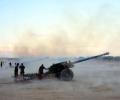
The Indian Army is enhancing the combat prowess of its artillery units along the frontier with China by procuring an array of weapons systems, including an additional batch of 100 K9 Vajra howitzers, swarm drones, loitering munitions and surveillance systems.
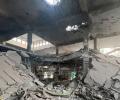
'There's something called deterrence by punishment.' 'That means you hit in a manner calculated to raise costs and consequences for Pakistan, so that the next time it attempts a Pahalgam-like attack, it has to think ten times.'
Ahead of Republic Day, the Indian Army announced on Thursday the addition of two new features to this year's parade: battlefield surveillance systems and a Defebce Research and Development Organisation tableau showcasing Pralay, short-range ballistic missiles.
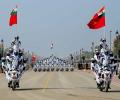
India will display its military prowess and cultural heritage at the 76th Republic Day celebrations on Kartavya Path in New Delhi. The parade will feature 16 tableaux from states and Union Territories, 15 from central ministries, and a tri-services tableau showcasing the spirit of "jointness" among the armed forces. The event will also include a flypast featuring 40 IAF aircraft and three Indian Coast Guard Dornier aircraft, as well as a display of cutting-edge defense platforms including BrahMos, Pinaka and Akash.

The exercise showcased India's military prowess and integrated multi-domain operations of the three services and the "shock and awe" impact that the armed forces seek to achieve in an operational situation with manoeuvre and fighting capabilities.

Nibe Space (NSPL), a subsidiary of Nibe, announced its vision to establish India's first multi-sensor, all-weather, high-revisit Earth observation satellite constellation. Aiming to strengthen India's self-reliance in the strategically crucial defence-space sector, NSPL signed memoranda of agreement with Indian and global partners, including Larsen & Toubro, Centum, AgniKul, Skyroot Aerospace, SpaceFields, SISIR Radar, CYRAN AI Solutions, and Thales Alenia Space as a technology partner.
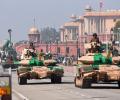
India will showcase its military prowess and rich cultural heritage on Kartavya Path in New Delhi on January 26 to mark the 76th Republic Day. Indonesian President Prabowo Subianto will be the chief guest at the event, which will also see the participation of a marching contingent and a band contingent from Indonesia. The theme of the parade is 'Swarnim Bharat: Virasat aur Vikas', focusing on the platinum jubilee of the enactment of the Constitution. The parade will feature a number of cutting-edge defense platforms, including BrahMos, Pinaka and Akash, as well as the Army's Battle Surveillance System 'Sanjay' and DRDO's surface-to-surface tactical missile 'Pralay'.

Prime Minister Narendra Modi and French President Emmanuel Macron have called for enhancing trade and investment ties between their countries and committed to further deepening their engagement in the Indo-Pacific. They discussed a full spectrum of bilateral relations, including key global and regional issues, and stressed the urgent need for reform in the United Nations Security Council. The leaders also underscored their commitment to ensuring the global AI sector can drive positive social, economic, and environmental outcomes.
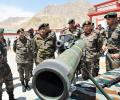
The Army has significantly bolstered its fire power along the frontier with China by deploying a range of rockets and artillery weapons and plans to procure an array of additional systems, including 100 K9 Vajra howitzers and UAVs, to augment combat prowess.
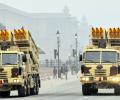
'If you take any ministry of defence project, Nibe is up there, getting orders.'

The synergised demonstration of indigenous defence capabilities during 'Bharat Shakti' is a "testimony to its commitment towards modernisation through indigenisation," the sources said.
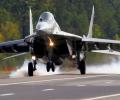
The procurement will come at a cost of Rs 38,900 crore.
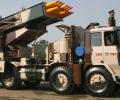
The ministry of defence has bought two regiments of the indigenous Pinaka multi-barrelled rocket launcher for Rs 3,230 crore.

Like the Shourya and Prahar missiles, the Pralay is powered by conventional solid fuel, and its payload is designed to carry only a conventional warhead.

The mesmerizing march included elite marching contingents, missiles, warplanes, surveillance gadgets and lethal weapon systems, with French President Emmanuel Macron gracing the occasion as the chief guest.

In the confrontation in Doklam, where Indian and Chinese soldiers were lined up eyeball-to-eyeball, senior Indian commanders recount they could sense the uncertainty in the Chinese. While Indian soldiers had to be restrained from pushing the Chinese troops back, our chief interpreter heard the Chinese officers threatening to open fire on PLA soldiers who wavered or withdrew, reveals Ajai Shukla.

An industrial house bred in old-school manufacturing values, Godrej & Boyce has displayed unusual agility to become a trusted builder of advanced weaponry, discovers Ajai Shukla.

The army has long been deficient in artillery, the modern battlefield's most lethal killer, says Ajai Shukla.
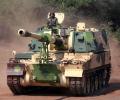
'Landmark developments herald the end of two decades of stagnation in the army's modernisation plans,' notes Brigadier Gurmeet Kanwal (retd).
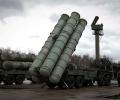
Ahead of Prime Minister Narendra Modi's visit to Russia, defence ministry's top acquisition council on Thursday cleared the purchase of an estimated Rs 40,000 crore Russian S-400 Triumf air defence missile systems, besides giving the go-ahead to other projects worth over Rs 25,000 crore.

Ajai Shukla presents an action plan for Defence Minister Rajnath Singh to fix the systemic weaknesses in defence.

The defence ministry is shooting to achieve an annual export target of $5 billion by 2025.
