
It is about proving that the agency can still deliver when the stakes are high.

A high-level committee investigating the failures of ISRO's PSLV rockets, which have impacted strategic satellite missions, has yet to release its report and recommendations, raising concerns about the future of the ageing launch vehicle.

The move follows a quiet visit by National Security Advisor Ajit Kumar Doval to the Vikram Sarabhai Space Centre in Thiruvananthapuram.
The main focus of the all weather RISAT-1B satellite will be to observe the Indian land with its C-band synthetic aperture radar.

The perfect launch of the satellite catapulted India into a select band of countries having indigenous radar imaging technology

The 1,858 kg spacecraft, the country's first microwave remote sensing satellite, was injected into orbit by the Polar Satellite Launch Vehicle about 19 minutes after a perfect lift off at 5.47 am at the end of the 71-hour countdown from the Satish Dhawan Space Centre, around 90 km from Chennai.
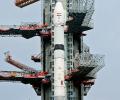
The Polar Satellite Launch Vehicle (PSLV) in its 63rd mission, would carry the earth observation satellite (EOS-09) which would be capable of capturing high-resolution images of the Earth's surface under all weather conditions.

ISRO has projected wheat production of 122.24 million tonnes.
"The launch of Chandrayaan 2 will be in 2014. We are working towards it. It would be on a GSLV, after we launch two GSLVs within an interval of six months," ISRO chief K Radhakrishnan told reporters here soon after the launch of RISAT-1.

The NRSC satellite imagery revealed that the lake covered approximately 162.7 hectares. Its area increased to 167.4 hectares on September 28 but drastically reduced to 60.3 hectares.
"I would like to warmly congratulate all scientists of the Indian Space Research Organisation (ISRO) for the successful launch today of the Polar Satellite Launch Vehicle (PSLV)-C19 carrying the Radar Imaging Satellite -1(RISAT -1), the heaviest satellite launched till date using PSLV, " Dr Singh said.
The placing of four satellites into orbit on October 12, 2011 is yet another milestone in the glorious career of Indian Space Research Organisation's trusted Polar Satellite Launch Vehicle.

The RISAT-2B would replace the RISAT-2, which has been actively used by India to monitor activities in camps across the border in Pakistan to thwart infiltration bids by terrorists.

The stage is set for the launch of India's satellite IRNSS-1D on Saturday from Sriharikota onboard workhorse PSLV-C27 that would pave the way for the country's own navigation system on par with the GPS of United States.

The Chandrayaan-2 will conduct the next level of scientific studies on the Moon, writes T E Narasimhan.

India is set to operationalise its own navigational system with the successful launch of IRNSS-1D, the fourth in the series of seven navigational satellites, onboard PSLV-C27 from Sriharikota on Saturday.

This is ISRO's new record of launching 20 satellites, including those from the US, Germany, Canada and Indonesia.

In a landmark late Monday night journey into a new era of space application, India successfully launched its first dedicated navigation satellite using the Polar Satellite Launch Vehicle which blasted off from the Satish Dhawan Space Centre.

In the years to come, India's space assets will play a much bigger role if and when hostilities break out on our borders, says Pallava Bagla.
