
'If a stranger refuses to pet my Russian dog, what treatment can I expect for myself?'

In a move to plug gaps in the Insolvency and Bankruptcy Code (IBC), the ministry of corporate affairs (MCA) has proposed robust norms against avoidance transactions, wrongful trading, and inordinate delays via changes to look-back period and fixed timelines for the tribunals to reject or approve plans, among other measures. The MCA has proposed that the IBC should provide the adjudicating authority with 30 days for approving or rejecting a resolution plan under Section 31. If a decision is not made on the resolution plan within that period, the adjudicating authority will record reasons in writing for the same, the ministry has proposed.

Analysts on Monday gave a mixed reaction to the railway budget, with some terming it as a "non-event" saying there were no radical measures to bridge the revenue deficit in the document, and a few calling it "pragmatic" given the limitations.

A quarterly study of PE investment activity based on data provided by Venture Intelligence, such funds in the third quarter of this year totalled $3.01 billion through 103 deals, according to the PwC MoneyTree India report.

"Yeh sab doglapan hai." With these words, Ashneer Grover not only called out an entrepreneur being hypocritical, but also shot to fame as a reality television star. It happened in the first few days of January, when the funded part of the start-up world needed some warm-up to get back to work, and inevitably Grover's antics on the show became a talking point. The Twitterati also debated whether it was unbecoming of a founder to diss a peer's business model with such abrasion. And hundreds of memes, with the dialogue set in various circumstances, flooded social media.
In a tectonic shift in the global economic centre of gravity, the size of India's economy would grow to 90 per cent of the United States by 2050, with China becoming even bigger than the US, according to a PricewaterhouseCoopers report. The global advisory firm projected that Brazil seems likely to overtake Japan by 2050 to move to the fourth place, while Russia, Mexico and Indonesia all have the potential to have economies larger than those of Germany or the UK by 2050.

The investments exceeded the $2 billion mark for the first time in 6 years.

Foreign banks set the template in consumer banking in its infancy, but have almost vacated this booming space.

'It is surprising and unfortunate that unfounded allegations are now being made without any reference to me whatsoever,' Vijay Mallya said.

Less than 50 per cent respondents admit that their company has sufficient security controls, says PricewaterhouseCoopers.
Govt has decided to suspend Sections 7, 9, and 10, which are used to trigger insolvency proceedings for six months or a period not exceeding one year from the date they commence.
The global entertainment and media industry is expected to grow at a moderate rate over the next five years as economic uncertainty offsets the impetus of digital technologies, according to a new study.
The growth in M&As is likely to gather steam as firms within the region and and outside are looking to Asia as the home for growth, it said.

While the most obvious beneficiary of this roll-out will be manufacturers of FASTags, or the Radio Frequency Identification chips, a PwC report says implementation of a pan-India electronic toll collection system on national highways may help save approximately Rs 87,000 crore annually.

IIM Lucknow has concluded its 2020-21 final placements.

The PwC survey found more than 50 per cent respondents reporting lack of adequate skill sets

Easier dilution norms for mega initial public offerings (IPOs) have come into effect. Companies with post-listing market capitalisation (m-cap) of more than Rs 1 trillion will not be required to dilute a minimum of 10 per cent. The move to relax dilution norms is seen as a precursor to Life Insurance Corporation's IPO. The central government has said companies with an m-cap exceeding Rs 1 trillion will have to dilute Rs 5,000 crore and at least 5 per cent of their m-cap. Experts said the earlier framework discouraged large companies from listing since they were forced to offload a large volume of shares during the time of their IPO.

The initiative is being undertaken by the government of Karnataka, considered one of the leaders in the technology space. Currently, India doesn't have such a platform and, globally, there are very few privately-run platforms.

Dealmakers and advisors feel investors are shifting their focus to Asia Pacific, especially India, owing to geopolitical instability driven by events such as Brexit and protectionist trade wars.

Goods and Services Tax (GST) collections at Rs 95,480 crore in September touched the highest level so far this fiscal, the finance ministry said on Thursday.

Amid fears of a third wave of coronavirus pandemic and hardening of retail inflation, the Reserve Bank is likely to maintain status quo on interest rate and watch the developing macroeconomic situation for some more time before taking any decisive action on monetary policy. The RBI is scheduled to announce its bi-monthly monetary policy review on August 6 at the end of the three-day meeting -- August 4-6 -- of the Monetary Policy Committee (MPC). The RBI Governor-headed six-member MPC decides on the key policy rates.
The management institute also clocked 100% placement, says Virendra Singh Rawat.

A significant 71 per cent of India's CEOs are very confident of their companies' growth in the next 12 months, a 7-point increase over last year's and 33 points above this year's global average (38 per cent).

The Reserve Bank of India (RBI) on Wednesday proposed to make interoperability mandatory for digital payments firms. It also allowed users to withdraw cash from e-wallets and fintech companies to process RTGS and NEFT transactions. The RBI expressed dissatisfaction over prepaid payment instruments' (PPIs') failure to migrate towards full-KYC (know your customer) PPIs, and therefore interoperability, even two years after guidelines were issued.

The increase in infrastructure spends in the country is likely to be driven by sectors like housing, telecom, healthcare, education and transportation.

The industry is expected to spend an additional $500- 1,000 million during the same period on logistics functions.

China on Tuesday announced a major policy change for its crisis-ridden power sector by allowing coal-fired power plants to charge their industrial and commercial customers market-driven prices. The National Development and Reform Commission (NDRC) of China said the electricity generated by coal-fired plants would discover price in market trading "in an orderly manner" from October 15. This is being done to pass on the high costs of coal and is being held up as the boldest reform in the Chinese power sector.

To begin with, there would be the immediate integration of various technology stacks. This would create more business for global consulting and IT services entities such as KPMG, PwC, EY, Accenture and IBM, among others. Indian service providers - Infosys, Tata Consultancy Services (TCS), and Wipro, for instance - would also cash in.

'Health will continue to be at the centre of the government's attention as it underpins economic recovery and our collective well being.'

Last Saturday, USL board asked its Chairman Vijay Mallya to quit.

With $120 billion worth of deals, 2018 was the best year on record. Many also blame frequent policy flip-flops and increasing tax scrutiny as big dampners for business.

Surge in UPI transactions is because of an increased consumer interest in making bill payments and recharging mobile phones online, and purchase of non-essential goods on e-commerce platforms.

Of the 1,145 offers made this year, consulting firms made up 34 per cent, followed by banking, financial services and insurance, pharma/healthcare, IT/ITeS and FMCG/retail.
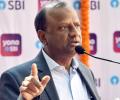
'At the first board meeting I chaired, I sensed that corporate governance is an issue in this company.' 'I started taking steps that may have aggrieved a few.' 'This has now become a mission I intend to accomplish before I step down.'

However, Icra Rating Principal Economist Aditi Nayar feels that the numbers are a bit too optimistic and need real heavy-lifting by the Centre and the states. "The survey forecasts on real and nominal GDP will require a substantial push from Central and state spending as private sector capacity expansion is anticipated to be intermittent, and sector-specific in the next couple of quarters," she said. Nayar added that private consumption is likely to chart a differentiated recovery across income and age groups. Based on the comments made in the Survey, she expects the Union Budget to incorporate a growth in gross tax revenue of 15-16 per cent.

From cloud computing to people analytics, most lucrative future jobs will be dominated by people with digital skills and expertise, explains Sarita Digumarti, chief learning officer, UNext Learning.

Equities in India saw record FPI inflows of $16.8 billion in November and December, taking the benchmark indices to new highs.

From watches and sunglasses to trekking/fitness bicycles, online shoppers seem ready to loosen purse strings.

Last year's Budget had created uncertainty about the quantum of tax to be withheld on dividends paid to non-residents, as the exact tax rate was not specified under section 195.

The analyst community tracking the Indian IT services industry took special note of Accenture's first quarter (Q1) performance, which showcased the rapid growth of its consulting business that outperformed its outsourcing business. Bookings indicate that the trend will continue. Consulting bookings increased 41.6 per cent year-on-year (yoy) to $9.4 billion, higher than the 17.6 per cent growth in outsourcing to $7.4 billion. The management commentary was also more bullish on the consulting business.
