
Buying a mature rocket technology gives companies the designs and hardware know-how, but not necessarily the decades of engineering wisdom needed to make it work.

A high-level committee investigating the failures of ISRO's PSLV rockets, which have impacted strategic satellite missions, has yet to release its report and recommendations, raising concerns about the future of the ageing launch vehicle.

The move follows a quiet visit by National Security Advisor Ajit Kumar Doval to the Vikram Sarabhai Space Centre in Thiruvananthapuram.
'There's too much coincidence in back-to-back failures of missions critical to national security.'
'A solid motor, once ignited, burns until the propellant is exhausted. It cannot simply stop mid-burn,' said a retired senior ISRO official. 'That is what makes this failure puzzling.' Venkatachari Jagannathan reports on the latest PSLV failure.

The Indian Space Research Organisation (ISRO) has rescheduled the launch of PSLV-C59 to Thursday due to an "anomaly" detected in the PROBA-3 spacecraft. The launch was originally scheduled for Wednesday at 4.08 pm from the spaceport in Sriharikota. The anomaly was identified by scientists at the European Space Agency (ESA), who requested the rescheduling of the launch. The PROBA-3 mission, a joint project between ESA and ISRO, aims to study the Sun's corona using two spacecraft that will fly in formation. The launch will provide valuable insights for ISRO's future solar missions, including the Aditya-L1 mission which was launched in September 2023.

In a first-of-its-kind initiative involving precision-flying, Indian Space Research Organisation on Thursday successfully launched the Proba-3 mission onboard a PSLV-C59 rocket, a solar experiment undertaken by the European Space Agency.

Aditya -- the name in Sanskrit refers to the Sun -- is a coronagraphy spacecraft manufactured at the U R Rao Satellite Centre in Bengaluru to study the solar atmosphere.

Heralding a new era, India on Friday night launched its heaviest commercial space mission ever with its polar rocket successfully putting five British satellites into the intended orbit after a flawless takeoff.

India's Polar Satellite Launch Vehicle will lift off from Sriharikota on July 10 taking five foreign satellites into orbit, including three earth observation spacecraft whose imagery will be utilised by a Beijing-based company as well as an experimental nano-satellite that will deploy a large, light-weight sail in order to hasten its descent back to earth.
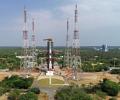
Days after landing on the Moon, India will aim for the Sun on Saturday with its maiden solar expedition, as ISRO's trusted PSLV will carry the Aditya L1 mission on a 125-day voyage to the Sun.

ISRO, in a tweet, said EOS-04 was placed into an intended sun synchronous polar orbit of 529 km altitude at 6.17 am.

Around 23 minutes after lift-off, the primary satellite got separated and it was followed by six other co-passenger satellites, which were deployed into the intended orbits sequentially, ISRO said.
Antrix, ISRO's commercial arm, is eyeing 10% of the $357 billion global market.

Cartosat-3 satellite is a third-generation agile advanced satellite having high-resolution imaging capability.

As India prepares to launch its Rs 450 crore mission to Mars this year, a top space official says the country's first martian odyssey -- that has attracted some criticism -- is not just for pride but for undertaking "meaningful research".
Prime Minister Narendra Modi lauded the scientists saying, "with this successful launch, we will determine our own paths powered by our technology".

Other than the Cartosat-2 series satellite, the PSLV is carrying 29 nano satellites from 14 countries - Austria, Belgium, Chile, Czech Republic, Finland, France, Germany, Italy, Japan, Latvia, Lithuania, Slovakia, the United Kingdom and the United States of America besides a nano satellite from India.

With the Indian Space Research Organisation set to launch the Mars Mission on November 5, Chairman K Radhakrishnan, in an interview with Praveen Bose, talks about the complexities, the challenges and the benefits of the Rs 450-crore mission.
