
Finance Minister Nirmala Sitharaman on Thursday said the Indian economy is witnessing a strong recovery after a long and strict lockdown. Addressing a press conference to announce more stimulus measures to boost growth, she said macro-economic indicators are pointing towards recovery. She noted that COVID-19 active cases have declined from over 10 lakh to 4.89 lakh with case fatality rate (CFR) at 1.47 per cent.

ICICI Bank was the top laggard in the Sensex pack, sinking over 10 per cent, followed by Bajaj Finance, HDFC, IndusInd Bank, Axis Bank and Maruti. Bharti Airtel and Sun Pharma were the gainers in the BSE index. NSE Nifty suffered a heavy loss of 566.40 points, or 5.74 per cent, to settle at 9,293.50.

The 30-share Sensex ended down 64 points at 20,787 and the 50-share Nifty ended down 20 points at 6,192.
The 30-share Sensex ended down 64 points at 20,787 and the 50-share Nifty ended down 20 points at 6,192.

The Nikkei India Services Purchasing Managers' Index, which tracks services sector companies on a monthly basis, stood at 52 in September, down from August's 43-month high of 54.7, pointing to a slower and moderate rate of expansion.
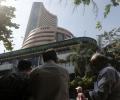
Financials emerged as the top gainers while auto shares rallied on robust September sales
Of the BRIC (Brazil, Russia, India and China) economies, China, Russia and Brazil posted sharper increases in activity, but India registered a fourth successive decline in output.

FY22 will be the year to rebuild with the IMF projecting output growth at 11.5 per cent, economic survey at 11.0 per cent and the RBI's Monetary Policy Committee at 10.5 per cent.

Large investors track high-frequency data that is immediately available today. That data has been bullish, points out Debashis Basu.

Slowdown persists in China. India's GDP estimates for 2015-16 are liable to be pared; projections for 2016-17 are lacklustre.

Wall Street brokerage Goldman Sachs has lowered its estimate for India's economic growth to 11.1 per cent in fiscal year to March 31, 2022, as a number of cities and states announced lockdowns of varying intensities to check spread of coronavirus infections. India is suffering the world's worst outbreak of COVID-19 cases, with deaths crossing 2.22 lakh and new cases above 3.5 lakh daily. This has led to demand for imposition of nationwide strict lockdowns to stem the spread of the virus - a move that the Modi government has so far avoided after the economic devastation last year from a similar strategy.
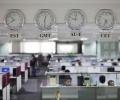
Manufacturing production growth eased in May, which combined with the slowdown in services resulted in a weaker increase in private sector output, the survey said.

Meanwhile, outlook for global emerging markets remained relatively weak in September.
The 30- Share BSE Sensex ended 19924 up 22 points or 0.11 per cent, while the broader 50-share NSE Nifty closed down by 2 points or 0.01 pct at 5907.

Bumper liquidity as a result of global central bank stimulus measures should prevent a sharper downturn.

The latest PMI showed inflation pressures ebbed further last month with both costs of raw material and prices charged rising at a slower pace than March.

A reading below 50 means contraction in the sector.
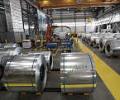
Recent reform measures announced by the government expected to boost the sector.

August witnessed the fastest pace of growth in new business orders since February.
The index, however has remained above the 50 mark - below which it indicates contraction - for more than three years now.
India's manufacturing sector growth improved in November, registering the fastest pace in five months, driven by a strong pick up in new orders and improved purchasing activity, an HSBC survey said on Monday.
Bumper liquidity as a result of global central bank stimulus measures should prevent a sharper downturn.

Both indices are down nearly 9 per cent from their all-time highs in mid-January. A sharp reversal seems difficult this time as the peak impact of the virus is yet to play out.
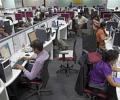

India's manufacturing sector witnessed a slowdown in July - the weakest growth rate since November - because of moderation in domestic and export orders amid sagging global economy, an HSBC survey said.

'Retail investors have been selling since the Budget and Foreign Portfolio Investors started selling.' 'Thus far, domestic institutions have picked up the slack, buying enough to keep the major indices from falling off a cliff.' 'However, there has been carnage in smaller stocks and the financial sector has been hit much harder than the major market indices,' points out Devangshu Datta.

Input prices rose at their fastest rate in 14 months but manufacturers absorbed much of the increase

Private sector output in India expanded for the first time in 8 months in February as slump in the services sector moderated and manufacturing grew at a stronger pace, an HSBC survey said.
The pace of activity in China's vast manufacturing sector quickened for the first time in 13 months in November, a survey of private factory managers found, adding to evidence that the economy is reviving after seven quarters of slowing growth.

The HSBC India Manufacturing Purchasing Managers' Index (PMI) - a measure of factory production - improved slightly to 55 in June, from 54.8 in May.

According to HSBC, the RBI will keep the policy rate on hold next week, although it is likely to cut the CRR by 0.25 per cent to address the lingering liquidity tightness.
.jpg)
The subdued labour market is likely to recover.
A reading above 50 means the sector is expanding, while a reading below 50 means contraction.

Tata Motors was the top Sensex gainer, up nearly 5%.

It was the second straight week of gains for the benchmarks.

India's manufacturing sector growth slowed marginally in February, although strong domestic orders were likely to support output expansion in the coming months, an HSBC survey has said.

The HSBC Emerging Markets Index, a monthly indicator derived from Purchasing Managers' Index surveys, inched up to 50.6 in May from 50.4 in April, indicating weak output growth across global emerging markets.

India's services sector growth rate saw a slight fall in July but remained in the positive terrain for the ninth month in a row, amid rise in new orders and employment levels holding up, an HSBC survey says.

The wider NSE Nifty too fell by 20.15 points or 0.19 per cent to end at 10,749.75.

Amid decelerating economic growth and falling industrial output, India's services sector has shown signs of promise in May recording the fastest pace of growth in the past three months, says an HSBC survey.
