
The new approach emphasises practical understanding and contemporary skills, encouraging students to think critically and apply concepts in real-world contexts, says Srividya Sridhar, principal of Lotus Petal Senior Secondary School.

Art education, physical education and wellbeing, vocational education and interdisciplinary studies will be compulsory.

The new NCERT Class 9 mathematics textbook, 'Ganita Manjari', integrates ancient Indian mathematical systems and historical context, marking a shift from previous editions by emphasising indigenous contributions and linking concepts to ancient texts and scholars.

Union Education Minister Dharmendra Pradhan launched an artificial intelligence and computational thinking curriculum for classes 3 to 8, aiming to integrate structured AI education into the school system.
Union Education Minister Dharmendra Pradhan announced that all high schools in India will have broadband internet connection within the next 2-3 years, with a focus on integrating Artificial Intelligence (AI) into education.

Foreign universities are unlikely to gain major ground in India's higher education market in the near term, as students and families continue to prioritise return on investment over brand value in a highly price-sensitive sector.

The Karnataka government has introduced a draft policy to address the growing concerns surrounding excessive and unsafe digital technology use among students, focusing on mental health, cyber safety, and responsible digital behaviour.

India and New Zealand are set to strengthen their sports collaboration through joint training camps, coaching exchanges, and knowledge sharing in sports science, analytics, and athlete performance systems, marking 100 years of sporting ties in 2026.
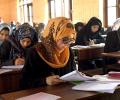
Students can then appear for a board exam in subjects they have completed and feel ready for.

In the academic year 2024-2025, the IB had 258 authorised schools in India, up from 183 schools in 2019.

The National Medical Commission has reintroduced 'sodomy and lesbianism' as unnatural sexual offences in the forensic medicine and toxicology curriculum for undergraduate medical students.
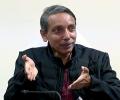
The UGC chief said the NCERT is fully justified in carrying out rationalisation of its textbooks' contents.

This was perhaps a missed opportunity for India to spotlight a core domestic challenge: The scale of workforce preparation required for a young, populous, rapidly growing country seeking to reach net zero, points out Radha Roy Biswas.
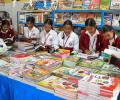
The National Council of Educational Research and Training (NCERT) has removed all references to the Mughals and Delhi Sultanate from its class 7 textbooks. The new textbooks, released this week, have been designed in line with the new National Education Policy (NEP) and the National Curriculum Framework for School Education (NCFSE) 2023, which emphasize incorporating Indian traditions, philosophies, knowledge systems, and local context into school education. The textbooks now include new chapters on ancient Indian dynasties, sacred geography, and government initiatives like Make in India and Beti Bachao, Beti Padhao. The revamp has been met with criticism from opposition parties who equate it with "saffronisation."

According to CBSE officials, an expert committee will be formed and a content development agency may be engaged to ensure updated textbooks are ready for the next academic session.
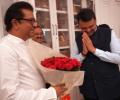
Maharashtra Navnirman Sena (MNS) president Raj Thackeray has slammed the state government's decision to make Hindi a mandatory third language in schools from Classes 1 to 5, calling it an attempt to "Hindi-fy" the state. Thackeray has vowed to oppose the decision vehemently and ensure it is not implemented. The move is part of the new curriculum implementation under the National Education Policy (NEP) 2020, which mandates a three-language formula for classes 1 to 5. Thackeray argues that Hindi is not a national language but a state language and its imposition undermines the principle of linguistic regionalization. He also questioned why Hindi is being forced on Maharashtra but not in southern states. The Opposition Congress has also criticized the move, calling it an imposition of Hindi and a threat to Marathi sentiment. The state government, however, defended its decision, stating that Hindi is a means of communication in the entire country and that Marathi is already compulsory.
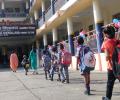
The Indian government has scrapped the 'no-detention policy' for classes 5 and 8 in schools it governs. This means that students in these classes who do not pass the year-end exams will be allowed to fail. The decision comes after the amendment to the Right to Education Act (RTE) in 2019, which has already led to 18 states and union territories doing away with the 'no-detention policy' for the two classes. The new policy will be implemented in over 3,000 schools run by the central government, including Kendriya Vidyalayas, Navaodyala Vidyalayas, and Sainik Schools.

The 19-member National Syllabus and Teaching Learning Material Committee (NSTC) will be headed by National Institute of Educational Planning and Administration (NIEPA) chancellor MC Pant and develop textbooks for classes 3 to 12.

Across all sectors, the future of work depends on adaptability.
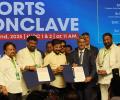
FIFA on Saturday launched its first talent academy for youngsters in India in collaboration with the All India Football Federation (AIFF), aiming to provide advanced training to talented footballers in the country.

The ministry and the Central Board of Secondary Education will hold consultations with school principals next month for conducting board exams twice a year, the sources said.
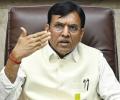
Cabinet approves Khelo Bharat Niti, says it will bring India into top-5 of world sports

The National Council of Educational Research and Training is preparing a report that will focus on general issues like inclusive, compulsory and comprehensive education.

An amended government order issued on Tuesday said Hindi will "generally" be the third language, instead of being mandatory, but gave an option to opt out if 20 students per grade in a school express the desire to study any Indian language other than Hindi.
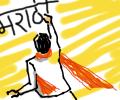
'Maharashtrians are facing a dual battle -- numerical battle with North Indians and financial battle with Gujaratis and Marwaris.' 'This has created anxiety about survival and ownership over Mumbai and Maharashtra.'
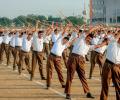
"Gandhi's pursuit of Hindu-Muslim unity provoked Hindu extremists" and "Organisations like RSS were banned for some time" are among the texts missing from the class 12 political science textbook for the new academic session.
Easy but tricky -- that is how the students described the question papers as the examinations for class X and class XII under Central Board of Secondary Education started on Saturday across the country and abroad. For the first time, 20 per cent of the questions required 'high-order thinking skills' as prescribed by the National Curriculum Framework, the guiding document for preparation of NCERT textbooks.
The new pattern announced by CBSE and various State Education Boards will bring in a fresh dose of objectivity into this year's Class X board exams. Here's what students can expect in their board exams next year.
New syllabus, books endorsed by CABE amidst BJP boycott
Keeping exam-related stress in mind, the National Curriculum Framework Report 2005 has made some novel suggestions.

Palshikar and Yadav, who were chief advisors for the original Political Science books for classes 9 to 12, said, "While the modifications have been justified in the name of rationalisation, we fail to see any pedagogic rationale at work here. We find that the text has been mutilated beyond recognition. There are innumerable and irrational cuts and large deletions without any attempts to fill the gaps created.

Do not sound as if you intend to permanently settle overseas, warns Ritika Gupta, CEO and counsellor at AAera Consultants.

The signatories to a letter sent to NCERT Director Dinesh Saklani include Kanti Prasad Bajpai, a former Jawaharlal Nehru University professor who currently serves as the vice dean at the National University, Singapore, Pratap Bhanu Mehta, a former vice-chancellor of the Ashoka University, Rajeev Bhargava, a former director of CSDS, Niraja Gopal Jayal, a former JNU professor, Nivedita Menon, a JNU professor, Vipul Mudgal, the head of civil society watchdog Common Cause, K C Suri, a former professor at the University of Hyderabad who is now associated with the Gitam University, and Peter Ronald deSouza, a former director of the Indian Institute of Advanced Studies.

A number of academicians as well as political scientists Yogendra Yadav and Suhas Palshikar, who were part of the textbook development committee of the NCERT, had asked the council to drop their names from textbooks over 'several substantive revisions of the original texts'.

The textbooks themselves have not been finalised by the National Syllabus and Teaching Learning Material Committee (NSTC), he said.

The National Medical Commission on Thursday withdrew and cancelled guidelines under Competency Based Medical Education Curriculum in which it had reintroduced sodomy and lesbianism as unnatural sexual offences in the forensic medicine and toxicology curriculum for undergraduate medical students.

The Left leader said the NCERT, which was set up on the basis of the 2005 National Curriculum Framework, has been demolishing the very goals of the NCF through the removal of such passages from textbooks.
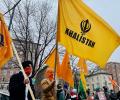
The NCERT has dropped references to the demand for a separate Sikh nation of Khalistan from the class 12 political science textbook following objections from the Shiromani Gurdwara Parbandhak Committee (SGPC), according to top education ministry officials.

As per the NCERT, the decision has been taken to reduce the content load on students in view of the COVID-19 pandemic.

Describing the assessment for preparatory stage (class 3 to 5), the draft recommends that "written tests should be introduced at this stage".
 © 2026 Rediff.com - Advertise with us - Disclaimer - Privacy Policy - Sitemap - Feedback - About us - Terms of use - Grievances