People in the know said plans were afoot to begin the sale of all food grains through online, with a major quantity through auctions that would be later extended to other commodities.

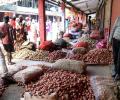
A group of onion traders gathered at the Pimpalgaon Agricultural Produce Market Committee (APMC), near Nashik, to inspect one of the season's final harvests of red onions as they look to place their bids. They were surrounded by farmers, who brought their produce here from different parts of the district. Farmers have reasons to be optimistic.
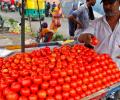
Tomato prices have been on the boil for more than a month. Data from major cities show that the spike has been between 125 and 150 per cent at the wholesale level. Soaring vegetable prices, including tomatoes, pushed the retail inflation rate to a nine-month high of 5.49 per cent in September, according to government data. Though reports say prices are expected to come down in the next few weeks after supplies improve from Madhya Pradesh and Himachal Pradesh, how long will the respite last is anybody's guess.

The price per kilogram of onion came down to Rs 2 to Rs 4, which angered the growers, who had stopped the auction at the APMC last week for a day.

Tomato prices are likely to touch Rs 300 per kilogram in the coming days and the prices of vegetables are also on the rise, according to wholesale traders. Kaushik, a member of Agricultural Produce Marketing Committee (APMC), said that vegetable wholesalers are facing losses as the sale of tomato, capsicum, and other seasonal vegetables has fallen drastically. He said that the prices of tomatoes have shot up to Rs 220 per kilo from Rs 160 per kilo in the wholesale market, owing to which retail prices can also go up.
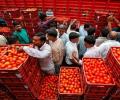
Vegetable vendors and wholesalers have blamed rains for disruption in tomato supply, leading to the price of the kitchen staple skyrocketing in retail markets of the national capital. Local vendors are selling tomatoes in the price range of Rs 80 to Rs 120 per kg, depending on the quality and the localities. Anil Malhotra, a member of the Azadpur Agricultural Produce Marketing Committee (APMC), said tomato prices shoot up every monsoon but it was never this high.

The government and the farmers must come back to the negotiating table with only the interest of the country in mind, suggests Vivek Gumaste.

Farmer Ishwar Gaykar (36), from Pachghar village in Junnar tehsil of Pune district, had faced a difficult decision of dumping a large quantity of harvested tomatoes in May this year due to low prices.

Barely days after imposing a 40 per cent export tax on onions to cool down soaring prices, which, in turn, triggered widespread protests across the main growing belts, the Centre on Tuesday sought to mitigate both political and economic tensions gripping parts of Maharashtra. It decided to procure an additional 200,000 tonnes of onions at Rs 2,410 per quintal for its buffer stock from farmers, a rate that is strikingly close to the price at which they were being exported before the 40 per cent duty was levied on August 19. The export price before the imposition of the duty stood at around $320 per tonne free on board (approximately Rs 2,650 per quintal).

The government's annual Economic Survey on Friday strongly defended new farm laws, saying they herald a new era of market freedom which can go a long way in improving lives of small and marginal farmers in India. These legislations were designed "primarily" for the benefit of "small and marginal farmers", which constitute around 85 per cent of the total number of farmers and are the biggest sufferer of the "regressive" APMC-regulated market regime, the survey said. The pre-budget document defended the farm laws in the backdrop of long-running farmers' agitation at various borders of the national capital seeking repeal of these legislations expressing concern that they are pro-corporate and could weaken government regulated mandis, also called Agriculture Produce Marketing Committees (APMCs).
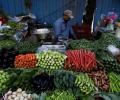
Unprecedented rains and floods in the northern region in the past few days have not only caused extensive damage to lives and property but have also impacted business and commercial establishments. Vegetable prices have gone through the roof in the national capital and many other parts of the country since rains started pouring earlier this month. Traders say vegetable prices would come down only after roads open and skies clear, even as water in the fields will take time to recede.

'As far as contract farming is concerned, we already have a model Act and states will be encouraged to adopt them.'

'On one side you have the farmers of India and on the other side are few corporate families.' 'Unfortunately, those holding the levers of power today are more sympathetic towards these corporate families and helping them benefit at the cost of poor farmers.'

'Crony capitalism will gain due to these Acts.'
Cargill believes the reforms would act as a catalyst in attracting private sector investment in building supply chains for taking Indian farm produce to national and global markets.

Where do the four members of the Supreme Court appointed panel to interface with farmers stand on the Modi government's farm laws?

>The protesters should entrust the final judgement on the farm reform laws to the Supreme Court-mandated committee of experts and return to their villages, argues Virendra Kapoor.

'A perception has been built in our country that whatever Modi says you cannot challenge that.'
The agriculture ministry, in the last few weeks, issued guidelines and letters to states to ensure agriculture and food products reach consumers in a timely manner, while farmers don't have to come to the mandis to sell them.
.jpg)
In most developed markets, there are reporting agencies for spot markets and generally deals took place on the over-the-counter market.

Union leaders, who came out of the meeting venue shouting slogans, said the talks remained deadlocked and some of them threatened to boycott any further meetings if no solution was found at Thursday's meeting.

The President's assent to these bills comes amid the Opposition criticising the manner in which they were passed in Parliament.
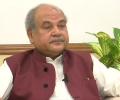
The Congress leadership has become stunted, it does not understand agriculture and the party is trying to mislead farmers for its own vested interests, said Union Agriculture Minister Narendra Singh Tomar.

The national Covid recovery rate was recorded at 98.10 per cent, the data updated at 8 am showed.
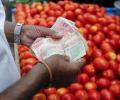
Trade sources believe that tomato supply from Maharashtra has slumped due to incessant rain in the state towards the fag end of the monsoon season, reports Dilip Kumar Jha.

Modi said many farmers benefitted after fruits, vegetables were brought out of APMC Act in some states a few years ago.

The government's predicament is a result of its own doing: That of not ensuring adequate buy-in by the stakeholders before passage of the laws, notes Vivek Gumaste.

'The availability of vegetables has gone down due to fewer arrivals in wholesale mandis. Their supply was disrupted because of low yields and high spoilage,' says Shyam Bhimraoji Karlekar, chairman, APMC Wardha, one of the largest sellers of vegetables in Maharashtra.

The Agricultural Produce Marketing Committee Act of a state regulates the purchase of agricultural products, such as cereals, pulses, fruits and vegetables for that region. It hobbles farmers, imposing multiple levies on produce and disallows direct sales to private companies.

A barrier-free market -- coupled with removal of controls, licensing system, intermediaries and state-imposed levies on farm commodities -- will benefit both sellers and buyers.

'The Modi government is not listening to us. So now we are coming to Delhi to talk with the central government.'

Robust procurement of paddy and wheat since 2017 and prompt payment to farmers have helped the UP government cultivate a positive and pro-farmer perception, defusing possible farm face-off situations.

India's COVID-19 tally rose to 1,11,92,088 with over 18,000 fresh cases being reported in a span of 24 hours in the country after 36 days, while active cases registered an increase for the fourth consecutive day on Saturday and were recorded at 1,80,304, according to the Union health ministry.

While reforms may translate into new opportunities for firms like ITC, Adani Wilmar and Reliance Retail, farmers are unlikely to use it for fear of upsetting commission agents.

A group of 200 farmers will travel to Jantar Mantar from the Singhu border in buses with a police escort and hold protests there from 11 am to 5 pm, sources in the Delhi Police said.

Vegetables and fruits have weights of 1.74 per cent and 2.11 per cent, respectively, in the wholesale price index.
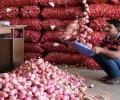
Onion has become costlier by over 33 per cent in the last one week and over 70 per cent in September so far, reports Dilip Kumar Jha.
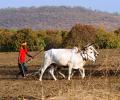
'We will be hoisting the tiranga, but this kind of celebration is uncalled for when the farmers in this country are dying by suicides, their families are ravaged by poverty and farmers are not enjoying any freedom.'

'Government is saying that I will not be responsible for ensuring you get MSP but traders and large corporate will be responsible. 'India now is the only country that is saying such things'

Three union ministers -- Agriculture Minister Narendra Singh Tomar, Food Minister Piyush Goyal and Minister of State for Commerce and Industries Som Prakash -- will hold discussions again with 40 farmer unions' leaders, including the Bharatiya Kisan Union which is spearheading the protests.
 © 2026 Rediff.com - Advertise with us - Disclaimer - Privacy Policy - Sitemap - Feedback - About us - Terms of use - Grievances