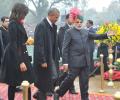
'Reviving the nuclear deal was crucial before the Obama visit... It was time for the BJP to admit that it was wrong, and redo the civil nuclear liability laws.'

Key was not to be left behind and quipped that he is thankful to Modi for not raising his country's poor performance in the series so far. New Zealand were whitewashed 0-3 in the Test series and are trailing in the ongoing five-match ODI series as well.

The CPEC poses a clear and imminent danger to Indian security interests, says Kulbir Krishan.

Jaishankar's talks with Yang and later in the Strategic Dialogue were expected to cover the key India-China differences like China blocking India's bid to join the NSG and UN ban on Azhar.

China will be the nuclear threat of most concern to New Delhi for at least another decade, the latest report by the Arms Control Association says.
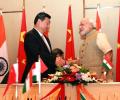
'China's actions at the NSG will certainly taint India-China bilateral relations and enhance suspicion of China's intentions. A fresh clear-eyed and objective evaluation of the India-China relationship is necessary, especially as India tries to correct adversely balanced bilateral economic ties and the two countries engage over the long-term,' says Jayadeva Ranade.
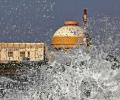
This would make India the world's second-biggest nuclear energy market after China

'India must close the missile technology gap with both China and Pakistan as early as possible, or else the credibility of India's nuclear deterrence will remain suspect,' says Brigadier Gurmeet Kanwal (retd).

For me, Arundhati (Chukku) Ghose was the last word on multilateral economic issues when we worked together in the ministry of external affairs on UN affairs. If her disarmament persona had not made her a celebrity in that area, she would have been known for the work she did in economic matters in different capitals. She was highly respected for her views and no one wanted to be seen on the opposite side of the argument with her. But she was always patient in explaining her position and in accommodating different perspectives, says Ambassador T P Sreenivasan.

'While economic ties are making incremental progress, it is in the security and strategic domains that the India-Japan synergy is more compelling,' says Dr Rajaram Panda.

'Hillary Clinton is no friend of India,' says Rajeev Srinivasan. 'Not that Trump is necessarily one, but at least he gets the benefit of the doubt.'
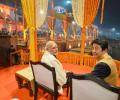
'Modi and Abe are working seriously for India-Japan bonhomie to grow stronger.' 'It is a win-win situation for both countries and the future look promising,' says Rajaram Panda, the Indian Council for Cultural Relations India Chair Visiting Professor at Reitaku University, Japan.

The Nobel Prize for Malala may have caused deep divisions across the globe and disturbed the peace, while the award to OPCW, though not without critics, may have served the cause of peace by eliminating a weapon of mass destruction from the face of the earth, says Ambassador T P Sreenivasan.
'By his very presence in Delhi on Republic Day, Obama is revisiting the most defining relationship of the 20th century after a period of stagnation,' says Ambassador T P Sreenivasan.

As political rivals clamour to retain their pan-Tamil credentials, the BJP may use the 'nationalist' card to even the odds in its favour, says N Sathiya Moorthy.
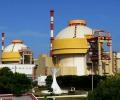
'Decisions on nuclear power have so far been taken by a small select group, primarily interested in profiteering from their actions, stating 'secrecy' as necessary from the national security point.' 'This argument is false, because we are dealing with the 'civilian' nuclear power sector, which is open even to the IAEA,' says Dr A Gopalakrishnan, former chairman of the Atomic Energy Regulatory Board.

The government must justify why we need to buy foreign reactors when we have developed up to 700 MWe unit-size pressurised heavy water reactors, a design which can be easily extended to 900 to 1000 MWe unit size. Why can't the 'Make in India' philosophy apply to indigenous nuclear reactors, more than 18 of which have been designed, built, and being operated by Indian engineers, asks Dr A Gopalakrishnan.

'With the recent challenging of the notion of the Indian Ocean Region being India's strategic backyard, China is gradually upping the ante in the maritime realm around India.'

'Diplomatic engagement will continue even as India keeps all its options open with respect to discretely targeting the Pakistani military and its terrorist proxies.'
