
'What the government should do to create jobs is to help revive the MSME sector.' 'This sector gives employment to lakhs of people.' 'The MSME sector provides more employment than the big industries.' 'So, what should be done immediately is to revive the MSME sector.'

The Supreme Court has refused to interfere with the government and RBI's loan moratorium policy, and declined to extend the six-month loan moratorium period.

Krishnamurthy Subramanian listed land, labour, law, and liquidity as the key areas of big reforms.

The government's Rs 20.97 lakh crore COVID-19 package lacks in addressing the immediate concerns of the economy as the actual fiscal impact of the additional stimulus is only about 1 per cent of the GDP as opposed to the claim of 10 per cent, Fitch Solutions said on Tuesday. Prime Minister Narendra Modi on May 12 announced a stimulus package of Rs 20 lakh crore, or nearly 10 per cent of GDP, to deal with the economic fallout of COVID-19. The contents of the package were broad-based and announced in five tranches.

'In May 2020-2021, nearly 10 crores (100 million) lost jobs. 'Covid is not the reason for the present crisis. It aggravated the crisis.'

'When you don't have food to eat, will you be worried about the virus or the next meal?'

'India never tried to grab land of its neighbours like Bhutan and Bangladesh'
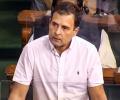
Lending his support to the ongoing farmers protests, he said in Lok Sabha that it was not an agitation of the farmers only but a movement of the country and the government will have to repeal the laws.

The Narendra Modi government on Thusday released the 2017 government calendar. The calendar comes with a theme for every month and has Prime Minister Narendra Modi featured from start to end.

With the world's worst outbreak of COVID pandemic stalling a nascent economic recovery, the government has begun assessing the impact of the second wave of infections on different sectors and may look at providing support at an appropriate time to segments requiring fiscal help. Some of the economic indicators, including the Goods and Services Tax (GST) collections, still provide confidence and incoming data will throw some more light on the state of the economy, sources said. Services sectors like hospitality, tourism and aviation which had just started recovering were hit hard by the second wave of COVID, the sources said, adding these segments might need some support on an urgent basis from the government.
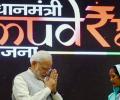
Not only has the Mudra loan mela generated no jobs, it has frittered away trillions of taxpayers' money and it's time to bury the scheme, argues Debashis Basu.

SBI was the top gainer in the Sensex pack, rallying over 10 per cent, followed by Kotak Bank, Dr Reddy's, UltraTech Cement, ITC and HDFC Bank. On the other hand, Axis Bank, Bharti Airtel, ICICI Bank, Maruti and HCL Tech were among the laggards.
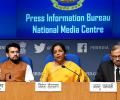
'It was like a doctor giving some simple pain killers to a patient in dire requirement of chemotherapy.' 'There was no sense of urgency or desperation in this particular Budget.'
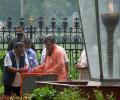
With Narayan Rane, the BJP looks to expand its footprint in Mumbai and Konkan. But a perceived self-goal by him may have galvanised the restive Shiv Sena cadre and voters to coalesce around their party. Dhaval Kulkarni reports

The next meeting of the GST Council will be held on September 28-29 in Goa.
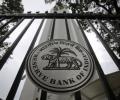
If appointed interim head, Vishwanathan would head the central board meeting scheduled this Friday

Union Minister Nitin Gadkari said opening of transport and highways will go a long way in instilling confidence among the public and cautioned towards maintaining social distance and adopting all safety measures like hand wash, sanitizing, face masks, etc while operating buses and cars.
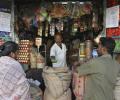
Everyday consumerables, such as grocery and order-in food items are the key buyout sector, analysts say, and a major reason for kirana stores' digitisation push.

'It is because we treat them as our own people, and there is no difference between owners and workers here.'

Chief Economic Adviser K V Subramanian on Monday said the overall impact of the second wave of COVID-19 on the country's economy is not likely to be large but cautioned about an uncertainty surrounding the pandemic going ahead. He further said that given the circumstances due to the pandemic, it is difficult to forecast if the country would achieve a double digit growth in the current fiscal. The Economic Survey 2020-21 released in January this year had projected GDP growth of 11 per cent during the current financial year ending March 2022.
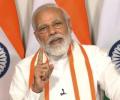
Last month, Prime Minister Narendra Modi had said that the economy is showing "green shoots" as the country emerges from the coronavirus lockdown and underscored the importance of being focussed on both life and livelihood.

'We have already sanctioned loans worth over Rs 3,000 crore to around 120,000 customers.'
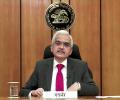
'There are some high-frequency indicators where uptick is visible and some where it is not'

Asserting that the self reliant India programme will help revive the global economy, Prime Minister Narendra Modi on Thursday told global business community that his government aims to transform the country through access, inclusion and empowerment while also ensuring complete data security. Addressing the World Economic Forum's online Davos Agenda Summit, where he also interacted with global business leaders, Modi also said India offers a predictable and friendly environment from tax regime to FDI norms. He said Aatmanirbhar Bharat movement is committed to global good and global supply chain while the country's digital profile has been completely transformed.

Since December 2018, monetary policy has been eased substantially by RBI with policy rates being cut by 75 bps and policy outlook being changed to 'accommodative'.

There are over 26 million MSMEs in the country that provide employment to around 60 million people.

India Inc gave a thumbs up to the UPA-II's last Union Budget before the general elections next year and said Finance Minister P Chidambaram presented a "bold" and "growth-oriented" Budget.
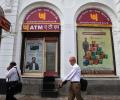
The RBI had on August 7 announced a five-member expert panel under former ICICI Bank chairman Kamath to make recommendations on the required financial parameters for recasting corporate loans.

'If many start-ups lose in this environment, there will be less number of people willing to start new businesses.'

The incremental stress is mainly from sectors including power, infrastructure, constructions, hospitality, iron and steel, telecom, and realty.
The major beneficiaries of loan recasting will be sub-Rs 500 crore corporate exposures and retail exposures, which were earlier expected to see the highest increase in NPAs in percentage terms.

No longer Bengal's finance minister, Amit Mitra, Mamata's principal chief advisor, will still advise and aid the 'chief minister and finance department on all matters relating to management of state finance', represent the 'state government in national and international events/meetings/committees' and examine 'important proposals/files and policy issues relating to financial matters referred to him for advice/views'.
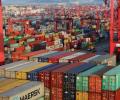
Sectors, which, recorded healthy export growth included electronics, engineering, chemicals, pharma and tea.
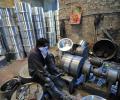
The protocol aims to "democratise" lending, reduce costs of credit, and ensure accessibility of credit to small companies and street vendors, according to Nandan Nilekani.
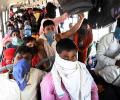
'COVID-19 is just an excuse to pass anti-labour laws.'

The party's research department team, which Rajya Sabha member M V Rajeev Gowda heads, has sifted through the suggestions received in the last five months, and the manifesto is slated to be released later this month, reports Archis Mohan.
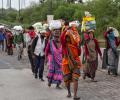
The beneficiaries of the second set of announcements are expected to be micro, small, and medium enterprises, farmers, women, poor, migrant workers, and other marginalised sections of the society, reports Arup Roychoudhury.

In televised remarks after Finance Minister Nirmala Sitharaman presented the budget, Modi said it has many provisions for the agriculture sector, including for making loans easier for farmers.

There are three proposals in the union budget 2013-14 that stand out with respect to start ups and MSMEs.
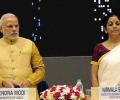
Prime Minister Narendra Modi on Thursday reviewed the impact of Covid-19 on the Indian economy and a possible second stimulus to boost sectors hit hard by the pandemic. Modi held discussions with Finance Minister Nirmala Sitharaman as the pandemic hit sectors from small industries to the aviation sector hard with millions of jobs at stake.
