
As MGNREGA comes to a close, both critics and supporters keenly eye VB G RAM G's performance.

The Indian government has announced the replacement of the Mahatma Gandhi National Rural Employment Guarantee Act (MGNREGA) with the Viksit Bharat Guarantee for Rozgar and Ajeevika Mission (Gramin), or VB-G RAM G Act, 2025, effective July 1. The new scheme aims to expand guaranteed wage employment and link it more closely with infrastructure development and climate resilience, but faces concerns from opposition parties and labour rights activists.

A bill to repeal the MGNREGA and introduce a new rural employment law, the Viksit Bharat Guarantee for Rozgar and Ajeevika Mission (Gramin), has been circulated among Lok Sabha members.
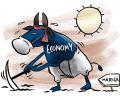
India's post-pandemic recovery appears to be shaping up like the letter K, widening the inequality among states. The last part of the series captures the rising rural distress, as seen through the prism of MGNREGS demand. The pandemic appears to have exacerbated rural distress in the poorest states.
However, ration card, driving licence, voter identity card, Kisan passbook with photo, job card issued under MGNREGS and a certificate issued by a gazetted officer or a tehsildar will be admissible as proof of identity for people to get the benefits under the scheme till the time they get Aadhaar.

The Rural Development Ministry has been allocated Rs 1.88 lakh crore in the Union Budget for 2025-26, around 5.75 per cent more than the allocation in the previous budget.
Almost 63 per cent of the increased allocation of around Rs 1.01 trillion has been spent in the first five months of 2020-21.
Around 40 per cent of the country is staring at drought-like conditions ahead of the monsoon as water levels have receded sharply.

Following the lacklustre growth numbers in the second quarter (Q2FY25), economists believe the upcoming Union Budget for 2025-26 should focus on reforms that will stimulate consumption, manufacturing and spur employment. India's growth unexpectedly slowed to 5.4 per cent in the second quarter, due to low capital formation, weak consumption, besides adverse weather impact.

Jharkhand mining secretary Pooja Singhal, earlier arrested and remanded to the custody of the ED in a suspected money laundering case, was suspended by the Jharkhand government on Thursday, an official said.

Congress leader Rahul Gandhi launched a scathing attack on Prime Minister Narendra Modi and former Delhi Chief Minister Arvind Kejriwal, accusing them of neglecting the welfare of backward sections, Dalits, tribals, and minorities. Gandhi promised a caste census in Delhi if the Congress forms the government, echoing his national call for removing the 50 percent cap on reservations. He also criticized Kejriwal's governance, drawing parallels with Modi's alleged reliance on propaganda and false promises. The Congress and AAP are part of the INDIA bloc, but are contesting the upcoming Delhi assembly polls separately. Gandhi's speech highlights the growing political tension ahead of the polls, where the Congress aims to regain its foothold in Delhi.
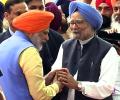
Whether it was the MGNREGS or the NFSA or the Aadhaar-based DBT scheme for cash transfer, the Modi government has built on the basic architecture created by the Singh government. Policy makers in the Modi government, instead of discarding them as products of the previous political regime, worked on them, expanded their scope and reach, and used new tools to improve their performance, explains A K Bhattacharya.
To minise wasteful administrative costs, number of enterprises in strategic sectors will ordinarily be only one to four; others will be privatised/merged/brought under holding companies, she said.

'There is no immediate threat to the government, and they would prefer the growth agenda.'

Using the Mahabharat reference as a leitmotif, Leader of Opposition in the Lok Sabha Rahul Gandhi on Monday claimed that an atmosphere of fear prevails all around with a group of six trapping the entire country in a 'chakravyuh' he promised would be broken by the INDIA bloc.

With the fiscal deficit target staring at the government, the FY25 Budget has limited expenditure options, points out A K Bhattacharya.

Few finance ministers announce any taxation measure that could upset the stock market. Ms Sitharaman decided to take that risk, observes A K Bhattacharya.

The Congress has so far announced 82 candidates for the seven-phase Lok Sabha polls beginning April 19.

The Union government is projected to share about 32 per cent of central taxes with states during the financial year 2024-25 against the 15th Finance Commission's recommendation of 41 per cent. The Revised Estimates (RE) for FY24, too, show a similar share of states in the central taxes at 32 per cent. In absolute terms, however, there has been an increase in the amount devolved to states compared to the Budget Estimates (BE) for FY24 at Rs 11 trillion.
Many farmers in drought hit states are seeking MGNREGA work but the state government's coffers do not have enough fund to pay the salaries of these workers.
The deficit stood over Rs 8 trillion in the first seven months of the current financial year. Non-tax revenues, comprising transfers from the RBI and dividends of the public sector units, shored up the Centre's revenues.
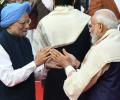
False and acrimonious debates such as Modi versus Manmohan might allow for victories that are political and partisan. But the real loser is the nation, India and Bharat, notes Arvind Subramanian, former chief economic advisor to the Modi government in its first term.
Sources in the Rural Development Ministry said the actual expenditure incurred in 2020-21 will be higher than the allocated funds and it will at least be at par with this year's total estimated expenditure of MGNREGS.
Enthused by higher than expected GDP numbers in the fourth quarter of 2022-23, Chief Economic Adviser (CEA) V Anantha Nageswaran on Wednesday said India's economic growth may exceed the initial estimate of 6.5 per cent in the current fiscal and the country can look for another year of solid economic performance.
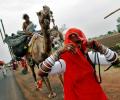
'We cannot leave our entire unorganised sector to the vagaries of market forces.'

NITI Aayog has not said what the reasons were for having achieved or not having achieved what was sought to be achieved, or what lessons can be learned for the future, points out Aakar Patel.

Per capita income has more than doubled to Rs 1.97 lakh in around nine years. Indian economy has increased in size from being 10th to 5th largest in the world in the past nine years. Seven priorities of the Budget, 'Saptarishi', are inclusive development, reaching the last mile, infrastructure and investment, unleashing the potential, green growth, youth power and financial sector.

The plan could mature into either an umbrella programme for urban youths similar to the Garib Kalyan Rozgaar Abhiyaan or a modified urban-focused version of MGNREGS.

Launching the scheme, Modi said during the nationwide lockdown, the talent from cities returned to villages and it will now give a boost to development of rural areas. The 'Garib Kalyan Rozgar Abhiyaan' will be implemented on a mission mode in 125 days in 116 districts of six states -- Bihar, Madhya Pradesh, Uttar Pradesh, Rajasthan, Jharkhand and Odisha -- that received the maximum numbers of migrant workers back.

Good monsoon is likely to create more jobs in the agriculture sector, which in turn could save the exchequer around Rs 10,000 crore

A total of 22.05 crore applications were received during the period.
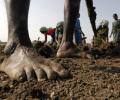
Data captured in central government records have a lag.

Both prime ministers believed in crafting schemes to help the common man. Modi used quite effectively the instruments Dr Singh introduced. In assessing Modi's success with many schemes, Dr Singh's fundamental work should not be ignored, points out A K Bhattacharya.

Of these 8.5 million additional people employed in September, 6.5 million were in rural India, reveals Mahesh Vyas.
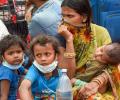
For states like West Bengal, Bihar, Odisha, Jharkhand and Uttar Pradesh, where migration is high, the return of workers could be as much an opportunity as a liability. All states have launched portals to register migrant workers; additional fields like nature of employment and remuneration in the past 2-3 years are being added to help in skill mapping.

The current estimate, however, largely covers only the cost of infrastructure such as pipes, construction of borewells, overhead costs among others and not the expenditure to be incurred on operation and maintenance.
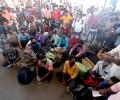
May 2021 will end with double-digit unemployment rate, falling employment rate and substantial loss of employment, points out Mahesh Vyas.
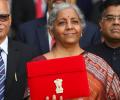
Had Finance Minister Sitharaman thought a little more about the middle class, disadvantaged sections, and the poor who are struggling, it would have been an inclusive Budget that would have made history, notes Ramesh Menon.

Budget has already bombed at the box office and passing it without a revisit will be a mockery of the exercise though any modification may be short lived and perfunctory, observes V Ranganathan.

The rural development ministry has asked NGO's to run the Mahatma Gandhi National Rural Employment Guarantee Scheme in in Naxal-hit areas.
