The main elements of the programme are bilateral meetings with the US leadership, participation in the Quad Leaders' Summit, address at the UN General Assembly and business interactions.

Prime Minister Modi's visit saw India and the US signing several major deals to boost cooperation in key areas such as defence, space and trade.
The Indian High Commissioner to the United Kingdom, Vikram Doraiswami, who was touring Scotland this week was blocked from entering a gurdwara in the capital Glasgow by pro-Khalistan extremists.
Pompeo will travel to India, Sri Lanka, Japan and South Korea from June 24 to 30. His four-nation is aimed at deepening US partnerships in the strategic Indo-Pacific region.

It is understood that India's border row with China figured in the talks between Foreign Secretary Harsh Vardhan Shringla and US Under Secretary of State for Political Affairs David Hale though there was no mention of it in the press statements issued by the two sides.

According to the Biden-Harris Transition, 'the president-elect noted that he looks forward to working closely with the prime minister on shared global challenges, including containing COVID-19 and defending against future health crises, tackling the threat of climate change, launching the global economic recovery, strengthening democracy at home and abroad, and maintaining a secure and prosperous Indo-Pacific region'.
'This includes increasing restrictions on freedom of expression and the detention of human rights activists and journalists'

Modi's visit to the US will commence in New York, where he will lead the celebrations of the International Day of Yoga at the headquarters of the United Nations on June 21.
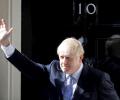
UK Prime Minister Boris Johnson was supposed to be the chief guest at Republic Day, but due to the surge in COVID-19 cases in the UK and the spread of a new strain, he cancelled his visit. Johnson is scheduled to visit India in April.

Ahead of the Quad summit on Friday, China said exchanges and cooperation between countries should contribute to mutual understanding rather than "targeting" a third party and refrain from "pursuing exclusive blocs".

Shringla said India will continue to work towards the reformed United Nations during its stint as a non-permanent member of the UN Security Council.

Announcing the hotline, the Chinese defence ministry said as agreed upon by the defence departments of China and Japan, the two sides have recently completed the construction of a direct telephone line for the sea and air liaison mechanism and will maintain communication on the arrangement for the launch.

It is the first mega exercise involving the two aircraft carriers after induction of the indigenously-built INS Vikrant in September.

The bilateral and Quad summits, in which Prime Minister Modi played a significant role, has sent the right message to China, observes Ambassador T P Sreenivasan.
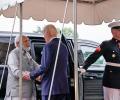
Foreign policy is always a work in progress and ups and downs are built into foreign policy process. What is permanent is national interest. Hopefully, this year, which will also witness general elections in the country, will also clear clouds in the foreign policy horizon, observes Rup Narayan Das.

'India should not be taken by surprise if the Biden administration seeks China's cooperation at some point,' alerts Ambassador M K Bhadrakumar.

One looks upon the coming new year with foreboding as current wars in Ukraine and Gaza spill over and escalate and new ones erupt in incipient fault lines across the world, notes former foreign secretary Shyam Saran.
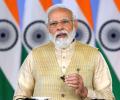
Modi emphasised the need to return to a path of dialogue and diplomacy in dealing with the Ukraine crisis.
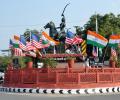
Kurt Campbell, the White House Asia Coordinator, said that in his view India is the most important bilateral relationship for the United States in the 21st century.

For the first time, the MiG-29K fighter aircraft undertook night landing on indigenously-built aircraft carrier INS Vikrant, a feat described by the Indian Navy as a 'historic milestone'.

Navy said the landing demonstrated India's capability to design, develop, construct and operate indigenous aircraft carrier with indigenous fighter aircraft.

Prime Minister Narendra Modi and his Japanese counterpart Yoshihide Suga met in Washington, DC, on Thursday to discuss ways to further cement the bilateral strategic ties ahead of the first in-person Quad meeting to be hosted by US President Joe Biden.
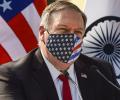
Severely critical of China, Pompeo, cited killing of Indian Army personnel in the Galwan Valley in eastern Ladakh in a clash with the Chinese military, and asserted that both India and the US are taking steps to strengthen cooperation against all threats and not just those posed by the Chinese Communist Party.
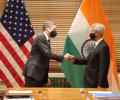
'We know that our Indian partners are committed to that rules-based international order. There are any number of tenets in that order. One of them is that borders cannot be redrawn by force'

'Countries around the world are like passengers aboard the same ship. For the ship to navigate the storm and sail toward a bright future, all passengers must pull together'

After his wide-ranging talks with Modi on the second and final day of his India visit, Johnson said the new defence and security partnership will enable India to strengthen its domestic defence industry as well as help the two countries protect vital shared interests in the Indo-Pacific.
US Defence Secretary Llyod Austin described China as a pacing challenge for the United States.

The virtual meeting between the two leaders came in the midst of some disquiet in Washington over India's position on the Ukraine crisis as well as its decision to procure discounted Russian oil.
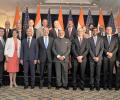
Prime Minister Narendra D Modi's itinerary for his June 21-24 US visit could include an address to a fledgling business advocacy group, the US-India Strategic Partnership Forum.
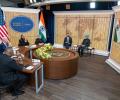
The virtual meeting comes in the midst of some disquiet in Washington over India's position on the Ukraine crisis as well as its decision to procure discounted Russian oil.

Trade tensions between India and the US have been rising with President Donald Trump complaining that tariffs imposed by New Delhi on American products were "no longer acceptable".
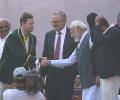
Prime Minister Narendra Modi and his Australian counterpart Anthony Albanese will hold extensive talks on Friday with a focus on boosting overall bilateral ties in areas of trade and investment, defence and critical minerals.
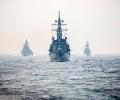
'Any future course of action towards active participation in the alliance when formed would need a lot of deliberation, long term vision and should be in our best national interests,' notes Commodore Vengalil Venugopal (retd).
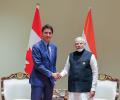
'They are too connected for the relationship to completely sour.' 'It will be difficult to mend this relationship, but it will start with full and clear evidence on the issue in question.'

The agreement will allow sharing of high-end military technology, classified satellite data and critical information between the two countries.

Had India agreed to join the trade pact, Indian markets would have been flooded with cheap Chinese products.
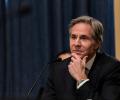
The two sides are also expected to explore ways to deepen defence collaboration, including exercises, defence transfers and technologies ahead of the next edition of the 2+2 defence and foreign ministerial dialogue to be held in the US later this year, they said.

External Affairs Minister S Jaishankar has said India faces a 'very complicated challenge' from China, and the Narendra Modi government has taken steps to ensure no attempts are made to change the status quo in the border areas unilaterally.
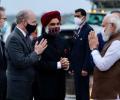
Prime Minister Narendra Modi on Thursday is scheduled to have as many as eight meetings, including with Vice President Kamala Harris, on the first working day of his current US trip.
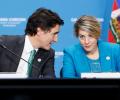
'The Americans want to have a good relationship with India. They see it as a counterweight to China. And also American businesses are all trying to get out of China and go to India and Vietnam as well, but India largely.'
