
Russian President Vladimir Putin will make a two-day visit to India from December 4 to hold annual summit talks with Prime Minister Narendra Modi that is expected to produce a plethora of significant outcomes, including in the defence sphere, to further solidify the bilateral strategic ties.

China has reacted positively to Russian President Vladimir Putin's visit to India, emphasizing the importance of trilateral ties between China, Russia, and India for regional and global peace and stability.

India and Russia have agreed to encourage joint manufacturing of military hardware and spare parts in India, aiming to improve maintenance of Russian-origin defence equipment and boost overall bilateral defence cooperation.

Russian President Vladimir Putin's visit to India this week aims to secure energy supplies, stabilise defence deliveries and ensure bilateral trade continues smoothly despite strong Western sanctions, GTRI said on Tuesday.
However, these are understood to be exploratory talks, with an agreement unlikely to be formalised during the current visit.

Congress leader Rahul Gandhi alleges the government discourages foreign dignitaries from meeting the Leader of the Opposition due to insecurity, breaking established traditions.

The enduring relationship between the two countries have survived the disintegration of the erstwhile USSR in 1991, the end of the Cold War and the regime change in both countries, points out Rup Narayan Das.

'Don't look at Russia only as a place to earn quickly and then leave.' 'Try to build experience in serious companies, skills and certifications that will serve you anywhere in the world.'
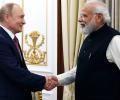
Russian President Vladimir Putin is expected to visit India around December 5 to hold annual summit talks with Prime Minister Narendra Modi to further solidify bilateral strategic ties.
Russian President Vladimir Putin will visit India in December for an annual summit with Indian Prime Minister Narendra Modi, the Kremlin said.
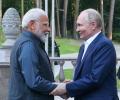
The Indian government is dealing with the matter having in mind the national interests of this country in the first place, he said.
Prime Minister Narendra Modi spoke with Russian President Vladimir Putin, discussing the Ukraine conflict and reaffirming the commitment to deepen the India-Russia strategic partnership. The conversation occurred amid US pressure on India over Russian oil purchases.

New Delhi, while opting not to retaliate yet to the American tariffs, has in recent weeks sought to reinforce its friendship with Moscow, and recalibrate its ties with Beijing rather than surrender to Washington's diktats.

Sanctioning Russian oil would have led to a sharp surge in oil prices to above $80 per barrel levels, which would impact pump prices in the US ahead of midterm elections next year.
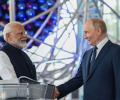
Prime Minister Narendra Modi conveyed to Russian President Vladimir Putin that India is ready to make all possible contributions towards a peaceful resolution of the Ukraine conflict.

The Indian government has expressed its disagreement with the IMF staff's 'baseline' assumption that the 50 per cent US tariffs on its goods exports 'would remain in place indefinitely', based on which the staff pegged the country's GDP growth at 6.6 per cent this year, and pared its 2026-27 projection by 20 basis points to 6.2 per cent.
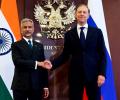
External Affairs Minister S Jaishankar has called for India and Russia to adopt a creative and innovative approach to address complex geopolitical challenges, emphasizing diversification and expansion of cooperation.

India should simultaneously prioritise domestic exploration and production of more oil and gas in the country, and ensure we retain diversified suppliers for imports, points out former foreign secretary Ranjan Mathai.

The legendary Mikoyan-Gurevich MiG-21 fighter jets, the the backbone of the Indian Air Force's combat fleet for more than six decades, streaked through Indian skies for the last time on Friday -- its final adieu edged in history and many a remembrance.

'There are times when India should stand up without hesitation and voice its indignation over the US' pressure tactic. This is one such moment,' asserts Ambassador M K Bhadrakumar.
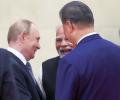
Navarro's remarks came after the public display of bonhomie by the three leaders on the sidelines of the Shanghai Cooperation Organisation (SCO) summit in Tianjin on Monday.

A senior Russian diplomat has called the US pressure on India for its procurement of Russian crude oil "unjustified," expressing confidence in continued energy cooperation between India and Russia despite external pressures.
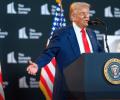
Former White House official John Bolton suggests that tariffs imposed on India by the US for purchasing Russian oil may have unintended consequences, potentially driving New Delhi closer to Beijing and Moscow.
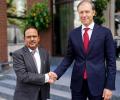
National Security Advisor Ajit Doval met with Russian First Deputy Prime Minister Denis Manturov to discuss bilateral military-technical ties and implementation of joint projects in strategic sectors. The meeting comes amid growing US pressure and tariffs on Indian goods.
The US House Foreign Affairs Committee Democrats stated that imposing tariffs on India will not deter Russian President Vladimir Putin or address Russia's invasion of Ukraine.

Former White House trade advisor Peter Navarro accuses India of being an 'oil money laundromat' for Russia, alleging that India's oil purchases are funding Putin's war in Ukraine. The accusations come amid existing trade tensions and tariffs imposed by the US.

India and Russia always stood "shoulder-to-shoulder" even in the most difficult situations, Prime Minister Narendra Modi told Russian President Vladimir Putin on Monday, against the backdrop of possibly the worst phase in New Delhi's ties with the US in over two decades.
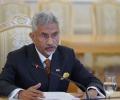
The relations between New Delhi and Washington are on a downturn after Trump doubled tariffs on Indian goods to a whopping 50 per cent, including 25 per cent additional duties for India's purchase of Russian crude oil.

By threatening to punish India with high tariff, Trump is actually planting a tantalising thought in the Indian mind that the Modi government should suitably 'incentivise' him, explains Ambassador M K Bhadrakumar.
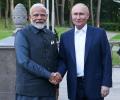
Russian President Vladimir Putin has accepted Prime Minister Narendra Modi's invitation to visit India for the annual high-level meeting as the two leaders held a telephone conversation, the Kremlin said on Monday.
'We need to be very vigilant as we are passing through some fraught times.'

India and Russia on Tuesday set a target of $100 billion in annual trade volume by 2030 and vowed to develop a robust bilateral payment settlement mechanism using national currencies. The two sides also inked a total of nine agreements to further broadbase cooperation in a range of areas including in the economic domain following summit talks between Prime Minister Narendra Modi and Russian President Vladimir Putin.
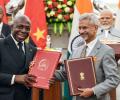
India's External Affairs Minister S Jaishankar has called on Europe to display sensitivity and mutuality of interest for deeper ties with India, stating that New Delhi seeks partners, not "preachers." Jaishankar emphasized the importance of "Russia realism" in India's foreign policy, highlighting the natural complementarity between India and Russia as a resource provider and consumer. He criticized attempts by the West to address the Russia-Ukraine conflict without Russia's involvement, arguing it "challenged the basics of realism." Jaishankar also stressed the importance of finding common ground with the US, suggesting that focusing on mutuality of interest rather than ideological differences is key to successful engagement.

Russia on Monday accused the US of "actively" exploiting the "contradictions" between India and China to its advantage and asserted Moscow and New Delhi accumulated mutual trust and confidence based on decades-old ties that would help the two sides to deal with the current geopolitical turbulence.

Singh and Shoigu held extensive talks, covering the regional security situation and key aspects of bilateral defence relations, including industrial partnership, at a meeting on the sidelines of a conclave of the Shanghai Cooperation Organisation (SCO) in New Delhi.

In the document, Russia underlined that it will build on a privileged strategic partnership with India with a view to enhance and expand cooperation in all areas on a mutually beneficial basis.
He further criticised South Africa's use of the G20 platform to promote "solidarity, equality, and sustainability" to promote "Diversity, Equity, and Inclusion (DEI) and climate change."
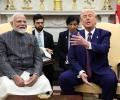
'Trump administration wanted a positive tone at this summit, but there was still some anxiety that there could be some awkward moments -- and there were not.'
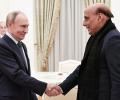
'Friendship between our countries is higher than the highest mountain and deeper than the deepest ocean,' the defence minister told the Russian president.

In his opening remarks at the talks, Defence Minister Rajnath Singh asserted that India is confident of overcoming the challenges with a strong political will and an inherent capability of its people.
