
Despite geopolitical tensions and FII outflows, Indian small and midcap stocks have not only recovered losses but are also outperforming largecap indices, driven by attractive valuations, domestic institutional support, and a rebound in earnings.

The rupee plunged to a fresh low of 93.72 against the dollar on Friday, falling 1.15 per cent in a single session - its sharpest one-day decline since February 24, 2022 - as elevated crude oil prices and strong dollar demand from oil-marketing companies and foreign portfolio investors (FPIs) weighed on the currency.

After two months of net outflow, foreign investors turned buyers in June, infusing Rs 26,565 crore in Indian equities, driven by political stability and a sharp rebound in markets. Looking ahead, attention will gradually shift towards the budget and Q1 FY25 earnings, which could determine the sustainability of FPI flows, Vipul Bhowar, Director, Listed Investments, Waterfield Advisors, said.
The rupee on Monday failed to maintain initial gains and ended lower by five paise at 60.21 against the dollar on fag-end demand for the US currency from banks and importers.

The rupee had retreated from three-week high and ended six paise down at 60.67 against the dollar on demand from importers for the US currency in Thursday's trade.
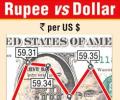
A weak dollar overseas failed to restrict the rupee's decline, a forex dealer said.

In dull trade, the rupee on Monday ended a mere two paise lower at 60.20 against the US dollar on weak local equities and imported-driven demand for the American currency.
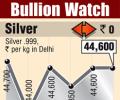
However, FII outflows of Rs 545 crore (Rs 5.45 billion) capped the gains in the rupee, which had slumped by 126 paise in past two days.

Tracking local stocks, rupee on Tuesday regained 19 paise to end at 61.85 against dollar as reports of easing geopolitical tension between Russia and Ukraine helped emerging market currencies script a smart recovery.

The rupee on Thursday appreciated 20 paise to end at 62.37, its highest in two weeks, on positive trends in local equities and fresh dollar selling by exporters.

Continuing its range-bound movement for the fourth session, the rupee today closed up by two paise at 59.25 ahead of industrial output and retail inflation data.

The local currency had lost 119 paise in the past five sessions on rising worries over current account gap and fears that withdrawal of US stimulus will hit inflows from overseas.

At the Interbank Foreign Exchange market, the domestic currency resumed stable at its overnight close of 60.07 a dollar and immediately touched a low of 60.09.
The rupee on Tuesday gained 29 paise to close at seven-month high of 60.48 against the dollar on sustained selling of the US currency by exporters and banks.

Capital inflows continued to aid the rupee's rise, although a strong dollar overseas capped the gains.

However, the hefty initial gains of the rupee, which had jumped to 61.05 intra-day, were substantially erased on month-end demand for US dollars from private oil firms and some defence-related purchases, amid fall in domestic stocks.
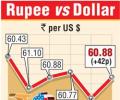
The local currency opened higher at 61.20 a dollar from the previous close of 61.30 at the Interbank Foreign Exchange Market.

The rupee weakened by 27 paise to trade at six-week low of 60.45 against the US dollar in early trade today at the Interbank Foreign Exchange market on high demand for the American currency from importers.

The rupee on Wednesday snapped its two days of losses and edged up two paise to end at 59.27 against the dollar following late selling of the US currency by exporters.
.jpg)
Some analysts believe that markets are expected to remain unclear and would have to wait until tomorrow's US non-farm payrolls data.
.jpg)
Snapping a two-day fall, the rupee opened strong at 59.49 a dollar from the previous close of 59.76 at the Interbank Foreign Exchange Market and then touched a low of 59.59.

After another day of volatile trade, the rupee today appreciated by seven paise to close at a new one-month high of 59.04 against the dollar as the RBI's liquidity-tightening measures continued to lend support.

After a day's respite, the rupee on Wednesday fell by 29 paise, its biggest single day fall in a week, to end at 56.73 today due to heavy dollar demand from importers amid renewed concerns over withdrawal of US monetary stimulus.

Rs 1,000 now buys $13.5 against $14 a year ago.
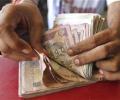
Month end dollar demand from oil importers has forced rupee to trade weak.

Increased demand from oil importers for the American currency and a weak opening in the domestic stock market also put pressure on the rupee.

With days to go before the new tax regime around crypto assets kicks in, several investors are reportedly either booking profits, rejigging their portfolios or moving their crypto assets to their private wallets outside of India. Starting April, gains from trading in crypto and other virtual assets like non-fungible tokens (NFTs) will be taxed at a flat 30 per cent, as announced in the Union Budget. And, 1 per cent of tax will be deducted at source (TDS) on every transaction involving crypto and other virtual assets. The new tax regime also bars investors from offsetting losses from one crypto asset (such as Bitcoin) against gains from another (say, Ethereum).

Record equity divestment by the Reliance Group in its telecom and retail businesses garnering around $23 billion revved up the deal street in 2020, which otherwise would have gone down as one of the dullest on record, and dealmakers are seeing sunnier days in 2021 given the large scope for consolidation in a slew of sectors ravaged by the pandemic. With Jio Platforms alone garnering over $16 billion (Rs 1,18,318 crore) by selling 25.24 per cent stake and Reliance Retail notching up $6.4 billion (Rs 47,265 crore) by divesting around 9 per cent shareholding, the deal street signed off with $85 billion in the deal kitty across 1,270 transactions. This is higher by about 10 per cent over 2019. What is significant is that over a third of the total deal value came from Reliance transactions, say investment bankers.

'A time-wise, as well as price correction, so that the market can absorb the gains made over the past 17 months.'

Since its peak, the S&P BSE Sensex has dropped nearly 3,000 points.

Cashi Crisis: Day 9: Aaj ki Taaza Khabar!
 © 2026 Rediff.com - Advertise with us - Disclaimer - Privacy Policy - Sitemap - Feedback - About us - Terms of use - Grievances