
The space agency said the Mission Operations Complex (MOX), located at the ISRO Telemetry, Tracking and Command Network (ISTRAC) in Bengaluru, is buzzing with energy and excitement.

Indian Space Research Oganisation (ISRO) on Sunday said it has successfully performed the first earth-bound manoeuvre of the country's maiden solar mission, Aditya L1, from ISRO Telemetry, Tracking and Command Network (ISTRAC) in Bengaluru.

The next operation - reduction of orbit- will be done at 11 PM on Sunday, ISRO added.

Aditya L1, the first space based Indian mission to study the Sun underwent the second earth-bound manoeuvre successfully, during the early hours on Tuesday, Indian Space Research Organisation (ISRO) said.

August 23, the day the Chandrayaan-3 lander touched down on the lunar surface, would be celebrated as 'National Space Day'.

ISRO on Monday said a two-way communication between the Chandrayaan-2 orbiter and Chandrayaan-3's Lunar Module has been established.

Aditya-L1 is the first Indian space-based observatory that will study the Sun from a halo orbit around the first Sun-Earth Lagrangian point (L1), which is located roughly 1.5 million km from the Earth.

Chandrayaan-3 is now in an orbit, which when closest to Earth is at 173 km and farthest from Earth is at 41,762 km, the space agency said.

Chandrayaan-3 mission's lander 'Vikram' chose a relatively flat region on the lunar surface to touch down, images captured by its camera showed.
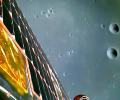
Taking to X (formerly Twitter), ISRO said, "Chandrayaan-3 Mission. Chandrayaan-3 Rover to MOX, ISTRAC, Moon walk begins!"
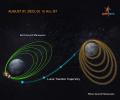
The ISRO had said it would attempt softlanding on the lunar surface on August 23.

Shifting the focus to its next space odyssey after successfully placing a lander on the moon's uncharted South Pole region, the Indian Space Research Organisation (ISRO) chief S Somanath on Saturday said that the country's maiden solar mission Aditya-L1 is ready and will be launched in the first week of September.

A visibly emotional Modi addressed scientists at the Indian Space Research organisation's command centre in Bengaluru, who were involved in the Chandrayaan-3 mission and lauded them for their efforts.

Here is a glimpse of the journey of India's third lunar exploration venture has taken so far.

'Today onwards, the onboard thrusters will be fired and Chandryaan-3 will be taken away from Earth for an eventful landing on Moon's surface on August 23'

India is now on the Moon and the success of the lunar mission has sounded the bugle for the emergence of a developed nation, Prime Minister Narendra Modi said on Wednesday as Chandrayaan-3 landed successfully on the lunar surface.
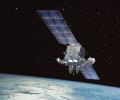
The Indian Space Research Organisation said it successfully carried out an "extremely challenging" controlled re-entry experiment of the decommissioned orbiting Megha-Tropiques-1 (MT-1) satellite.

'I am extremely excited to be at the ISRO Centre in Bengaluru to witness the extraordinary moment in the history of India's space programme,' Modi tweeted earlier in the day.
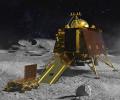
ISRO chairman K Sivan said the proposed soft-landing was going to be a 'terrifying' moment.

The Chandrayaan-2 spacecraft is expected to reach the moon's orbit on August 20 and land on lunar surface on September 7.

An ISRO official said: "Unless and until everything is intact (lander), it's very difficult (to re-establish contact). Chances are less. Only if it had soft-landing, and if all systems functioned, then only communication can be restored. Things are bleak as of now."

There will be two more orbit manoeuvres to make the spacecraft enter into its final orbit passing over the lunar poles at a distance of about 100 km from the Moon's surface.

All spacecraft parameters are normal, the Bengaluru headquartered space agency said after the maneuver.

The New York Times, The Washington Post, The BBC and The Guardian, among many other leading foreign media outlets, all carried stories on Chandrayaan-2, India's landmark moon mission.

Hours before Chandrayaan-2's 'Vikram' module's proposed soft landing on the Lunar surface, Indian Space Research Organisation chairman K Sivan said on Friday things are progressing as per plan for the much-awaited event.

Two de-orbit manoeuvres of Vikram Lander, to bring it further down, have been planned to prepare for its landing in the south polar region of the moon.

"Since its injection into Earth's orbit yesterday, it has been functioning smoothly on the orbit. We are planning to perform orbit raising manoeuvres in the early hours of of Thursday," an Indian Space Research Organisation spokesman told PTI over phone.
'The unflappable temperament and nerves of steel under extreme pressure -- essential ingredients in space research -- were on full display in the rows occupied by the scientists still engrossed in their monitor screens,' says Minnie Vaid, author of Those Magnificent Women And Their Flying Machines, ISRO's Mission to Mars.

Indian Space Research Organisation's plan to soft land Chandrayaan-2's Vikram module on the Lunar surface did not go as per script in the early hours of Saturday, with the lander losing communication with ground stations during its final descent.
