
The fee hike for the US H-1B visa by the Donald Trump administration has no short-term impact on Tata Technologies Ltd, although it will change resourcing plans for the future, according to its CEO and managing director, Warren Harris.

In a major shift from his earlier stance, United States-President elect Donald Trump has expressed his support for the H-1B visa programme and acknowledged frequently using it for his own properties, calling it a 'great programme', according to a report by New York Post.

Indian Americans contribute approximately 5% to 6% -- roughly $300 billion -- in federal tax revenues annually.

'If the Trump administration decides to put guardrails on H-1B visas, that will surely impact both US and Indian firms.'

US Vice President JD Vance and Prime Minister Narendra Modi held a phone call to discuss expanding the India-US comprehensive global strategic partnership, focusing on trade, defence, energy security, emerging technologies, and critical minerals. The discussion comes amidst rising tensions in West Asia and recent regional realignments, with both leaders reaffirming their commitment to strengthening cooperation.
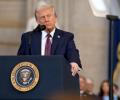
Trump also said that he has also used the H-1B visa programme.

Tech Mahindra's net profit declined 4.5 per cent to 1,195 crore in the September quarter over a year earlier. It was, however, slightly higher than 1,141 crore sequentially.

Indian-origin tech companies cornered a fifth of all H-1B visas issued by the US with Infosys and Tata Consultancy Services leading the pack, an analysis of data from the US immigration department showed. According to data from the US Citizenship and Immigration Services, in April-September 2024 period, out of the total 1.3 lakh H-1B visas issued to different employers, about 24,766 visas were issued to Indian-origin companies.

The US needs to understand that it could potentially lose out on attracting several Netravalkars in the future if it curbs the influx of such industrious Indian immigrants, argues Vishal Menon.
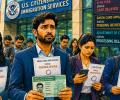
This could come as a setback to thousands of Indian engineers who have waited for years for their work visas to pave the way for the coveted Green Card.

With the duration of stay capped at four years, the biggest impact of the new F-1 visa rules is likely to be on PhD scholars, students enrolled in longer professional programmes, those whose graduation gets delayed and students moving from one academic programme to another, highlight education experts.

The US has received a sufficient number of petitions needed to reach a cap for the much-sought-after H-1B foreign work visas for the fiscal year 2024, a federal agency has announced. The H-1B visa is a non-immigrant visa that allows US companies to employ foreign workers in speciality occupations that require theoretical or technical expertise. Technology companies depend on it to hire tens of thousands of employees each year from countries like India and China.

Elon Musk, who has previously vowed to "go to war" to defend the H-1B visa program, has reignited debate surrounding the program by labeling it "broken" and in urgent need of "major reform." Musk, along with Indian-American tech entrepreneur Vivek Ramaswamy, has been tapped by Trump to lead his Department of Government Efficiency (DOGE). While Musk acknowledges the need for foreign workers in the tech industry, he believes the current H-1B system needs significant changes, including raising the minimum salary and adding a yearly cost for maintaining the visa. The H-1B visa, which allows US companies to employ foreign workers in specialty occupations, has been a subject of debate for years. The tech industry advocates for more H-1B visas to attract highly skilled workers, while some argue that it allows businesses to replace Americans with lower-paid foreign workers.
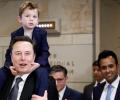
A major divide has emerged within Donald Trump's MAGA team in the United States, as Elon Musk and Vivek Ramaswamy who advocated for the expansion of the visa program for 'highly skilled workers' faced heavy backlash from within President-elect's base, CNN reported.
Ahead of Trump's inauguration here on January 20, the debate on foreign guest workers visas for highly skilled professionals, the H-1B, has intensified which has literally created divisions in both the Democratic and the Republican parties.

Prime Minister Narendra Modi urged US President Donald Trump to prioritise the safety of Indian seafarers in the Strait of Hormuz during the implementation of Washington's proposed Iran peace deal, as both leaders focused on repairing strained bilateral relations at the G7 summit.

US Vice President JD Vance has stated that immigrants who become US citizens should prioritise the interests of the United States above their country of origin. He emphasised the importance of allegiance to the US for the effective functioning of the American system.

External Affairs Minister S Jaishankar raised India's concerns with US Secretary of State Marco Rubio regarding changes to US visa and immigration policies, emphasising that legal mobility should not be negatively affected. Rubio acknowledged potential 'bumps' during the transition as the US aims to improve its immigration system.

Prime Minister Narendra Modi and US President Donald Trump exchanged pleasantries and held a brief conversation at the G7 summit, their first in-person encounter in 16 months, setting the stage for high-stakes bilateral talks amidst continuing strain in India-US relations.

Not only is Samay Raina going the Kapil Sharma route by bringing celebrities as special guests on his show -- which also means he has to be careful that his jokes don't land them in trouble as well -- but he also has to promote sponsors blatantly, observes Sreeju Sudhakaran.

Prime Minister Narendra Modi and US President Donald Trump are set to hold comprehensive talks focusing on a bilateral trade deal, defence cooperation, and energy and critical minerals sectors during the G7 summit in Evian-les-Bains, France.
The US has received sufficient number of applications needed to reach the Congressionally mandated 65,000 H1-B visa cap for the fiscal year 2023, the country's federal agency for immigration services said on Tuesday. The H-1B visa is a non-immigrant visa that allows US companies to employ foreign workers in speciality occupations that require theoretical or technical expertise. Technology companies depend on it to hire thousands of employees each year from countries like India and China.

The US Department of Homeland Security has clarified that not all immigrants seeking green cards will be required to return to their home country to make such applications, partially walking back a previous announcement.

US Secretary of State Marco Rubio will visit India for four days to strengthen bilateral relations, holding talks with Indian leaders and attending the Quad foreign ministers' meeting.
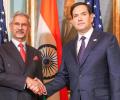
This will be the first face-to-face meeting between Rubio and Jaishankar following President Donald Trump's imposition of an additional 25 per cent tariff on India for Delhi's purchases of Russian oil, taking the total levies imposed on India by the Trump White House to 50 per cent.

Speaking at the 'Samudra se Samruddhi' event, where he inaugurated and laid foundation stones of projects worth Rs 34,200 crore, Modi said all the problems of India have only one solution, and that is self-reliance.

US Secretary of State Marco Rubio arrived in Kolkata for a four-day diplomatic tour to India, marking the first visit by a US secretary of state to the city in 14 years. His itinerary includes meetings with Indian officials, energy talks, and a Quad Foreign Ministers Meeting.
In a huge relief for H-1B visa holders, a White House-backed bipartisan deal has been unveiled under which automatic work authorisation would be granted to about 100,000 H-4 visa holders, who are spouses and children of a certain category of H-1B visa holders. The National Security Agreement that was announced on Sunday after long negotiations between the Republican and the Democratic leadership in the US Senate also provides a solution to about 250,000 aged-out children of H-1B visa holders. The move comes as good news for hundreds and thousands of Indian technology professionals who are waiting in a painstakingly long wait for a Green Card, in the absence of which their spouses cannot work and their aged-out children face the threat of deportation.

'Unfortunately, today most ministers are busy with either election duty or praising duty. They are not interested in serving duty.' 'Ministers have become relaxed like retired people still holding onto jobs.' 'Look at how the NEET paper leaked. But there is no accountability.' 'After 12 years, they have become saturated. They are short of ideas.'

An actress and her family have been booked for allegedly cheating a London-based software engineer of Rs 9.35 crore under the pretext of marriage. The complaint was filed by the engineer's father, alleging that his son was duped over several years.

Ramaswamy's stance on H-1B visas is reminiscent of the 2016 Trump campaign, when then-candidate Donald Trump, who has also hired a number of foreign workers under H-1B visas for his businesses, took a hardline stance on these foreign workers before later softening his rhetoric.

As large-scale layoffs begin at Facebook's parent company Meta, employees on work visas such as H-1Bs are now faced with uncertainty over their immigration status, with CEO Mark Zuckerberg acknowledging "this is especially difficult if you're here on a visa" and offering support to those impacted. Meta announced that it is laying off 11,000 employees or 13 per cent of its workforce, with Zuckerberg describing it as "some of the most difficult changes we've made in Meta's history." US-based technology companies hire a large amount of H-1B workers, the majority of whom come from countries such as India.

India would confront a more entrenched China, a less dependable United States, and a regional order increasingly shaped by great-power bargaining over which it exercises limited influence, notes Amberish K Diwanji.

The US has received enough electronic applications during the initial registration period to reach the 2022 fiscal year cap for the H-1B foreign workers visa, the most sought-after work visa among Indian professionals. The US Citizenship and Immigration Services, the federal agency which screens and allocates H-1B applications, said it was randomly selected from among the registrations properly submitted to reach the cap. The H-1B visa is a non-immigrant visa that allows the US companies to employ foreign workers in speciality occupations that require theoretical or technical expertise. The technology companies depend on it to hire tens of thousands of employees each year from countries like India and China.

The US has received enough petitions needed to reach the Congressionally-mandated 65,000 H-1B visa cap for the fiscal year 2021 and successful candidates for the most sought-after work visa among foreign professionals, including Indians, would be decided by a computerised draw of lots. The H-1B visa is a non-immigrant visa that allows the US companies to employ foreign workers in speciality occupations that require theoretical or technical expertise. The technology companies depend on it to hire tens of thousands of employees each year from countries like India and China.
The US is planning to resume the process of domestic visa revalidation in certain categories, like H-1B and L1 visas, on a pilot basis later this year, a move that will benefit tens of thousands of foreign tech workers, particularly from India. Until 2004, certain categories of non-immigrant visas, particularly the H-1B, could be renewed or stamped inside the US. After that, for the renewal of these visas, in particular, those on H-1B, the foreign tech workers have to go out of the country, mostly to their own country to get the H-1B extension stamped on their passport.
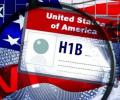
The H-1B visa is a non-immigrant visa that allows US companies to employ foreign workers in speciality occupations that require theoretical or technical expertise.
In a latest report on immigration, US Chamber of Commerce, which is world's largest chamber with more than 3 million members, asserted that such an allegation against Indian companies is 'hyperbole'.
A presidential advisory sub-committee has recommended the federal government to extend the grace period for H1-B workers, who have lost their jobs, from the existing 60 days to 180 days so that the workers have enough opportunities to find a new job or other alternatives. "The immigration subcommittee recommends the Department of Homeland Security and the US Citizenship and Immigration Services (USCIS) to extend the grace period for H1-B workers, who have lost their jobs, from 60 days to 180 days," Ajay Jain Bhutoria, member of the President's Advisory Commission on Asian Americans, Native Hawaiians, and Pacific Islanders, said on Tuesday. In his presentation, Bhutoria highlighted the significant challenges faced by H1-B workers laid off from their jobs.
A group of influential lawmakers have introduced a bipartisan legislation in the US Senate to comprehensively overhaul the H-1B and L-1 visa programmes and usher in more transparency in the recruitment of foreign workers. The H-1B visa is a non-immigrant visa that allows US companies to employ foreign workers in speciality occupations that require theoretical or technical expertise. Technology companies depend on it to hire tens of thousands of employees each year from countries like India and China.
