
He said there were no signs of an "overt collusion" between China and Pakistan during the Ladakh standoff but India also caters to a long term strategy for not a two, but a two-and-half front war. With the half front, he was referring to the internal security.

'The military advantage the Indian Army had gained by the Special Frontier Force occupying the heights of the Rezang La-Rechin La ridge on the Kailash Range is lost without the PLA withdrawing to east of the Khurnak Fort line.'

Sources said the Indian delegation was warmly greeted by senior officials of the Chinese Army before the talks began.

The marathon fourth round of Lt Gen-level talks also focussed on steps for pulling back large number of troops and weapons from rear bases along the Line of Actual Control in eastern Ladakh.

'If you behave like a nail, the adversary will behave like a hammer.'
India has told China that disengagement at all friction points is necessary to contemplate de-escalation of troops in eastern Ladakh even as the foreign ministers of the two countries agreed to establish a hotline for "timely" communication and exchange of views.

Over the last few weeks, bipartisan support for India against China has been increasing.
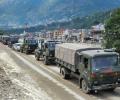
Indian Army planners find themselves contemplating the possibility of more Chinese intrusions along the contested 3,488-km border. That could lead to the army having to man a 'hardened LAC' round the year, like the LoC with Pakistan, reports Ajai Shukla.

Indian Army officers are convinced China is maintaining the pretence of dialogue and negotiations in order to create the opportunity to occupy more Indian territory. Senior Indian planners apprehend this might be a Chinese ploy to divert attention from Depsang, in Northern Ladakh, which might be China's actual target.

The talks took place over video call on Sunday. According to sources, talks were held for over two hours in a cordial and forward-looking manner.
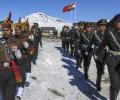
The decision to disengage the forces, locked in a bitter standoff for the last six weeks in eastern Ladakh, was taken at a nearly 11-hour-long meeting between senior Indian and Chinese commanders in Moldo on the Chinese side of the Line of Actual Control (LAC) on Monday.
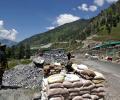
India's top military and strategic brass on Tuesday reviewed the overall situation in eastern Ladakh amid indications that the latest round of talks between senior military commanders of Indian and Chinese armies on the next phase of disengagement of troops may not have produced encouraging results, people familiar with the developments said.

Senior commanders of the two armies held intense negotiations for nearly 11 hours on Sunday at a designated meeting point in Moldo on the Chinese side of the Line of Actual Control.
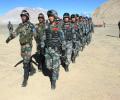
During the course of the intense and complex negotiations between senior commanders of the two armies that ended at 2 am on Wednesday, the Indian delegation also apprised the Chinese PLA about the "red lines" and conveyed that the onus was largely on China to improve the overall situation in the region, the sources said.

The time is ripe to extend the confrontation with the Chinese to the maritime domain, says former RA&W officer Krishan Varma.
The sources said there was clear sign of withdrawal of structures and troops from the patrolling point 14 in Galwan Valley and that they are likely to move back more than a kilometre in the area.

'The last ten months show that India is not going to trust China.' 'Our military commanders are not going to believe that all is well till it actually is.'
