
The Supreme Court refused to stay a provision barring the declaration of tribal lands as waqf properties, upholding key provisions of the Amended Waqf Act.

The Supreme Court overturned a Madras High Court order restricting the Tamil Nadu government from using the names and photographs of current and former chief ministers in welfare schemes. The court also imposed a fine on the AIADMK leader who filed the initial plea.

The Supreme Court of India has stayed several key provisions of the Waqf (Amendment) Act, 2025, citing potential violations of the Constitution. The court emphasized that laws should only be stayed in rare cases where provisions are manifestly unconstitutional or violate fundamental rights.
Supreme Court Justice M M Sundresh recused himself from hearing the bail plea of advocate Surendra Gadling, an accused in the Elgar Parishad-Maoist links case. The case has been adjourned multiple times.

Chandrapuram Ponnusamy Radhakrishnan was sworn in as the 15th Vice President of India, succeeding Jagdeep Dhankhar.

The Supreme Court has expressed concern over the increasing pollution levels during winter and has suggested that the Punjab government arrest farmers who engage in stubble burning. The court believes that this action would send a strong message and help curb air pollution.

'It is a crisis of BJP's own doing. This is an in-house fire.'
Supreme Court Justice B V Nagarathna dissented against the collegium's recommendation to elevate Patna High Court Chief Justice Vipul Manubhai Pancholi to the Supreme Court, citing concerns about seniority, regional representation, and the circumstances of his earlier transfer.

The Supreme Court on Monday granted protection from arrest to psephologist Sanjay Kumar in connection with two FIRs lodged by the Election Commission of India accusing him of spreading misinformation over Maharashtra's electoral rolls through posts on social media.

The CJI called Justice Gavai his "biggest support" while expressing confidence in the latter's leadership and commitment to constitutional values.
Calling itself the "custodian of the Constitution", the Supreme Court on Thursday asked if it could "sit idle" if a constitutional functionary like governor failed to discharge duties, as it reserved its verdict on the presidential reference on grant of assent to bills.
The Supreme Court is scheduled to hear a plea for the restoration of statehood to Jammu and Kashmir. The plea highlights the delay in restoration and its impact on democratic rights and development.

The Supreme Court has ordered authorities not to take coercive action against owners of diesel vehicles over 10 years old and petrol vehicles older than 15 years in Delhi-NCR.

Supreme Court judge, Justice B R Gavai, expressed hope that the "current difficult phase" in ethnic strife-torn Manipur will be over soon with the assistance of the executive, legislature and judiciary and the state will prosper like the rest of the country. Justice Gavai, who led a delegation of Supreme Court judges that visited Manipur, called upon the people of the state to work together to restore peace and harmony. He also urged the people of the state to work together to restore peace and normalcy, and lauded the natural beauty he witnessed while travelling from Imphal to Churachandpur. He expressed delight in noting that training programmes were being imparted at the relief camps, and thanked the Chief Justice of Manipur High Court and the district legal services authority for their efforts. Justice Gavai also stressed the need for readmission of students who had to drop out of school due to the conflict and called upon the educational institutions and the public to ensure all students complete their education.

The Supreme Court has upheld the deletion of the 'waqf by user' provision in the amended waqf law, stating it is not arbitrary and addresses potential misuse.

The Supreme Court has put on hold several key provisions of the Waqf (Amendment) Act, 2025, including the clause that only those practicing Islam for the last five years can dedicate a property as Waqf. The court also addressed the powers of collectors and non-Muslim participation in Waqf Boards.

The Supreme Court has agreed to reexamine the case of a death row convict punished for raping and killing a minor in 2008, focusing on whether sentencing guidelines were properly followed.
The Centre told the Supreme Court that governors are not indefinitely sitting on bills passed by state legislatures, and that barring a few exceptions, most have acted in a way which the apex court would have perhaps desired. Solicitor General Tushar Mehta argued that a Governor is "not a rubber stamp" and has a duty to preserve, protect, and defend the Constitution.

The Supreme Court of India has dismissed a plea against the construction of a new passenger jetty and terminal at the Gateway of India in Mumbai, upholding a Bombay High Court verdict that allowed the project to proceed. The project aims to improve passenger travel between South Mumbai and other locations.
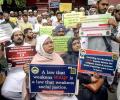
A bench comprising Chief Justice B R Gavai and Justice Augustine George Masih asked senior advocate Kapil Sibal, appearing for those challenging the validity of the law, and Solicitor General Tushar Mehta, representing the Centre, to file their written notes by Monday.

The Supreme Court has questioned the NHAI regarding toll collection on a highway stretch in Kerala where commuters face extreme delays. The court is reviewing a High Court order suspending toll collection due to poor road conditions and severe traffic congestion.
Justice Gavai's comment came while the apex court bench, also comprising Justice Augustine George Masih, was considering a fresh plea seeking an inquiry into the recent violence in West Bengal during anti-Waqf law protests.
The Supreme Court has scheduled hearings starting August 19 for the Presidential Reference concerning constitutional issues related to timelines for handling bills passed by state assemblies. The court has directed the Centre and states to submit written arguments by August 12.

The Congress party has accused Union Minister Nitin Gadkari of conflict of interest, alleging his sons' companies have benefited from the government's ethanol blending policy. The BJP has rejected the allegations.

The Supreme Court is scheduled to hear a plea on August 8 seeking directions to the Centre for the restoration of statehood to Jammu and Kashmir. The plea highlights concerns about the delay and its impact on democratic rights and development.

The SC has sought a response from the Centre on a plea seeking the restoration of statehood to Jammu and Kashmir.
The Supreme Court is hearing arguments regarding a presidential reference on whether fixed timelines can be imposed on governors and the president for acting on bills passed by state legislatures. The court is considering objections to the maintainability of the reference under Article 143 of the Constitution.
A Constitution bench comprising Chief Justice B R Gavai and Justices Surya Kant, Vikram Nath, P S Narasimha and A S Chandurkar, would fix the timelines on July 29 and commence hearing on the presidential reference in mid-August.
The Supreme Court has ruled that a Governor cannot send bills to the President for consideration if the state assembly has already cleared them for a second time. The court was questioning the Centre over the powers of the Governor when it comes to granting assent to bills.
BJP-ruled states argued in the Supreme Court that governors and the President have autonomy in assenting to bills passed by state assemblies, asserting that courts cannot mandate assent.

Outgoing Supreme Court Justice Sudhanshu Dhulia bids farewell, expressing his deep connection to the legal community and the country.
The Centre has opposed the imposition of fixed timelines on governors and the President for decisions on bills passed by state legislatures, arguing that such constraints were intentionally omitted by the Constitution's framers.
The Supreme Court has stayed the Calcutta High Court's decision that stalled the implementation of a revised list of Other Backward Classes (OBCs) in West Bengal, providing relief to the state government.

Issuing notice to the ED on the plea filed by the Tamil Nadu government and Tamil Nadu State Marketing Corporation (TASMAC), a bench comprising Chief Justice B R Gavai and Justice Augustine George Masih told Additional Solicitor General S V Raju, appearing for the anti-money laundering probe agency, that "Your ED is crossing all the limits."

The Supreme Court of India has advised a petitioner, who claims to have suffered disability due to the side effects of the first dose of a Covid-19 vaccine, to file a suit for damages instead of pursuing his plea before the court. The court suggested that filing a suit could provide quicker relief than waiting for a potentially lengthy decision on the petition.
The Supreme Court on Monday agreed to hear a plea of Ashoka University's political science department head Ali Khan Mahmudabad challenging his arrest for social media posts related to Operation Sindoor.

Dubey launched a broadside against the Supreme Court on Saturday, saying Parliament and state assemblies should be shut if the apex court has to make laws.
The Supreme Court has questioned the practice of Governors withholding assent to bills indefinitely, stating that it renders the constitutional provision of 'as soon as possible' meaningless.
The Centre has told the Supreme Court that imposing fixed timelines on governors and the president to act on bills passed by a state Assembly would amount to one organ of the government assuming powers not vested in it by the Constitution and lead to a "constitutional disorder".

The Supreme Court on Tuesday agreed to hear next week a plea which flagged Bharatiya Janata Party MP Nishikant Dubey's recent criticism of the apex court and Chief Justice of India Sanjiv Khanna, and sought removal of derogatory videos from social media platforms.
