
Defence Minister Rajnath Singh has conveyed to his Chinese counterpart Admiral Dong Jun that India and China should maintain the positive momentum in the bilateral ties and avoid adding new complexities.

The Galwan valley clash took place on June 15 last year when Indian troops led by Colonel Babu took on the Chinese troops near the patrolling point 14 area.

Relations between India and China have been in an 'abnormal state' since the 2020 Galwan clash and it is a 'possibly longer than medium-term issue', External Affairs Minister S Jaishankar said in New York.

External Affairs Ministry Spokesperson Anurag Srivastava said China's claim over Galwan Valley was not in accordance with its own position in the past, noting that attempts of transgression by Chinese side were invariably met with appropriate response from the Indian troops.

The United States has asserted that it stands with India against Chinese aggression as several lawmakers slammed China for choosing a People's Liberation Army soldier.

Chinese President Xi Jinping, who made a rare visit this week to the restive Xinjiang region which borders Ladakh, met the troops and officers stationed there and praised their "outstanding contributions" to the border defence and stabilisation of the volatile province.

National Security Advisor Ajit Doval on Monday emphasised the need to counter terrorism in all its forms for overall regional peace and stability during a meeting with Chinese Foreign Minister Wang Yi in Beijing.

Chinese and Indian troops clashed in Galwan Valley for several hours on the night of June 15 in their deadliest brawl in the last five decades.

"He told me his (retirement) papers were through and he would return home in a weeks time and asked me to go ahead with the house warming ceremony on June 3 which I did," she said.
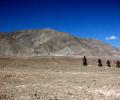
While the de-escalation process was underway, a violent face-off took place on Monday night between Indian and Chinese troops leading to the death of 20 Indian soldiers.
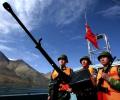
The step was taken by both the sides as they wanted to avoid a repeat of June 15 violent face-off as the troops were in close vicinity.
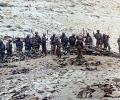
'The Galwan Valley clashes helped us prioritise our national security approach towards the northern border'

Gen Naravane said that the Indian Army did not hide casualties during Galwan clash in eastern Ladakh as the Chinse have done.
The Congress on Friday questioned the silence of the government on the veracity of a video which purportedly shows injured Indian soldiers in captivity of the Chinese and said if it is genuine, then Prime Minister Narendra Modi must ensure that China is held globally accountable for indulging in war crimes.
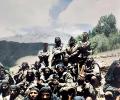
Major Padmapani Acharya was awarded the Mahavir Chakra for his courage in the Kargil War.
'The next decade will be even more transformative,' says Prime Minister Modi. 'We are moving from digital governance to global digital leadership.'

The visit comes a week after 20 Indian Army personnel were killed in a brutal assault by the Chinese military in Galwan Valley which escalated the border tension.
'We need to be very vigilant as we are passing through some fraught times.'

"China is an absolutely impossible factor to ignore in what has been our confrontation with Pakistan," Tharoor said.

India on Wednesday delivered a strong message to China that the 'unprecedented' incident in the Galwan Valley will have a 'serious impact' on the bilateral relationship and held the 'pre-meditated' action by Chinese army directly responsible for the violence that left 20 Indian Army personnel dead.

The jawan, Sachin More, was a native of Malegaon in Nashik district, around 200 km from Mumbai.
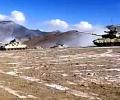
Senior Congress leader and former defence minister A K Antony on Sunday alleged that disengagement in both the Galwan Valley and Pangong Tso Lake areas and the creation of a buffer zone was a 'surrender' of India's rights.

'If the Chinese military gets hold of some western sectors on the India-China boundary, it will give them added military advantage.'

The government has adopted a multi-pronged approach involving the Army, the Indian Air Force and the Navy as well as diplomacy and economic measures to send out a firm and clear message to China that its misadventure in eastern Ladakh was not acceptable at all.

China said that after this incident both sides are in communication and coordination on the matter through diplomatic and military channels.

"Our country has never bowed down and will never bow down to any world power, and I am able to say this because of braves like you," Prime Minister Narendra Modi said on Friday while interacting with the soldiers, who were injured in the June 15 clash with the Chinese troops in eastern Ladakh's Galwan Valley.
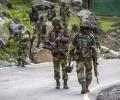
The former army chief-turned-minister did not provide any evidence to support his statement. He said China historically never accepted any war casualties including in the 1962 conflict with India.
The sources said there was clear sign of withdrawal of structures and troops from the patrolling point 14 in Galwan Valley and that they are likely to move back more than a kilometre in the area.
Six Army personnel including Col Santosh Babu, Nb Sub Nuduram Soren, Hav K Palani, Hav Tejinder Singh, Nk Deepak Singh and Sep Gurtej Singh, who lost their lives in the Galwan valley clash, have been awarded Chakra series wartime gallantry medals posthumously.
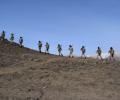
Indian military sources said no firearms were used in the clashes and that most of the injuries were sustained following stone-pelting and use of rods by the Chinese side.
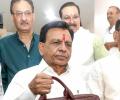
The controversy followed after another Madhya Pradesh minister, Vijay Shah, came under fire for remarks about Col Sofiya Qureshi who conducted media briefings on Operation Sindoor along with Wing Commander Vyomika Singh.
Even after the one month of the incident, China has still not disclosed how many of its soldiers were killed in the incident.
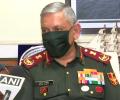
'Chinese soldiers don't have much experience of fighting in these kinds of areas and operating in this kind of terrain'

India is preparing to resume the Kailash Mansarovar Yatra, a pilgrimage to Mount Kailash in Tibet, after a three-year hiatus. The decision comes as part of efforts to improve relations between India and China, which have been strained since a military standoff in 2020. The two countries have also agreed in principle to resume flight services between them.

The talks took place over video call on Sunday. According to sources, talks were held for over two hours in a cordial and forward-looking manner.
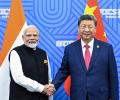
The Galwan clash occurred six months after the Doklam disengagement and two high-profile meetings. India should not be caught by surprise once again, asserts former foreign secretary Shyam Saran.
External Affairs Minister S Jaishankar said the 2008 Mumbai terror attack marked a turning point in relations with Pakistan when Indians collectively felt that such behaviour from a neighbouring country could no longer be tolerated. Speaking at Charotar University of Science and Technology, Jaishankar acknowledged India's transformation under Prime Minister Narendra Modi over the last decade, while Pakistan has remained unchanged, continuing with what he termed as its "bad habits."

A popular Chinese blogger, detained earlier this year for his comments regarding military casualties of Galwan valley clash with India, has been sentenced to eight months in prison.
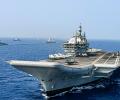
'It brings precarious peace because the red lines have shifted. 'The next Pahalgam attack would mean a full scale war.'

China supplied more than $20 billion worth of arms to Pakistan. These include 20 J-10CE and JF-17 Block III fighter aircraft, Wing Loong drones, frigates, submarines, Hongqi HQ-9P surface-to-air missiles, 240 PL-15E air-to-air missiles, LY-80 air defence systems, ZDK early warning aircraft and other weapons.
