
Global analysts say a successful launch of operational GSLV MkII rocket will reduce dependency for ISRO on foreign launchers.
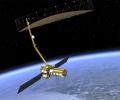
NISAR will not be used for surveillance and will be used to observe the earth.
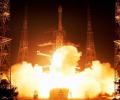
ISRO is part of an exclusive league which has forayed into the Moon and Sun.
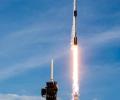
'The solution is to replace, clean up, retest and proceed.' 'There is nothing to worry about if corrected.'

Twice every 12 days, the NISAR satellite will scan nearly all of earth's land and ice surfaces to measure changes in the planet's ecosystems, growth and retreat of its land and sea ice, and deformation of its crust.

The Department of Space (DoS) plans to realise entirely-built rockets -- GSLV-Mk III and SSLV -- from Indian industry partners, in addition to PSLV, according to a top official of its commercial arm NSIL.

The flight took off from Sriharikota in the Bay of Bengal on schedule.
With the development of GSLV Mark-III, India will be able to launch heavy satellites into the geosynchronous transfer orbit. This vehicle is billed as the technological successor to GSLV Mark-II.
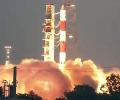
'There's too much coincidence in back-to-back failures of missions critical to national security.'
'The satellite's condition is healthy.'
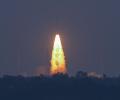
India on Sunday successfully launched its heavy-duty rocket with indigenous cryogenic engine that placed a communication satellite into the orbit, with Indian Space Research Organisation scientists finally taming the 'naughty boy' GSLV and propelling the country into an elite club of countries.
'The work is already on with various data being studied.'

It is important for India to develop multiple launch sites and become capable of undertaking more launches in a year's time, says Ajey Lele.
A PSLV rocket carrying Earth observation satellite EOS-09 failed to launch from the Sriharikota spaceport early on Sunday.
ISRO officials said that the Rs 330 crore mission failed minutes after the rocket lifted off at 4.27 pm. Although they would go ahead with the same mission next year, it is still considered to be a setback since ISRO had planned on using the GSLV rocket for its second moon mission.
It is scheduled for lift-off at 1658 IST on Thursday from the space port at Satish Dhawan Space Centre at Sriharikota, about 100 km from Chennai.
The indigenous rocket will carry the second technology experiment satellite GSAT-2.

The Indian Space Research Organisation successfully put India's heavy rocket Geosynchronous Satellite Launch Vehicle-Development 5 (GSLV-D5) into orbit from the spaceport at Sriharikota, Andhra Pradesh at 4.18 pm on Sunday.
Launch of India's latest communication satellite GSAT-5P onboard homegrown GSLV-F06, powered by Russian cryogenic engine, failed on Saturday when the rocket developed a snag soon after lift-off from the spaceport in Sriharikota.
It is raining heavily at Sriharikota where the Satish Dhawan Space Centre is located
India's ambitious attempt to flight-test its indigenous cryogenic engine on Thursday received a setback as the homegrown rocket Geosynchronous Satellite Launch Vehicle (GSLV-D3) deviated from path within seconds of lift-off.
There was no major design flaw in the Indian Space Research Organisation's Geostationary Satellite Launch Vehicle, which crashed seconds after take-off on December 25 last year, said a fact- finding panel.
Indian Space Research Organisation is preparing to launch a geosynchronous satellite launch vehicle (GSLV-D3), powered for the first time by a home-made cryogenic engine, from Sriharikota spaceport this month, its chief K Radhakrishnan said on Friday.
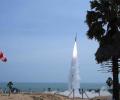
The fuel cost will come down if rockets are launched from Kulasekarapattinam as they will have a straight trajectory and need not have to avoid Sri Lanka, which is being done by rockets flown from Sriharikota.
Chief of the Indian Space Research Organisation K Radhakrishnan, while commenting on the failure of the latest communication satellite GSAT-5P onboard homegrown GSLV-F06 powered by a Russian cryogenic engine, said that the vehicle faced problems 50 seconds after its launch."The command for aborting the launch was issued when the vehicle was at an altitude of 8 km and 2.5 km away from Sriharikota," said the ISRO chief.
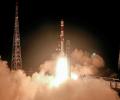
The Indian government has approved the construction of a third launch pad at Sriharikota, capable of sending heavier spacecraft into orbit. This new facility will support India's ambitious space program, including the Gaganyaan human spaceflight mission and a lunar landing. The launch pad will be built at the Satish Dhawan Space Centre and is expected to be operational within four years.
The decision was taken keeping in view aspects like servicing the operational launches of INSAT, potential commercial opportunities and strategic reasons.

In terms of success rate, the PSLV rocket has an enviable record of 57 successful missions out of 58 commercial ones.

Narayanan has a long and distinguished career at ISRO, having played a key role in several important missions, including Chandrayaan-2 and 3, and the Gaganyaan programme.
India's top space scientists are analysing data to find out what caused the failure of Geosynchronous Satellite Launch Vehicle mission and an expert committee is likely to be formed soon to give a report on it.
ISRO's vendor policy and quality control processes are under scanner.
The launch is slated for 1658 IST from the space port at Sriharikota in Andhra Pradesh.
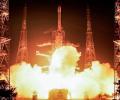
ISRO has put out stunning photos of the launch of GSLV-D5. The vehicle smoothly lifted off to space from Sriharikota on Sunday afternoon and put India into the elite 'cryogenic club'.
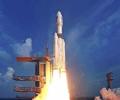
Taking its baby steps towards realising India's ambition to send humans into space, Indian Space Research Organisation on Thursday successfully tested the atmospheric re-entry of a crew module after its heaviest launch vehicle GSLV MK III blasted off from Sriharkota.
Indian Space Research Organisation is all set for the launch of the first flight-testing of indigenous cryogenic engine on homespun rocket, Geosynchronous Satellite Launch Vehicle (GSLV-D3), from the Satish Dhawan Space Centre at Sriharikota at 4.27 pm on Thursday.
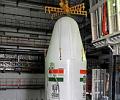
The launch of a Geosynchronous Satellite Launch Vehicle was called off by the Indian Space Reasearch Organisation at the eleventh hour on Monday due to a fuel leak in its second stage -- in a setback to the mission to test its homegrown cryogenic engine -- after its failure three years ago.
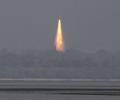
Indian Space agency Indian Space Research Organisation would launch the Geo-synchronous Satellite Launch Vehicle-Mark III (LVM3 X mission) on December 18 which would carry active solid boosters, liquid core stage and a passive cryo-stage.
India's top space scientists will be meeting in Thiruvananthapuram on Saturday to analyse the data and find the cause for failure of GSLV-D3 rocket, which was launched for the first time on Thursday using an indigenously made cryogenic engine.
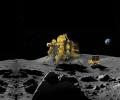
In a boost to the space programme, the government on Wednesday approved the Chandrayaan-4 mission to bring back moon rocks to earth, to send a spacecraft to orbit planet Venus and to expand the Gaganyaan project to build an Indian space station.

Scientists are working on conducting various tests for the ambitious Gaganyaan mission and the agency is coordinating with the Navy and others in this connection, he said.
