
Chinese leaders, including its generals, will have to weigh whether they can win a war if they ever attack Taiwan and if at all, can they sustain the subsequent devastation, notes Rup Narayan Das.

The United States' historical strategic alignment with Pakistan, dating back to the Cold War, has consistently aimed to create a political and military parity with India, despite India's significantly larger size and resources. This long-standing relationship continues to influence regional dynamics, particularly in West Asia and the Indo-Pacific.

'Nepal today is far more aware, self-confident, aspirational, and assertive.' 'India's policy so far has not been geared to this shift. It is time to redraw our Nepal strategy.'

Eminent historian and academic K.N. Panikkar, known for his Marxist interpretation of history and advocacy for secularism, has passed away at the age of 90. His contributions to historical research and defence of secular values are widely recognised.

Sri Lanka's response to the Easter attacks has been slow and politically contested, unlike India's swift institutional reforms after the 2008 Mumbai terror attacks, observes Colonel R Hariharan (retd).
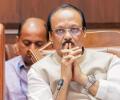
Maharashtra Deputy Chief Minister Ajit Pawar faced criticism after questioning 'who Parrikar?' when a woman suggested he emulate the late Goa CM Manohar Parrikar's surprise visits to address civic issues.

Trump has made it clear: the US will not lift its blockade of Iranian ports until a deal is signed.

Iran is fighting a different war: Older, slower, and in some ways more dangerous. Iran doesn't need to shoot down an F/A-18. It only needs to make the Strait of Hormuz feel dangerous long enough for insurance markets, shipping companies, and oil futures traders to do the rest. Prem Panicker continues his must-read daily blog on the war in the Middle East.
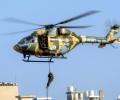
'The tools of warfare are changing. The MoD must deepen its engagement with technology thinkers that can present compelling visions of where warfare may be heading.'

'As the PLA higher command is almost dismantled and instability spreads, India needs to be prepared for any eventuality,' cautions China expert Srikanth Kondapalli.

The enduring relationship between the two countries have survived the disintegration of the erstwhile USSR in 1991, the end of the Cold War and the regime change in both countries, points out Rup Narayan Das.

It's a strategic approach in which the country's military and defence mechanisms evolve continuously in tandem with emerging threats. The new strategy anticipates events and prepares to counter those proactively.

A non-vegetarian party in the premises of a government-run school in Surat city of Gujarat has created a huge controversy and led to the suspension of the principal.
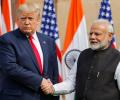
The China threat continues to resonate in the strategic partnership between India and the USA, points out Rup Narayan Das.

'The heat shield technology for re-entry vehicles was first mastered in DRDO for the Agni missile.' 'This is why the Americans were so opposed to Agni in the 1980s, unlike other missiles -- it was a re-entry vehicle.'
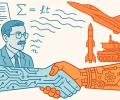
'Government officials use Gmail and ordinary phones without basic security consciousness.' 'Interoperability, especially in joint exercises with countries like the US, worries me.' 'It often means we open our systems to them, but they don't reciprocate.' 'They could have kill switches in their systems and might even be able to affect ours.'
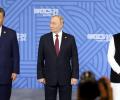
China has expressed its support for Russia's initiative to revive the Russia-India-China (RIC) troika, emphasizing its importance for regional and global security and stability.

India succeeded in busting the Pakistani narrative on Operation Sindoor, particularly among the Organisation of Islamic Conference (OIC) member nations, where Islamabad sought succour after carrying out terror activities across the border, Shiv Sena leader Shrikant Shinde said.
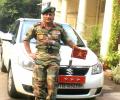
Lieutenant General Shakti Gurung deserves to be complimented in telling his life story and that of his people, as subaltern communities within this vast and diverse nation of ours clamour for recognition and a plea for their voices to be heard and their aspirations to be met, notes Lieutenant General Gautam Moorthy.
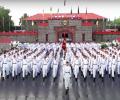
The first batch of women cadets joined the NDA's 148th course in 2022 after the UPSC (Union Public Service Commission) allowed women to apply to the defence academy following a Supreme Court direction in 2021.
'It is typical of China's strategic deception of making virtue out of necessity,' observes Rup Narayan Das.
India has secured international support in its fight against terrorism, with Russia, Japan, and the United Arab Emirates expressing solidarity and a commitment to working together to combat the threat. This follows a recent terrorist attack in Pahalgam, India, which claimed 26 lives. Multi-party parliamentary delegations from India briefed the leaderships of these countries on Operation Sindoor, India's response to the attack, and discussed ways to enhance cooperation in counter-terrorism and combating radicalism. These developments highlight the growing global consensus against terrorism and the importance of international collaboration to address this shared challenge.

After the 1962 War with China, there was a demand to forge greater defence cooperation between India and the West. One such voice was that of Sudhir Ghosh, a distinguished MP, to tie up strategic cooperation with the USA immediately after the Chinese attack on India, recalls Rup Narayan Das.
We need to equip the Indian Armed Forces, not 'commercial' as Trump wants, but 'operationally' looking at growing Chinese military capabilities, asserts Lieutenant General Prakash Katoch (retd).
The Indian Diaspora has been able to carve a niche in their adopted countries as a result of their talent, perseverance and hardworking nature, asserts Rup Narayan Das.
'Granting the country's highest civilian honour to Prime Minister Modi was surprising as it indicated the government was going out of its way to have India as a close partner.'

Investors should avoid making drastic changes to their asset allocation during a market correction.

Gyanesh Kumar, a 1988-batch Kerala Cadre IAS officer, has been appointed as the next Chief Election Commissioner (CEC) of India. Kumar, who was previously an Election Commissioner, will serve until January 26, 2029. His appointment comes amidst controversy as the Congress party demanded the government defer its decision until the Supreme Court concludes its hearing on a petition challenging the composition of the selection panel. Kumar's tenure will see him oversee several state assembly elections, including Bihar, Kerala, Puducherry, Tamil Nadu, and West Bengal.

'There is uncertainty regarding job opportunities for our children after they serve for just four years under the Agnipath scheme.'

The Tata Group is one of the very few Indian MNCs which has carved out a niche in China's highly competitive market, notes Rup Narayan Das.

The Battle of Lhagyala on November 23, 1962, fought by the 4 Rajput Regiment against the Chinese PLA, remains a forgotten chapter of heroism, with no survivors left to tell their story.
The India-US nuclear deal was aimed at ending India's nuclear isolation and nuclear apartheid, recalls Rup Narayan Das.

Ms Swaraj was a conscientious woman who understood suffering and pathos and attempted in her inimitable way to mitigate them, recalls Rup Narayan Das.

New Delhi has reached out to Moscow while waiting for a new president in Washington. New Delhi knows well that in international relations, there are no permanent friends or foes, only permanent national interests, points out Dr Rup Narayan Das.
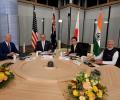
Saturday's Quad meeting in Delaware is taking place against the backdrop of China's assertive behaviour in the South China Sea, its sabre-rattling in the Taiwan Strait and increasing footprints in the Pacific and Indian Ocean, asserts Rup Narayan Das.
He drew the roadmap of India's economic reform, unshackled it from the licence raj and pulled it back from the brink when even its gold reserve was pledged.
Muhammad Yunus proved that he was neither an armchair economist nor a slogan mongering political activist, but a doer destined to do what Mahatma Gandhi said -- to remove every tear from every eye, recalls Rup Narayan Das.
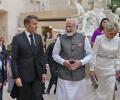
India-France synergy is poised to open vistas of collaboration between the two countries, notes Rup Narayan Das.

'We have to keep a watch because India-Sri Lanka has a history that whenever there has been a change in government, either the connectivity projects have been questioned or cancelled or revived.'

The power of the left-wing extremist groups is immense and they can, in one sense, if they want to, bring many sectors of the Indian economy to its knees, warns former home secretary GK Pillai
 © 2026 Rediff.com - Advertise with us - Disclaimer - Privacy Policy - Sitemap - Feedback - About us - Terms of use - Grievances