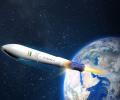
The Vikram-I rocket will fly with its maximum carrying capacity and put the satellites in a Low Earth Orbit.
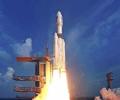
If successful, this would increase capacity to hurl small satellites into space, meeting both local demand and serving global customers.

Skyroot Aerospace has become the first private company in India to give wings to the Indian space programme, after the sector was opened to private players by the Centre in 2020.
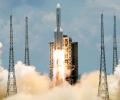
India's first privately developed rocket -- Vikram-S -- is set for launch in a sub-orbital mission with three payloads between November 12 and 16, Hyderabad-based space startup Skyroot Aerospace announced on Tuesday.

'The current launch is a sounding rocket, this cannot be called a milestone. The importance is this is for the first time a private player is doing it.'

The maiden mission of Skyroot Aerospace, named 'Prarambh' (the beginning), will carry payloads of two Indian and one foreign customers and is set for launch from the Indian Space Research Organisation's launchpad at Sriharikota.

India is set to take its first steps towards its own human space flight when the uncrewed Gaganyaan mission soars to the skies later this year. Private players in the space sector are also gearing up for launching satellites on home-built rockets.
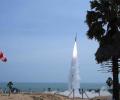
The fuel cost will come down if rockets are launched from Kulasekarapattinam as they will have a straight trajectory and need not have to avoid Sri Lanka, which is being done by rockets flown from Sriharikota.

Concerns are rising about the status of GalaxEye Space's Mission Drishti, India's first Made in India OptoSAR satellite, launched on May 3. Reports suggest the satellite is tumbling in space, and experts highlight potential issues with solar panel deployment and stabilisation. The company has remained silent on the matter, fueling further speculation.

For the first time in India, the facility enables 3D printing of aerospace and rocket components up to one metre in height.

Prime Minister Narendra Modi inaugurated Skyroot's Infinity Campus, highlighting government reforms and the rise of private space companies in India. He also unveiled the company's first orbital rocket, Vikram-I.
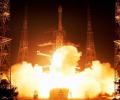
Indian Space Research Organisation is gearing up for one of its busiest times with seven more launches planned this financial year, even as India's first human spaceflight remains scheduled for 2027, its chairman V Narayanan said.

These upcoming launches carry added significance in light of setbacks suffered in recent years.

A Chinese rocket start-up has suffered yet another launch failure, resulting in the loss of three satellites as part of a commercial constellation being assembled for global weather forecasting and earthquake prediction.
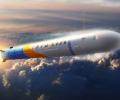
The spacetech startup is expected to launch the first rocket which can hurl satellites of 250-700 kg into a lower Earth orbit by end-2021.

'Today, as I look at our satellite -- tested, finished and ready to ship -- represents 1,642 days of grit and belief.'

From a surge in startups to crewed mission preparations, 2025 marks a transformative year as India eyes $44 billion space economy by 2033.

India took another leap in space infrastructure with the foundation stone laid for a new launch pad at the country's second rocket port in Kulasekarapattinam.
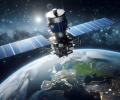
The private consortium would invest more than Rs 1,200 crore over the next five years to launch a constellation of 12 state-of-the-art Earth Observation satellites equipped with panchromatic, multispectral, hyperspectral, and microwave SAR (synthetic aperture radar) sensors.
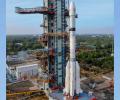
At 6.23 am on 29.1.2025, the 50.9 metre tall and weighing 420.7 ton Geosynchronous Satellite Launch Vehicle-F15 (GSLV-F15) is slated to blast off from the second launch pad carrying the 2,250 kg NVS-02 navigation satellite.

'A solid motor, once ignited, burns until the propellant is exhausted. It cannot simply stop mid-burn,' said a retired senior ISRO official. 'That is what makes this failure puzzling.' Venkatachari Jagannathan reports on the latest PSLV failure.
State-run Hindustan Aeronautics Limited has won a bid under which it will receive technology from the Indian Space Research Organisation for the end-to-end commercial production of the Small Satellite Launch Vehicle (SSLV), a first for the industry as India seeks to become a global hub for small satellite manufacturing and launches.

Kwatra termed India's successful launch of an American communication satellite on Wednesday as a 'very important and big day' for partnership between Washington and New Delhi, saying it caps a series of achievements in 2025 in bilateral space cooperation between the countries.
ISRO chairman announces plans for nine major launches by the end of the fiscal year, including the Blue Bird Block2 communication satellite for the US in collaboration with NASA.
Research and markets estimated in May that the global opportunity for small and mini satellites would grow nearly one and half times to $5.32 billion by 2021

'The launch of Nila, our very first satellite was very emotional as well as nerve wracking. We tried to calm ourselves by cracking some poor jokes!'

NASA, Axiom Space, and SpaceX are now targeting 12.01 PM (IST), Wednesday, June 25, for launch of the fourth private astronaut mission to the International Space Station, Axiom Mission 4, NASA said.

Preparations are in the final stages by the Chennai-headquartered space-tech startup Agnikul Cosmos for the maiden launch of India's first-ever private launchpad and the second rocket launch by a private sector player.
Chandrayaan-4 will involve at least two separate launches of the heavylift LVM-3 rocket that will carry five different components of the mission which will be assembled in orbit.

An unmanned private rocket contracted by National Aeronautics and Space Administration to carry cargo into the space has exploded seconds after its launch along the eastern Virginia coast of the United States.
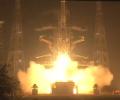
The Indian Space Research Organisation successfully launched its 100th mission on Wednesday, with a GSLV rocket carrying navigation satellite NVS-02.

The 6-metre tall launch vehicle Vikram-S is named after Vikram Sarabhai, the father of the country's space programme and lifted off at 11.30 am.

Sixty-two-year-old pilot Mike Melvill, on Monday, became the first human to fly a privately built ship beyond the Earth's atmosphere, as the world's first commercial space flight took off from a runway in California's Mojave desert.
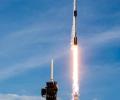
'The solution is to replace, clean up, retest and proceed.' 'There is nothing to worry about if corrected.'

The mission was originally scheduled for lift-off on May 29 but was put off multiple times when engineers detected a liquid oxygen leak in the boosters of the Falcon-9 rocket and NASA also detected leaks in the ageing Russian module of the ISS.
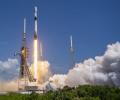
'ISRO recommended to carry out in-situ repairs or replacement and conduct a low-temperature leak test to validate system performance and integrity, before proceeding with launch.'

'With India's growing capabilities in the space sector, this creates promising opportunities for enhanced collaboration and market access.'
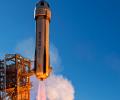
Blue Origin's 10th human flight, NS-30, will lift off from Launch Site in West Texas on Tuesday, February 25.
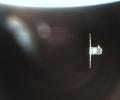
The Indian Space Research Organisation (ISRO) has successfully performed the docking of satellites as part of the Space Docking Experiment (SpaDeX). The docking was achieved after a series of maneuvers, including a trial attempt on January 12. The SpaDeX mission, launched on December 30, 2024, aims to demonstrate in-space docking technology using two small spacecraft. This technology is crucial for achieving complex mission objectives that require multiple rocket launches.

Isaacman's removal comes just days after Elon Musk's official departure from the White House, where the SpaceX CEO was serving in the role of a "special government employee" leading the Department of Government Efficiency.
 © 2026 Rediff.com - Advertise with us - Disclaimer - Privacy Policy - Sitemap - Feedback - About us - Terms of use - Grievances