
This brings its tax treatment on par with the Prime Minister's National Relief Fund.

With car penetration of around 22 per 1,000 population, India continues to be a big opportunity to sell cars, especially in rural areas.

The National Company Law Tribunal (NCLT) has directed to freeze and attach assets and properties of Videocon promoters following a petition by the ministry of corporate affairs. The NCLT Mumbai bench has directed the Central Depository Services Ltd (CDSL) and National Securities Depository Ltd (NSDL) that securities owned or held by the Videocon promoters "in any company or society be frozen, and be prohibited from being transferred or alienation" and the details be shared with the Ministry of Corporate Affairs (MCA). It directed the Central Board of Direct Taxes (CBDT) to disclose information about all assets of the Videocon promoters in their knowledge or possession, for the purpose of freezing and restraining such assets.
For the first eight months of the current financial year, the figure stood at Rs 7.17 trillion.
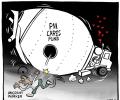
India Inc's philanthropic spends have grown by 3.62 per cent to Rs 22,000 crore in FY21 as profits expanded, and a majority of the allocations have been done to pandemic-linked causes, a report said on Tuesday. The report by rating agency Crisil said that while the first wave saw greater spending in cash largely through the PM-CARES Fund, the preference shifted to more direct support through in-kind spends in the second wave. Corporate contributed only Rs 85 crore to the PM-CARES Fund during the second wave between March and June 2021, as against Rs 831 crore to what was classified as 'others'.

Custom authorities have been keeping strict vigil on the cargo movements from Bhutan, Taiwan, China, Afghanistan, South Korea Japan, and Dubai since January.

The earnings are, however, expected to be down around 2 per cent on a sequential basis due to pent-up demand getting exhausted and the adverse impact of rising metals and energy prices on consumer goods and manufacturing companies.

Passenger vehicle (PV) retail sales rose to 184,134 units last month against 85,733 units in May this year as the COVID-19 situation improved across the country. According to the Federation of Automobile Dealers Associations (FADA), which collected vehicle registration data from 1,295 out of the 1,498 regional transport offices (RTOs), two-wheeler sales rose to 930,324 units last month as compared to 410,757 units in May.
Digital payments and financial services firm Paytm is likely to allocate shares at the upper price band of Rs 2,150 apiece on November 16 after market regulator SEBI's approval which is expected to come on Monday, sources aware of the development said. Earlier the allocation was expected to take place on Monday and the Paytm Money app also displayed the same.

Road construction witnessed a near 60 per cent year-on-year jump in the first two months of financial year 2021-22 (FY22), despite restrictions being imposed in the wake of the second wave of Covid-19. Around 1,470 km of roads were constructed during the first two months of the current fiscal, as against 847 km in the corresponding period last year, according to official figures. However, these are provisional numbers as the state public works departments of Maharashtra and Goa are yet to provide data.

India Inc resorted to salary cuts to protect their profits in the June quarter, as revenues came under pressure due to the second pandemic wave that affected nearly the entire country, a report said on Wednesday. The "weak" wage growth will prove to be a drag on the overall economic recovery in the medium term as it will affect household consumption, the report by India Ratings and Research said. An environment of pandemic-led uncertainty and elevated inflation could impact the level of spending and hence the overall demand, it said.

The brokerage reduced its target price for the company to Rs 995 per share from Rs 1,350 apiece. Credit Suisse said RIL's liabilities increased from $19 billion to $65 billion in four years.

Analysts attribute this fall to the recent moderation in energy (mainly crude oil) and commodity prices, lowering of input costs for companies in sectors such as FMCG, consumer durables, and automobiles, reports Krishna Kant.

Experts attribute this trend to a combination of end of capital expenditure cycle, increased automation, RIL's preference for time-bound labour contracts, and telecom and retail's outsourced human resource model.

In the manufacturing sector, output is expected to decline by about 70 per cent as only food-processing, and drugs and pharma industries are allowed to operate while other segments, such as engineering and metals, have shut operations.

With 56,000 dollar-millionaire households, Maharashtra leads the country in wealth creation followed by Uttar Pradesh, Tamil Nadu, Karnataka and Gujarat, says a report. These states together account for 46 per cent of the 4.12-lakh millionaire households in the country. According to a wealth report by Hurun India, known for its annual rich list, there were 4.12 lakh dollar-millionaire households last year in the country, which has been one of the fastest wealth-creating economies producing the third-most number of billionaires annually.

Particularly hit has been the apparel sector, where the time taken by the industry to adjust to the Goods and Services Tax regime, downward revision of export incentives, and a credit squeeze faced by small and medium scale enterprises, has pushed production downwards.

'The move towards fiscal consolidation had to be diluted because of the relief to farmers as the government wants to appease the voters.'

According to PRIME Database, there are nine companies with active buyback programmes of Rs 8,605 crore. Among these, Infosys's share repurchase programme is the biggest at Rs 8,260 crore.
Digital payments and financial services firm Paytm has filed a draft red herring prospectus for its proposed Rs 16,600-crore initial public offering (IPO) with the Securities and Exchange Board of India.

Both the debt and equity markets have seen sharp volatility in recent months.

The retail frenzy over initial public offers (IPOs) seen over the past few months is not without reason. Over the past two years, 61 companies have tapped the primary market and raised funds via IPOs. Of these, 24 companies (nearly 39 per cent companies) have more than doubled at the bourses with Happiest Minds, IndiaMart Intermesh, Indian Railway Catering and Tourism Corporation (IRCTC), Affle India and Route Mobile surging 468 per cent to 722 per cent since their listing date till now. Retail participation in the equity market, according to analysts, has just reached an inflection point due to the low interest rate regime amid lack of investment-worthy avenues that can generate a good return for investors.

A government report revealed that fake companies floated with fake addresses, issued fake GST invoices and generated fake e-way bills, with fake vehicle registration details without supplying any goods causing huge loss to the exchequer.

Citing the massive surge in Omicron infections and the resultant impact on overall economic activities in the March quarter, Swiss brokerage UBS Securities has revised downwards its India's growth forecast for the current financial year to 9.1 per cent from 9.5 per cent earlier. However, UBS Securities does not see the third wave impact extending to the next financial year as it has revised upwards its real GDP forecast to 8.2 per cent, up from 7.7 per cent earlier, expecting the real GDP growth to remain well above the historical average. The World Bank pegs it at 8.3 per cent, unchanged from its June assessment, saying the recovery is not broad-based yet.

Ballooning debt forces more and more Indian promoters to sell out to global majors and PE players.

Budget-makers in North Block are looking to maintain this fiscal status quo, in spite of tax revenues nowhere close to where the government wants and in spite of possible higher expenditure commitments.

The mood at the Hotel Investment Conference South Asia (HICSA), the annual hospitality industry conference was rather upbeat. But hotel brand operators and owners remain cautiously optimistic of the outlook and are living on a hope that a third wave of the pandemic doesn't become a reality. Having just survived the unprecedented zero revenue situation, the two day confrence organised by consulting firm Hotelivate, was dotted with anecdotes and best practices adopted by the hotels of all hues.

The company's decision comes when there has been a dip in intake due to tepid demand, increasing automation, reports Debashis Mohapatra.

Though COVID-19 will wreak more damage to the finances of the Indian population, the insurance sector is unlikely to get hurt.

While Unilever has been aggressive, both organically and inorganically in the country, P&G's approach has been about achieving 'balanced growth' in terms of top line and bottom line.

The country's largest carmaker Maruti Suzuki India (MSI) on Tuesday reported 6.14 per cent decline in consolidated net profit at Rs 1,241.1 crore for the fourth quarter ended March 31, 2021. The auto major had posted a net profit of Rs 1,322.3 crore in January-March quarter of 2019-20, MSI said in a regulatory filing. However, revenue from sale of products stood at Rs 22,959.8 crore as compared with Rs 17,187.3 crore earlier, up 33.58 per cent.

Industry players say improving the penetration beyond the top centres will require setting up more branch networks and empanelment of distributors.

The 'mystery' of the education business sale by Cox & Kings is part of an Enforcement Directorate investigation, which is also examining the siphoning-off of funds to the tune of Rs 21,000 crore to dozens of so-called related-parties, highlighted by the forensic auditor.
Lower revenue collection puts upward pressure on government borrowing, ensuring that it deviates from the glided path of debt reduction

Vodafone Idea, the country's third largest telecom operator, on Wednesday reported a staggering Rs 73,878 crore of net loss in fiscal ended March 2020 -- the highest ever by any Indian firm -- after it provisioned for Supreme Court-mandated statutory dues. The firm, which has to pay Rs 51,400 crore dues after the apex court ordered the non-telecom revenues to be included in calculating statutory dues, said the liability has "cast significant doubt on the company's ability to continue as a going concern".
Some of the top indebted companies likely to face financial headwinds in the coming quarters include NTPC, PowerGrid, Tata Steel, Adani Power, JSW Steel, UPL, and Steel Authority of India. Together these 201 companies owed Rs 14.9 trillion to their lenders at the end of September 30, 2019, up 4.1 per cent year-on-year (YoY) during the first half of FY20.

The numbers become all the more important because actual tax collections fell short by Rs 1.91 trillion compared to what was projected in 2018-19. Besides, the Budget for FY20 did not give actual figures for 2018-19, but the revised numbers given in the interim Budget.
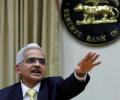
Chances of a rate cut in April improve if core inflation continues to ease, growth falling below the projected 7.2% for FY19 and if the global trade slowdown exacerbates.

Remittances growth is muted due to "structural" reasons which will hamper consumption demand locally, a report said on Thursday. "...the muted external remittances growth is more of a structural issue than transitory," India Ratings and Research said in its note. India has been the largest recipient of remittances from its diaspora spread all across the world and received over $70 billion inflows last year. The agency argued that flows had started to moderate even before the COVID-19 pandemic outbreak, pointing out that as a percentage of gross disposable income, the share of remittances fell to 2.5 per cent in FY19 as against 3.5 per cent in FY10.

Industrialists affirm their belief that the adverse effects of demonetisation and the goods and services tax are finally over.
