
Currently, FPIs can invest up to $30 billion in Government securities, of which $5 billion is reserved for long-term investors.

Asian Paints was the top gainer in the Sensex pack, rising around 3 per cent, followed by Kotak Bank, Axis Bank, HDFC Bank, Infosys, Reliance Industries and ITC. Broader NSE Nifty rallied 136.15 points or 1.02 per cent to its new record high of 13,529.10.

Bharti Airtel was the top gainer in the Sensex pack, rising around 3 per cent, followed by HUL, HDFC, ITC, IndusInd Bank, SBI, Sun Pharma, ONGC, Tech Mahindra, L&T and Asian Paints. On the other hand, Kotak Bank, Nestle India, Tata Steel, Bajaj Finance and HDFC Bank were among the laggards.

The Securities and Exchange Board of India (Sebi) has deferred the diktat requiring foreign investors to disclose their mobile number, email addresses and income details to depositories, a move believed to be aimed at curbing practices such as round tripping and money laundering. "Based on the representations received from MIIs (market infrastructure institutions), Sebi has decided to extend the deadline for making 6-KYC attributes mandatory for new accounts opened by 1 month to July 1, 2021. "Participants are accordingly requested to take note of the above and ensure compliance," NSDL said in a note on Tuesday. The regulator is also meeting custodians this week to thrash out a solution and address investors' concerns.

FIIs fear short-term capital gains would give rise to tax uncertainty and make their operations difficult, reports Pavan Burugula from Mumbai.

M&M was the top loser in the Sensex pack, shedding over 2 per cent, followed by Dr Reddy's Bharti Airtel, Tech Mahindra, HUL, ICICI Bank and Infosys. NSE Nifty dropped 64.80 points to 14,341.35.

Experts said the rules will help curb market manipulation and money laundering, which could take place during the transfer of shares between residents and NRIs.

M&M was the top gainer in the Sensex pack, rallying around 6 per cent, followed by SBI, ITC, NTPC, Bharti Airtel and ONGC. On the other hand, Bajaj Finance, HDFC, Bajaj Finserv, Titan, Sun Pharma and Dr Reddy's were among the laggards. NSE Nifty inched up 1.40 points to its fresh closing record of 14,564.85.

Equity benchmark Sensex rallied 487 points on Monday to close at a fresh lifetime peak, tracking gains in Infosys, HDFC twins and HCL Tech amid massive foreign fund inflows.

The primary issue market has hit an all-time high with 63 corporates raising Rs 1,18,704 crore through main-board initial public offerings (IPOs) so far in 2021, which is nearly 4.5 times more than the Rs 26,613 crore raised through 15 issues in 2020 and almost double of the previous best of Rs 68,827 crore in 2017, according to a report. Pranav Haldea, managing director of Prime Database Group, said the IPO frenzy was driven by new-age loss-making technology start-ups along with strong retail participation, and the resultant massive listing gains were the key highlights of the year. Another highlight was only 51 per cent or Rs 103,621 crore of the total Rs 202,009 crore was fresh capital raising and the remaining Rs 98,388 crore were offers for sale.

A first in 7 years, the combined institutional investor flow stands at Rs 69,000 crore in 2016-17

Indian equities are no longer cheap vis-a-vis global markets, and only a short distance away from being the most expensive they have ever been.

HDFC was the top gainer in the Sensex pack, rising around 3 per cent, followed by Bajaj Finance, HDFC Bank, IndusInd Bank, PowerGrid, UltraTech Cement, TCS, Tech Mahindra and L&T. On the other hand, ONGC, Maruti, Tata Steel, HUL, Bajaj Auto and Sun Pharma were among the laggards.

At least 200 investors have to furnish financial statements

The laggards include FMCG (16 per cent), Energy (37 per cent) and Media (34 per cent).

Foreign portfolio investors, on the other hand, have been net sellers in the markethaving pulled out Rs 8,600 crore
The RBI is of the view that it cannot carry out satisfactory due diligence for granting registration because the funding is from a jurisdiction that has been identified by FATF as having weak measures to combat money laundering and terrorist financing.

Shares of Adani group companies witnessed a massive drubbing in morning trade on Monday, tumbling up to 25 per cent, amid reports that the National Securities Depository Ltd (NSDL) has frozen certain FPIs accounts that have holding in some of these firms.

Subdued Asian and European markets due to escalating trade war between the US and China mainly led to caution on domestic bourses, brokers said.
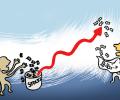
'The good news is that money continues to flow into India-focussed offshore funds.'
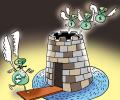
Only 10 per cent of stocks account for 93 per cent of investments.

The new norms provide an operational framework for FPIs, a new class of overseas investors that club all existing class of investors like foreign institutional investors and Qualified Foreign Investors.

Overall, net investment by foreign investors stood at Rs 2.58 lakh crore in 2014.

The approval comes few days before the company has to clear statutory liabilities of up to nearly Rs 35,586 crore, of which Rs 21,682 crore is licence fee and another Rs 13,904.01 crore is spectrum dues.

Market experts on why the bulls will be on the rampage first thing on Monday after the scrapping of enhanced surcharge on FPIs and other measures to ease the systemic liquidity squeeze and boost demand. Prasanna D Zore reports.

Listed companies have seen equity deals worth Rs 23,500 crore in March.
So far in 2019, India has been one of the highest recipients of foreign flows among Asian and Emerging Market (EM) economies
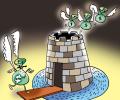
In February, FPIs sold $421 mn in debt; in March they have sold $133 mn so far
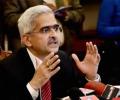
The Reserve Bank of India on Friday decided to leave benchmark interest rate unchanged at 4 per cent but maintained an accommodative stance as the economy faces heat of the second Covid wave.

Around 75 per cent, or 372 stocks, that are part of the BSE500 are trading at least 10 per cent below their all-time high levels, despite the index hitting a record high 20,515 points on the BSE in intra-day trade on Wednesday, surpassing its previous high of 20,390 touched in March 12. The index, which accounts for 93 per cent of BSE listed companies' market capitalisation, has gained 8 per cent from its recent low of 18,983, touched on April 19. In comparison, the benchmark S&P BSE Sensex gained 6 per cent over the same period, but is still nearly 4.5 per cent away from its all-time high of 52,517 that it hit on February 16.

ONGC was the top loser in the Sensex pack, shedding around 5 per cent, followed by Sun Pharma, PowerGrid, Bajaj Finance, IndusInd Bank, Dr Reddy's and Maruti. On the other hand, Reliance Industries, Titan, HDFC Bank and ITC were the gainers.

The relentless rally in small- and mid-cap stocks continues as large-caps show signs of fatigue. In July, the Nifty Smallcap 100 rose 8.1 per cent, extending its year-to-date (YTD) gains to 48.5 per cent, while the Nifty Midcap 100 added 3.1 per cent, taking its YTD rise to 33.5 per cent. On the other hand, the Nifty50 remained unchanged for the month, with YTD gains of 12.7 per cent.

The decline could be attributed to several measures taken by the market watchdog to stop the misuse of the controversy-ridden participatory notes.

Since December 2018, monetary policy has been eased substantially by RBI with policy rates being cut by 75 bps and policy outlook being changed to 'accommodative'.

'We are most bullish on all aspects of the financial sector -- private sector banks, even one state-owned bank, insurance, mortgage finance, broking, wealth management, gold finance, etc.'
Of the total investments made last month, P-note holdings in equities were at Rs 61,786 crore and the remaining in debt and derivatives markets.

Tax department sends notices saying they are liable to pay MAT.

Companies in the small-cap universe are having a dream run - the Nifty Smallcap 100 index has shot up more than 25 per cent on a year-to-date basis, even as the benchmark Nifty is up 7 per cent. This is the best start for the index since 2017 when the Nifty Smallcap 100 index surged 32.3 per cent between January 1 and May 10. However, in terms of outperformance to the Nifty, this year's performance is the best in more than a decade. A combination of sectoral tailwinds and lack of institutional selling pressure has helped small companies escape from the correction triggered by the second wave of Covid-19.

Of the total investments made last month, P-note holdings in equities were at Rs 72,321 crore and the remaining in debt and derivatives markets.

Hectic fundraising through initial public offerings (IPOs) is expected in October-November, with at least 30 companies are looking to collectively raise over Rs 45,000 crore through initial share-sales, merchant banking sources said. Of the total fundraising, a large chunk would be garnered by technology-driven companies. The successful IPO of food delivery company Zomato, which was overwhelmingly subscribed by over 38 times, encouraged new-age tech companies to come out with their primary share-sales.
 © 2026 Rediff.com - Advertise with us - Disclaimer - Privacy Policy - Sitemap - Feedback - About us - Terms of use - Grievances