
Lower IT exports will raise India's dependence on capital flows to fund imports.

Through the past 12 months, the Bank Nifty has risen 55%

Previous peak in 2010 crossed in first five-and-a-half months this year.

Operational income not covering even their interest expenses, finds study; analysts say if economy turns around, new equity issuances an option

Group policies are more suitable for diabetics; these are negotiable & flexible.

The markets gained nearly 7 per cent in the 4 trading sessions of March.

The growth premium India enjoyed has largely been lost.

HUL, UltraTech, Asian Paints, L&T, HDFC Bank top global valuation charts

Wiping off nearly Rs 4 lakh crore of investors' wealth during the day, benchmark Sensex crashed on Friday.

Large-cap scrips are still trading at a discount to mid-caps.

Anaysts recommend a 'buy' on Icra due to its positive outlook.
Anaysts recommend a 'buy' on Icra due to its positive outlook.

Under current laws, a company cannot sell mines but only transfer leases when it is acquired by another firm.

The road ahead for the markets in the short term will depend on external factors rather than domestic developments.

With mutual funds, promoters turning net-buyers, foreign investors may have to bid up prices to raise holdings.

More than half the Sensex companies have declared their results for the third quarter and there are more positive surprises than disappointments.

The bulk of of trading on stock markets is done algorithmically, by computerised clerks working at the behest of human traders.

In India, bond yields have fallen nearly 70 basis points in the last one year.

Analysts mostly prefer domestic plays beside select films with foreign exposure.

With commodity markets remaining soft and uncertain, it is likely the money will flow into equity markets with strong upsides, such as India.

Most analysts expect growth in the sales of Nifty-50 companies to decelerate, albeit marginally, in the quarter ended December compared to the corresponding period of 2013-14, with metals and real estate companies pulling down earnings.
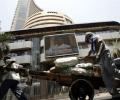
The banking, oil and metal sectors were the top sectoral losers on the BSE, while IT stocks rendered support at lower levels.

In the domestic market, the Tata Group has lost ground in the passenger car business.

FIIs have offloaded stocks worth Rs 13,110 crore

That resulted in a 50-basis point improvement in operating profit margins on a sequential basis.

This weakness is likely to continue in the near-term.

Many analysts find market expensive, even at current levels.

Infosys' aspirations to improve revenue per employee might also prove to be a tall task, believe analysts.

For equity investors, the risk-to-reward ratio is worsening.

Sensex rose 5.8% this year, against a 3.2% rise in Nifty; Axis Bank inclusion may blunt Sensex edge


Indian companies typically have higher return on equity.

Sales expansion also down 4.4%

Infosys has tried to bring stability to the troubled company, which was struggling to maintain its growth momentum in the changing dynamics of technology industry.

Benchmark share indices gained for the fifth straight session on Thursday led by index heavyweight Reliance Industries.

This was even as the country's economy grew by 7.3%.

Slowdown and liquidity squeeze by RBI have put India's top 10 indebted firms in a tight spot. But they have a few options.

A full-blown recovery remained elusive for India Inc in the July-September quarter, even as it overcame the challenge of achieving profitable growth.

Over the past four quarters, the Sensex companies' earnings trajectory has improved sharply because of a weak rupee.

Higher crude oil prices also translate into better corporate earnings for India's top companies
